

The Story of Ceferino Garcia, the Often-Forgotten Filipino Boxing Champion


While Emmanuel "Manny" Pacquiao will always be regarded as the greatest Filipino boxer ever, we can't help but think of his predecessors. Whether it's Pancho Villa or Flash Elorde, these titans of boxing put the Philippines on the global sports map. We're constantly looking for the next boxing icon, another man we can deem a hero.
For some reason, Ceferino Montano Garcia oftentimes gets lost in the fray in these discussions. Sure, religious boxing fans may know him for being a hall of fame. But rare are the times we actually look at the gravity of his work, how he became a trendsetter in his own right. The creator of the highly debatable "Bolo Punch" deserves more love.
The man is best known perhaps for holding the most victories and fights ever achieved for a Filipino boxer at 164 and 120, respectively. He is also the only Filipino to ever win the crowded middleweight world championship belt, the same class as names like Jake LaMotta, Bernard Hopkins, and Marvin Hagler, among other all-time greats. Garcia would held his own, bridging the gap between Villa's and Pacquiao's generations.
ALSO READ:
Pancho Villa, the First Filipino Boxer to Beat the Americans at Their Own Game
Pacquiao Ranks Second on 10 Greatest Boxers of All Time
Looking Back At Ceferino Garcia's Incredible Life
Born on August 26, 1906, Ceferino Montano Garcia is a boxing hall of fame who typified the Filipino fighter: unafraid and relentless, with the swagger to boot.
The eldest child of Fortunato "Porto" Garcia and Pascuala Pieras, Garcia would grow up with five siblings in Barrio Caraycaray, Naval in Biliran. From a young age, he'd always dreamt of being a boxer. He would later start competing in street matches in his teen years. According to his younger brother Alberto, he would be seen in the neighborhood gambling or playing pool when he wasn't picking fights. He had even been a blacksmith, helping his father out in the family trade.
He was supposed to enlist in the United States Navy but unfortunately was rejected because Garcia hadn't finished first grade. The boxing legend would leave home at 15, joining a bakery in Cebu City. It was here that he would be connected to a boxing promoter. At the age of 17, he would make his pro debut. On May 5, 1923, he fought against Pedro del Mundo in Manila, a match that resulted in a draw in the sixth round.
From there, his career would take home, rising through the ranks to become a top boxer in Cebu and Manila during the mid-1930s. His lethal widely criticized "bolo punch," of course, became quite the draw. What made it so powerful was the fact that it was thrown from behind his head, allowing for an upward trajectory hook coupled with a hell of a rotation of the arm and fist. It was pure entertainment (although it could be argued that the punch itself wasn't as effective as it appeared to be).
Interestingly, Gerardo "Kid Gavilan" Gonzalez and even “Sugar” Ray Robinson and “Sugar” Ray Leonard would later on take notes from Garcia's dreaded "Bolo Punch" and create their own versions. The controversial move, however, would later be disallowed.
Ceferino Garcia in action.
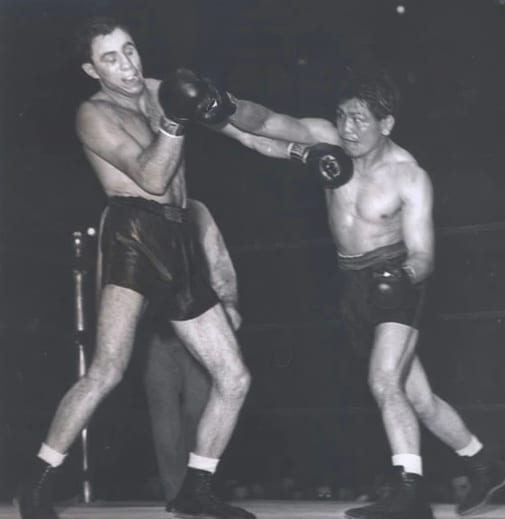
Authoring a Decorated Career
Eventually, Garcia would make his way to the United States for a shot at glory. His first professional match in America occurred on January 29, 1932, at the Olympic Auditorium in Los Angeles. He knocked out Alfredo Gaona in an impressive four rounds. His first real "big" fight happened in 1933, against Johnny “Bandit” Romero. Garcia would win by a knockout in the eighth round.
On October 2, 1939, Garcia would officially become middleweight champion. He defeated the rugged American boxer Fred Apostoli by technical knockout in the seventh round at the legendary Madison Square Garden.
For the time being, Garcia would attract huge crowds. He ended up defending the title against the likes of Glen Lee at the Rizal Track-Football Stadium. Interestingly, the Filipino boxer had even been a disciple of the great Jack Dempsey, an American world heavyweight boxing champion often remembered for his vicious fighting style. George Parnassus, on the other hand, was his trainer.
Throughout his prime, he would go against the likes of lightweight legends Barney Ross, Henry “Hank” Armstrong, and Luis "Kid Azteca" Villanueva. In Ross' case, he would fight Garcia three times. Kid Azteca, on the other hand, would fight the Filipino boxing champ four times. Each fighter had their rivalry with Garcia. Yes, Mexican and Filipino boxers have a long history of rivalries.
Garcia would go on to defend his belt a total of three times. He would only lose to Ken Overlin in the United States. This would be his final chance at the championship. Unfortunately, Garcia would only go 6-4-1 in his final seven matches. And on October 15, 1944, he officially retired following a bout against Bill McDowell, who beat him on points.
For a good two decades, he would go on to produce one of the finest resumes in boxing history. He totaled 76 knockouts, 14 draws, and 33 losses (according to The Boxing Record Book, Garcia actually racked up 114 wins). Garcia would become one of the great boxing icons of his time.
After his boxing career, he managed to find a permanent home in the United States and was even honored as a boxing legend in New York. In 1977, The Ring Magazine, for instance, regarded him as one of the best to ever do it. Garcia would get his own niche at the Canastota International Hall of Fame, as well. He would be inducted into the World Boxing Hall of Fame in 1981.
Garcia passed away on January 1, 1981 in San Diego, California.
