
When Capital Meets the Tide: How La Union’s CURMA Redefines Conservation

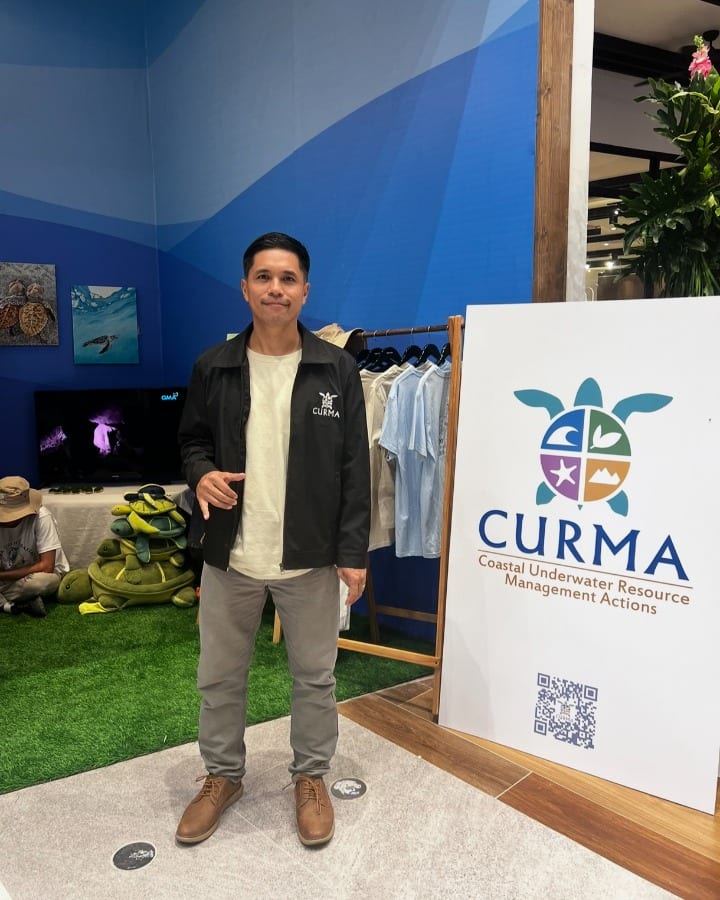
On a recent October afternoon in La Union, inside the newly opened SM City mall—a cavern of glass, light, and air-conditioning—Carlos Tamayo stood beside a sign that read CURMA: Coastal Underwater Resource Management Actions. Behind him, a rack of shirts in sea-glass colors and a pile of turtle plush toys gave the corner a beach-house warmth.
Tamayo wore a black jacket with the CURMA logo stitched over his heart, gray pants, and brown shoes that looked more used to sand than tiles. On the wall were paintings of pawikans underwater, their shells catching imagined light. A television glowed with night footage of a turtle laying her eggs.
Carlos Tamayo
To the casual passerby, it looked like a charming eco-booth tucked inside the country’s newest SM mall, another weekend attraction about saving the planet.
But to Tamayo, it was something else entirely: an experiment in persuasion.
Fifteen years earlier, he and a handful of volunteers had walked the coast in the dark, rescuing turtle eggs from poachers. Now, the same turtles he once protected were here with him, projected on a screen under mall lighting.
“We can’t stop the mall from coming up,” he said, smiling faintly. “But maybe we can influence the direction it’s going to.”
That statement contains a paradox that defines the new environmentalism taking shape along La Union’s coast. It’s not about barricades or boycotts anymore. It’s about proximity. Inside the mall, the pawikan is everywhere—painted across walls, etched into fixtures, its curves echoed in the ceiling’s wave-like forms.
The design is deliberate: San Juan town in La Union province is a popular surftown, and the mall has tried to bottle that spirit within its air-conditioned walls. But alongside the waves, they placed the turtles too, acknowledging that La Union’s story isn’t written only in surf, but also in shells that return, year after year, to its shores.
What CURMA is attempting here isn’t conservation in the traditional sense. It’s something subtler, almost psychological: the art of teaching consumption how to coexist with conscience.
ALSO READ
In This Part of La Union, They Have Baby Turtle Release ‘Parties’
See Photos of the Turtles of Apo Island Up Close
The Soft Approach
There’s a certain kind of logic that governs most conservation stories. Something precious is threatened; someone draws a line. The heroes build fences, draft laws, and send patrols. The villains cross them. Progress, in this view, means enforcement.
In the case of sea turtles—which the Wildlife Resources Conservation and Protection Act" of 2001 classifies as endangered—the penalties are severe: up to P1 million in fines and 10 years in prison.
Tamayo and his small team at CURMA began differently. Not with a fence, but with a question: Why do people take the eggs?
They spoke to fishermen who poached eggs and discovered it wasn’t greed. It was dinner.
For six to eight months each year, this side of the West Philippine Sea is too rough to fish. Surfing season is also nesting season. The same waves that draw tourists leave fishermen grounded. No fish means no income. So they turned to what the tide left behind: turtle meat for the market, turtle eggs for just P3 each.
Instead of arresting the poachers, Tamayo offered to pay them P20 for every egg they surrendered. No arrest, no judgment—just trust.
It worked. Within four years, poaching stopped. The same men who once dug up nests now patrolled them.
And they brought something science didn’t have: knowledge.
Generations of fishermen had learned the secret language of the tide—the lunar cycles, temperature drops, and wave patterns that signaled a nesting night. Their instincts, once used for poaching, became crucial for protection.
Now those same fisherfolks handle eggs like scientists. Each egg, when moved to a hatchery, must remain in the same orientation—top stays up, north stays north. It sounds obsessive, but it’s the difference between life and loss. CURMA’s hatchling success rate now hovers around 97 percent.
Tamayo calls it soft conservation. You don’t change behavior by shaming people. You change it by giving them a reason—and a role—to care.
Tourism and Turtles
In this stretch of black-sand beach in San Juan, tourism came first. Conservation followed. When CURMA began in 2010, resorts and restaurants were already rising along the shore once lined only with fishing huts.
The same lights that guided tourists to beach bars confused hatchlings crawling toward the sea. The same music that powered weekend parties drowned out nesting mothers. A town that once needed saving from scarcity now needed saving from abundance.
CURMA found itself negotiating between nightlife and nature. “We just have to find the fine line,” Tamayo said, “so people can still have livelihood, but in a more sustainable way.”
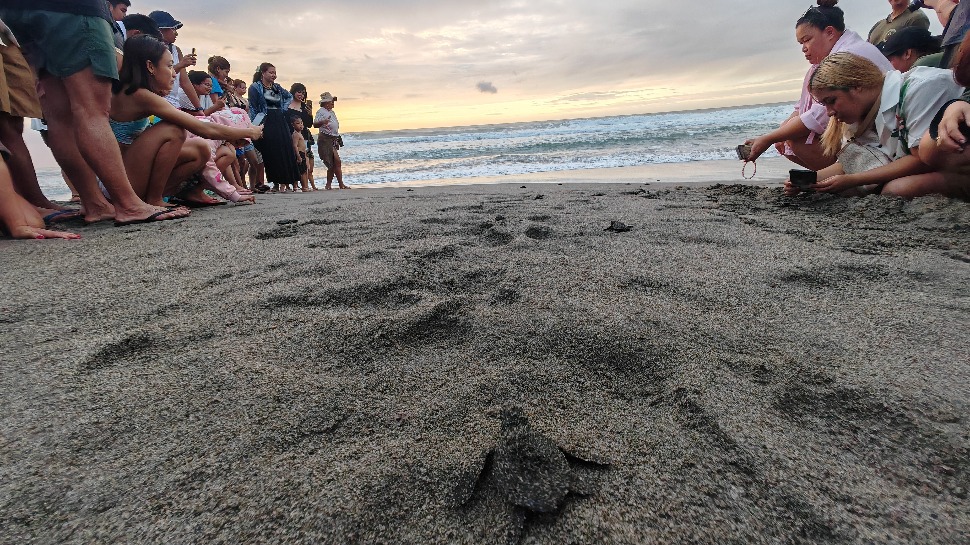
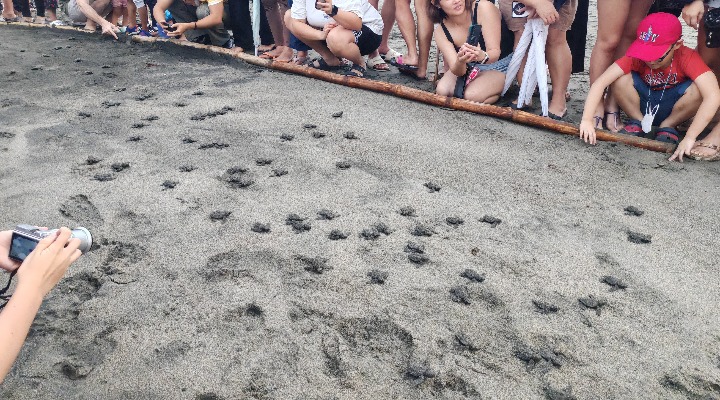
So they began to teach. Awareness campaigns reached schools, resorts, barangays, local offices, anyone and everyone. Turtle releases became both spectacle and learning moments: as tourists knelt in the sand to release hatchlings, Tamayo explained that this first crawl toward the surf imprints the beach’s coordinates in the turtles’ internal map. In 20 years, these same creatures will return to this same beach to lay their eggs here.
The turtle releases became a kind of soft diplomacy at work. Instead of lobbying or lecturing, CURMA simply shows people what’s at stake, and lets the sea make the argument. Years ago, a mayor once told Tamayo, “The turtles don’t vote.” He invited the official to a release anyway. The mayor came, watched, stayed silent. More local officials joined turtle releases at the beach, bringing along their toddlers or visitors to also witness the magical moment. Soon after, the province passed an ordinance protecting nesting beaches.
Today, beach lights are limited to red, orange, or yellow (lights with long wavelengths are less disruptive and often used as a "turtle-safe" alternative). Shoreline parties end by 10 p.m. Sound systems move inland during nesting months. CURMA has trained resorts and residents to adjust their lights and decibels.
La Union’s tourism—once thought incompatible with conservation—has learned to make space for both.
Why Turtles Matter
Turtles are slow, deliberate, unremarkable—until you learn how the ocean depends on them. They eat jellyfish that would otherwise choke coral reefs, sting surfers and traumatize swimmers. They prune sea grass so fish can spawn. They are what biologists call keystone species: remove them, and ecosystems collapse.
But even with poaching gone, another danger arrived. One that cannot be bribed or outwitted: the climate.
The sand that once cradled eggs now overheats in long and sizzling summers. Too much heat, and the hatchlings turn all female; too little, and they die. Rising tides eat away beaches. Storms flood nests before the eggs can harden. “They’re born already at a disadvantage,” Tamayo said.
.jpg)
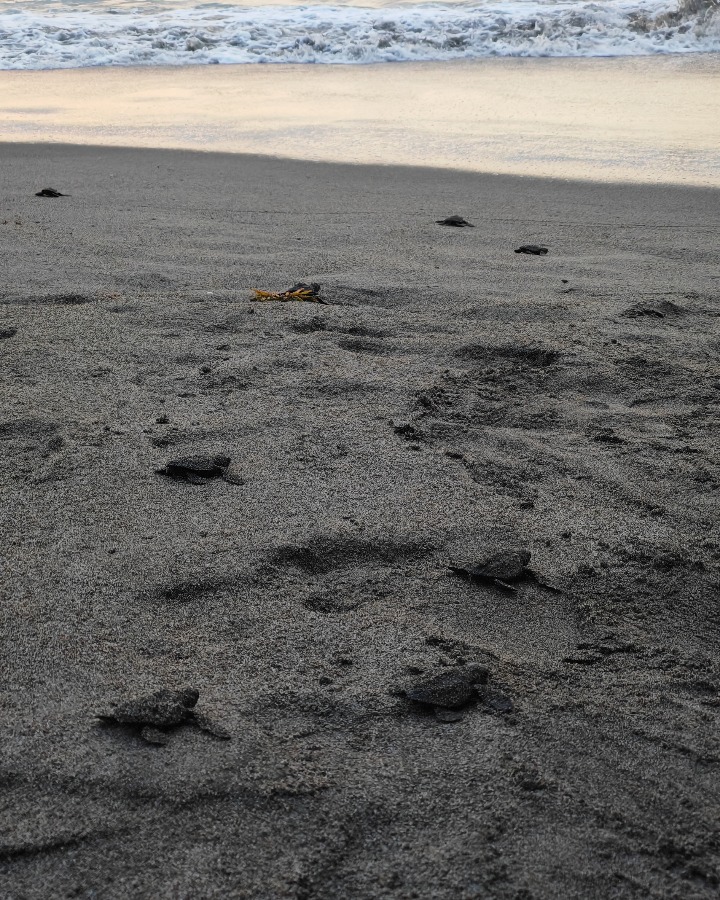
That’s why CURMA transfers eggs to a hatchery. Once the hatchlings emerge, they are returned to the same stretch of sand where their mother once laid them. That first walk fixes their home coordinates—the imprint that will guide them back two decades later, when it’s their turn to nest.
The Diplomacy of Conservation
If CURMA’s first decade was about people, this new chapter is about systems. The forces harming turtles—pollution, waste, overconsumption—don’t wear villainous faces. They wear logos.
Instead of vilifying them, CURMA chose collaboration.
Operating on grants, donations, and volunteers, Tamayo sought partnerships with embassies, foundations, and corporations. The Embassy of Canada in the Philippines supported mangrove planting, youth education, and coastal cleanups. The ASEAN Foundation is funding a youth leadership program that trained local students as “sea champions,” spreading awareness in their villages.
Among the first corporate allies was Owndays, an eyewear brand whose owner once joined a turtle release and, in 2024, funneled proceeds from limited-edition eyeglass cases into sea turtle conservation.
Among the global and local brands that set up shop at SM City La Union, clothing store UNIQLO was among those that sought CURMA first. Top executives arrived a week before their October 2025 branch opening, joined beach cleanups, and donated 100 UV protection full-zip hoodies to local fisherfolk and patrollers who work with CURMA.
They’re now talking about sending fabric scraps to CURMA’s community partners who shred waste to be transformed into other products. It’s a circular-economy program meant to address the pollution in sea, sand and land the turtles live in. The program initially included turning used cooking oil from restaurants in San Juan into soap, and selling shredded plastic waste as fuel to a cement factory in nearby Bacnotan town. The income went back to coastal families. Waste turned to livelihood. Care became circular.
“Now that they have a business interest in La Union, they are becoming more active in the province,” Tamayo shared when asked about what having a big mall in the coastal province means. “We’re brainstorming ideas with them on how their operations can be part of a circular economy,”
Most of these corporates didn’t need convincing. They needed connection. La Union’s growing popularity as a corporate team-building destination made the turtle release part of the itinerary. Executives who came for leisure left with sand on their shoes and a memory of hatchlings crawling toward the surf at sunset.
“They already care,” Tamayo said. “We just give them something real to care about.”
What CURMA once did for poachers, it now does for corporations: giving them an entry point into doing good without the guilt.
The Tide That Teaches
CURMA currently runs almost entirely on volunteers. Most have day jobs. They patrol beaches at dawn and return to work after breakfast. This model—the mix of education, livelihood, circular economy, and getting the buy-in of local officials and tourism entrepreneurs—works beautifully in La Union. Now, 13 other provinces in the Philippines, as well as groups in Indonesia and Malaysia, want CURMA to replicate the model.
It needs structure, people who can train, monitor, and document, and it needs funding to cover what passion can’t—transport, equipment, time. “To expand, we need a full-time team,” Tamayo says.
There’s a number he and his team have been aspiring for: release a million hatchlings by 2030. But the number is just arithmetic. The real hatchlings are the ideas that crawl out with them: that conservation can coexist with tourism, that livelihood can evolve without extraction, that even a mall can hold a movement.
Somewhere between surfboards and shopping bags, between the hum of commerce and the hush of the sea, a new rhythm is forming. It’s not anti-capitalist. It’s the realization that caring, like a tide, doesn’t need to crash to make an impact.
And in La Union—where waves and commerce never rest—a small group of people keeps proving the same thing: You don’t have to fight the current to change its course. You just have to move with it, until even capital begins to move with you.
