

Debunking the Myths About the First Philippine Flag

Yes, our history can be confusing. There are plenty of things Philippine text books have gotten wrong about the first Philippine Flag, too. Such is the case with these: While there is one displayed in Baguio City, that isn't even the original; or how President Emilio Aguinaldo wasn't the first one who waved it, after all. These are just two of the many myths we have rarely given a second thought about.
The celebration of National Flag Day starts on May 28 and ends on Independence Day, June 12. With it, we are reminded of the bloodshed it took for our democracy to prevail, the national liberation of our people, as well as our flag's very complicated past. Here are some facts about the first Philippine flag to set the record straight.
It Wasn't First Hoisted on June 12, 1898
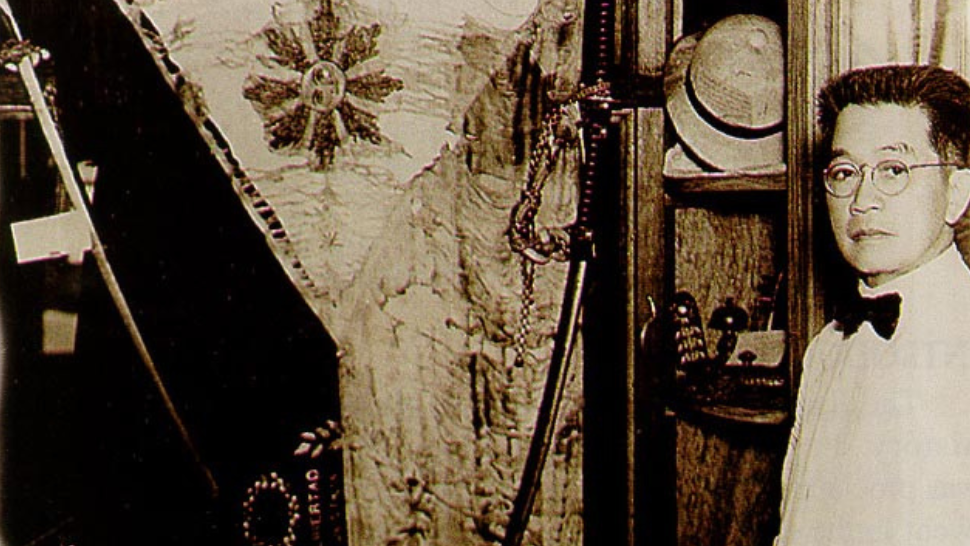
President Emilio Aguinaldo posing with one of the flags used during the Filipino-American War.

While modern history may have presented new criticism against Emilio Aguinaldo, it shouldn't take away from his contributions and sacrifices to the establishment of the first Philippine Republic.
Aguinaldo had designed the first Philippine flag during his exile in Hong Kong in the aftermath of the Pact of Biac-na-Bató with the Spanish governor-general in 1897. Contrarily, according to Julio Nakpil and Artemio Ricarte, the flag was said to be designed by pharmacist Feliciano Jocson. Aguinaldo was said to have adopted the design from Jocson.
From there, it would be sewn and embroidered in silk by the Mother of the Philippine Flag Doña Marcela Mariño de Agoncillo, her daughter Lorenza M. Agoncillo and Dr. Jose Rizal's niece Delfina Herbosa Natividad. It took five days for them to finish. The words “Libertad, Justicia and Ygualidad” was embroidered on one side of the flag while “Fuerzas Expedicionarias del Norte de Luzon” was on the other.
They would hand it to Aguinaldo on May 17, 1898, before his return to the Philippines. It would first be unfurled on May 28, 1898 during the Battle of Alapan. The same flag would be used during the proclamation of Independence at Aguinaldo's residence in Kawit, Cavite on June 12, 1898.
Lawyer Ambrosio Rianzares Bautista would wave the flag on this day. It also wasn't waved on the balcony, but rather from a window at the home.
ALSO READ:
Everything You Need to Know About Philippine Flag Etiquette
Philippine Flag Laws You Didn’t Know You Are Breaking
No, the Three Stars Do Not Represent Luzon, Visayas, and Mindanao
The famous Confeccion de la Standarte Nacional (Making of the Philippine Flag) painting by Fernando Amorsolo.

The three stars on the Philippine flag actually represent Luzon, Mindanao, and Panay. During the Philippine Declaration of Independence, Ambrosio Rianzares Bautista said the stars honor the "three principal islands of this archipelago—Luzon, Mindanao, and Panay in which the revolutionary movement broke out."
Manila, Cavite, Bulacan, Pampanga, Nueva Ecija, Bataan, Laguna, and Batangas were honored for the rays because these were the areas "which declared themselves in a state of war almost at the very start of the uprising.”
Aguinaldo said of the sun and rays: “stirred up Filipinos and spread the light over their world, piercing the clouds that enshrouded it; it is now the light which brightens every spot in the Philippine islands, and under its influence the Itas, Igorots, Manguians, and Moros, all of whom I believe were made in the image of God, and whom I recognize as our brethren, now come down from the mountains to join with us.”
Contrasting Shades of Blue
Marcos Sr. wanted a lighter shade of blue.

So what shade of blue does the Philippine flag have exactly? It's hard to say, really.
Aguinaldo said during a speech in Malolos said: "The blue carries an allegorical meaning that all Filipinos will prefer to die before submitting ourselves to the invader, whoever he may be; the white conveys the idea that, like other nations, the Filipinos know how to govern themselves, and that they do not recede from observation of foreign powers.”
In what is assumed to be an excerpt from a Philippine Herald article published in October 1929, on the other hand, Agoncillo described the flag as one that was “made from fine silk with a white triangle at the left containing a sunburst with eight rays at the center, a five-pointed star at each angle of the triangle, an upper stripe of dark blue and a lower stripe of red.”
Interestingly enough, that shade of blue's definition has had conflicting reports over the years. A letter from Apolinario Mabini claims that the blue of the Philippine flag should be sky blue. Meanwhile, Agoncillo's daughter, Marcela, said that it was navy blue. There is also an 1898 letter from La Solidaridad co-founder Mariano Ponce that the shade was somewhere in between the two.
Former President Ferdinand Marcos had the shade of blue changed to something lighter during his term. What is widely believed to be the original blue of the Philippine flag would be restored during President Corazon "Cory" Aquino's administration.
The Original Philippine Flag Was Lost in Pangasinan
The original design.

Unfortunately, the original Philippine flag was lost somewhere in Tayug, Pangasinan when Aguinaldo fought in Northern Luzon during the Filipino-American war, according to a report to Captain Baja on June 11, 1925. Marcela Agoncillo, on the other hand, said that she saw the original flag in 1919.
The Philippine Flag on display in the Baguio Museum is actually Aguinaldo's Battle flag. It was supposedly hidden from 1901 to 1919 during the American occupation, a time when the displaying of the Philippine flag was banned. The flag has been in Baguio since the '80s.
To this day, nobody knows where the original flag of 1898 is.
