

Today I Learned: In 1926, This Philippine Vaudeville Superstar was Jailed for Adultery

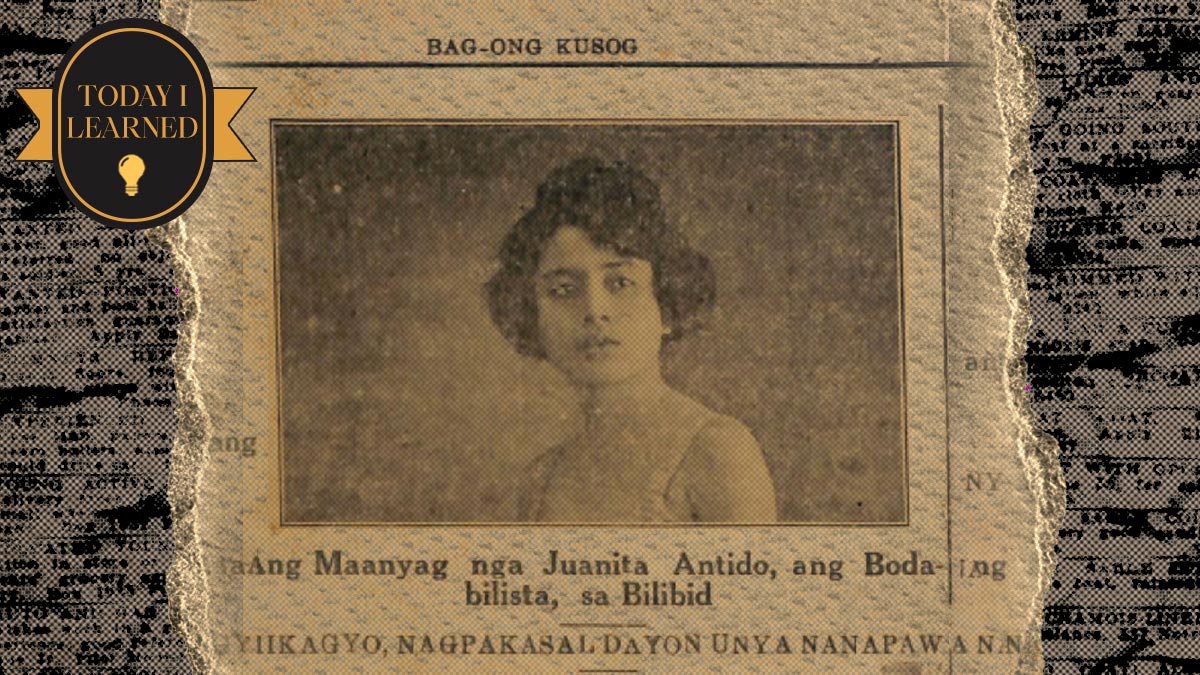
In the 1920s Philippines, few stars shone as bright as the vaudeville celebrity Juanita Antido. She led quite a life, but it was deemed scandalous in early 20th century Philippines.
Antido was dubbed the “Queen of Jazz in the Orient.” She performed in Penang, Shanghai, Singapore, Hong Kong, among other places. Antido appeared in advertisements in such publications as the South China Morning Post, Hong Kong Telegraph, and The China Mail. She was described in one paper as having introduced to Hong Kong “the famous shimmy shake.” The dance involves a vigorous shaking of the body from the shoulders down. You alternate moving your shoulders; one goes forward, the other goes back.
A reader of the Cebu weekly Bag-ong Kusog (New Force) wrote to describe the shimmy as a lewd dance that involved “igwad igwad sa lubot” or swaying of the butt. The reader asked that the dance be banned by an ordinance. Bag-ong Kusog described Juanita as “hawod sa sayaw nga paikid ikid” or an expert in dancing while wiggling the body.
Juanita was also an actress and appeared in the film White Hands, which was being screened at the Kowloon Theatre when she was performing in Hong Kong.
The Straits Echo reported on June 20, 1922 under the headline “THE ANTIDO VOD-A-VIL” about “a very successful entertainment” at the Penang town hall. Antido performed with her regular partner, Conchita Blus.
“Both the young ladies were in fine vein and appeared at their best. Miss Juanita Antido undoubtedly scored a big hit with her rendering of "The Venetian Moon" followed by a graceful eastern dance and her Chinese Song,” the paper reported.
But when she returned to the country after these series of performances in the region, Antido’s fortunes turned.
ALSO READ
Today I Learned: Heat Makes People More Depressed and Aggressive
Today I Learned: Sta. Ursula Church in Binangonan, Rizal Is Now a National Cultural Treasure
Bag-ong Kusog reported on October 10, 1924 that Antido was entered into the Convent of the Good Shepherd because her father had neglected her education even at such a young age. Her confinement in the convent was reported to be at the orders of Archbishop of Manila Michael O’Doherty.
“Gidakop sa mga tiktik ug gilaming dayon sa “Convento del Buen Pastor” kay kuno batan-on pa uyamot ug ang amahan wala magtagad pagpatoon kaniya,” Bag-ong Kusog reported. (“She was arrested by detectives and confined at the Convent of the Good Shepherd because she is still young and yet her father neglected her education.”)
Juanita’s father, Victor, went to court to secure her release but she ran away from the convent and had to be recaptured.
Bag-ong Kusog reported that lawyer Vicente Sotto filed a writ of habeas corpus with Judge Carlos Imperial.
The Tribune, in its “Turning Back The Pages” section on September 21, 1934, said the petition was filed by Albino Cruz, who claimed to have been Juanita’s husband. The section wrote about archival cases of 20 years back, five years back, and, in Juanita’s case, 10 years back.
“Cruz in his habeas corpus petition said he married Juanita, and therefore the convent had no right to confine her within its walls and deprive them of marital bliss,” the Tribune reported.
Judge Imperial eventually ordered the convent to release her. Bag-ong Kusog wrote that theaters all over Manila competed to sign up the entertainer. She eventually agreed to perform at Sine Lux, which paid her P500 a month.
On November 6, 1925, Bag-ong Kusog reported that Cruz filed an adultery case against Antido and a Manila judge ordered her to be brought to his court to face charges.
On August 6, 1926, Bag-ong Kusog wrote about Antido’s imprisonment in Bilibid. The subhead of the story read: “Mikagyo, nagpakasal, dayon unya nanapaw,” which translates to “She ran away, got married, and committed adultery.” This is Bag-ong Kusog’s final story on her and carried the same photograph of a beautiful and defiant Juanita.
The article provided more details on her adultery case.
“Nahilipat si Albino ug si Juanita mikapyot kang Benjamin Quirol, laing pustorawong batan-on,” Bag-ong Kusog wrote. (“Albino was caught unaware and Juanita clung to Benjamin Quirol, another dapper young man.”)
The paper said Juanita had a child with Benjamin. Juanita and Benjamin were convicted of adultery and sentenced to three years in jail. The paper said Juanita entered Bilibid carrying her child with Benjamin with her.
“Si Juanita misulod sa bilanggoan dala ang bunga sa iyang makasasalang gugma kang Benjamin.” (“Juanita entered jail carrying with her the fruit of her sinful love for Benjamin.”)
