

Major Oil Spills in the Philippines


The Philippines is no stranger to oil spills. This is a devastating irony, especially for an archipelago that is home to a rich marine biodiversity and is highly dependent on its coastal resources. These incidents have not only caused significant and long-term environmental damage but also negatively affected local communities and economies.
Here are some of the major oil spills in the Philippines:
MT Terranova Oil Spill in Manila Bay (2024)
On July 25, 2024, at 1:10 a.m., Philippine-flagged Motor Tanker (MT) Terranova capsized 3.6 nautical miles east of Lamao Point, Limay, Bataan. It was carrying 1.4 million liters of industrial fuel oil and was bound for Iloilo. The initial response of the Philippine Coast Guard was the deployment of three 44-meter multi-role response vessels to apply oil dispersants in the area.
A thick layer of industrial fuel oil from a submerged tanker off the coast of Bataan has reached the municipal waters of Hagonoy, Bulacan
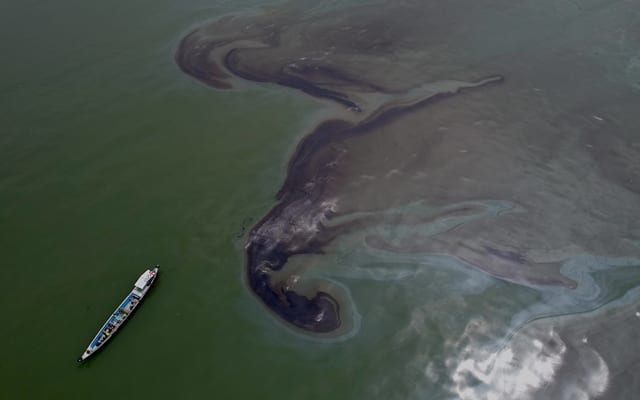
A thick layer of oil slick has since reached the municipal waters of Bulacan, specifically Hagonoy, with the possibility of reaching the coasts of Cavite, Pampanga, and Metro Manila, given the semi-enclosed nature of the bay.
MT Princess Empress Oil Spill in Oriental Mindoro (2023)
Oil tanker MT Princess Empress capsized in the waters off Naujan, Oriental Mindoro on February 28, 2023. It was transporting 900,000 liters of industrial fuel oil from SL Gaas Harbor Terminal in Limay, Bataan, and was en route to Iloilo. The vessel was declared fully submerged the following day, and oil sludge reached municipality waters in Oriental Mindoro, Antique, Palawan, Occidental Mindoro, Batangas, and Quezon.
Oil spill from MT Princess Empress reaches the shore of Pola, Oriental Mindoro
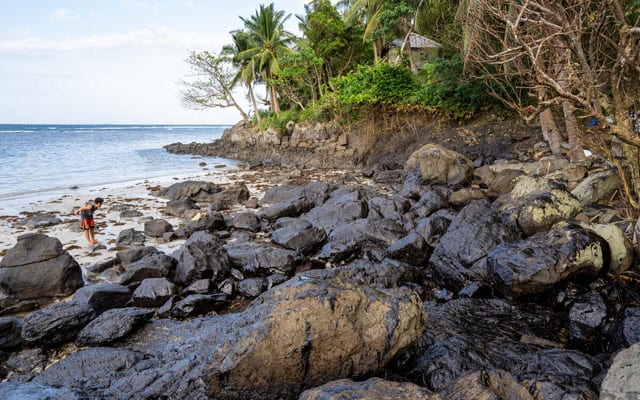
On March 20, 2023, as forecasted by expert simulation, the Mindoro oil spill reached the Verde Island Passage—known as the global center of marine biodiversity. Environmental damage was estimated to be around P7 billion, while P4.9 billion was the cost of damage to agriculture. Up to 27,850 farmers and fisherfolk were affected by the incident. It took four months before the PCG announced completion of oil removal and siphoning.
Petron Underwater Pipe Leak in Cavite (2013)
A diesel oil leak was seen near the coastline of Rosario, Cavite, on August 12, 2013. This caused parts of Manila Bay to turn red and plenty of dead fish to float on the water, effectively shutting down the fishing industry in at least four coastal towns in Cavite.
A fisherman's daughter plays on the shore in Barangay Kanluran, Rosario, Cavite, amidst an oil sheen brought about by the diesel oil spill that occurred on August 8, 2013.
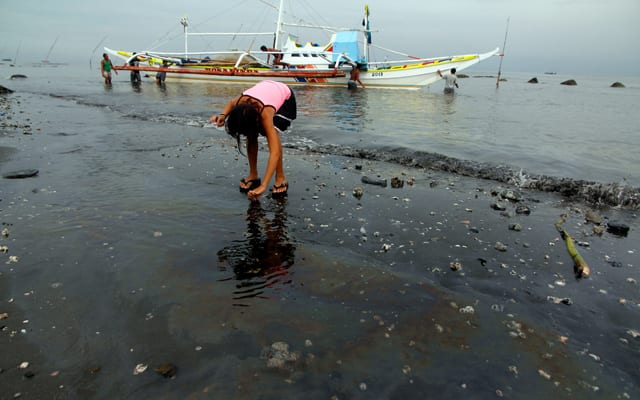
On August 12, 2013, it was confirmed by the Philippine Coast Guard that the oil spill was caused by a leak in a submerged pipeline of Petron Corp. PCG estimated that 500,000 liters of diesel had leaked into Manila Bay.
MT Solar 1 Oil Spill in Guimaras (2006)
In August 2006, the Solar 1 oil tanker sank off the coast of Guimaras Island. It was carrying 2.4 million liters of oil from Bataan to Zamboanga City. Only 9,000 liters were recovered from the vessel. This meant that more than one million liters had leaked out, affecting up to 16 square kilometers of coral reefs, 551 hectares of mangrove, 58 hectares of seaweed, and 824 hectares of fishponds.
A group of in Barangay Tando, Nueva Valencia, Guimaras, collect oil from beaches by hand.
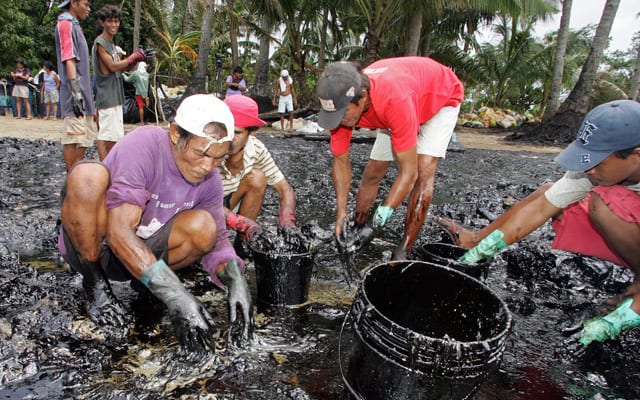
It also damaged Taklong Island National Marine Reserve, which is a feeding and breeding ground; and affected 20 communities and four municipalities in Guimaras, 27 communities in Iloilo, and 17 more in Negros Occidental. The cleanup took three years. This incident is considered one of the worst environmental disasters in Philippine history.
MT Mary Anne Oil Spill in Manila Bay (1999)
In July 1999, oil tanker MT Mary Anne capsized in the waters of Mariveles, Bulacan. This spilled 747,991 liters of oil into Manila Bay. The spill spread rapidly, contaminating the waters and affecting marine life, local communities, and the economy. PCG led the cleanup efforts, deploying chemical dispersants to mitigate the damage. However, the environmental and economic impacts were devastating, with long-term effects on the local ecosystem, tourism, and fisheries.
MV Princess of the Orient Oil Spill (1998)
Up to 600,000 liters of oil spilled into the Manila Bay entrance after the MV Princess of the Orient capsized on September 18, 1998, near Fortune Islands, Batangas. The vessel was sailing from Manila Cebu during a typhoon. It had 388 passengers on board, 150 were killed.
Sea Brothers I Oil Spill in Manila Bay (1999)
Sea Brothers I sank in the South Harbor of Manila Bay, spilling approximately 420,000 liters of oil from the damaged tanks. The vessel sank in seven meters of water after striking a breakwater in the Manila Harbor.
Oil Spill and the Philippines' Dependence on Fossil Fuel
Greenpeace Philippines Climate Campaigner Jefferson Chua, in a statement sent to Esquire Philippines on July 28, calls for "decisive and urgent action to prevent future oil spill incidents by ending the reliance on fossil fuels and holding oil and gas companies accountable for damages."
These oil spills continue because industrial fuel oil is carried by motor tankers to and from various parts of our archipelago, and underwater pipes keep this industry running.
"We would like to emphasize the need for stringent government regulations and enforcement to ensure that such disasters are avoided in the future. The Marcos Jr. administration must make oil and gas companies pay for the damages they cause and take responsibility for the climate crisis their destructive businesses have been fueling for the longest time."
