
At This Roadside Library in Makati City, There Are No Rules

Barangay La Paz has all the makings of your typical neighborhood.
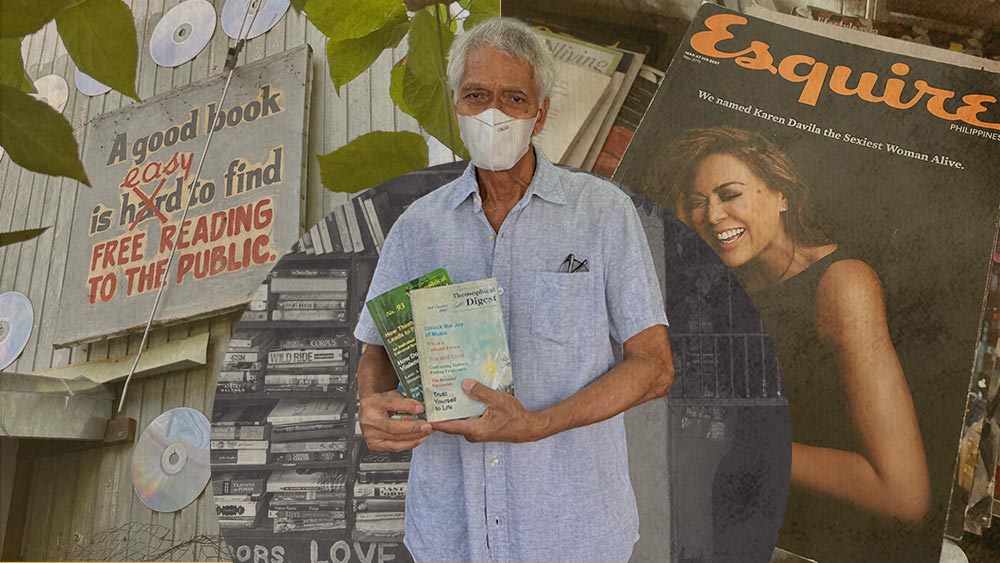
Along Balagtas Street, you can find the car wash lining sidewalks with soap suds and the tusok-tusok stand that serves practically everything on a stick. Passersby stop at the sari-sari store, seeking shade from the sun but maybe also cellphone load. But right beside them is something you haven’t seen anywhere else: a colorful display of books, arranged haphazardly atop slipshod shelves and tables. While it seems out of place, one could argue that it’s the main thread holding them together.
As I arrive in front of Reading Club 2000 on a random Tuesday afternoon, I find its caretaker, Hernando Guanlao, waiting for me. Mang Nanie, as he is often referred to, has his hands in his pockets surveying the surroundings, anticipating the afterschool frenzy that's about to unfold. It’s almost dismissal time at La Paz Elementary School; in a few hours, its students will come rushing to the fabled community library to scour the selections.
The rules of Reading Club 2000 are simple: there are none. Visitors are free to take as many as they wish, with no obligation to return or replace them. Though it lacks a system of organization, titles seem to sort themselves: littered around the first floor are textbooks, instruction manuals, and back issues of print titles. A few racks are dedicated to the typical fare you’d gravitate towards on public transportation: true crime, adult romance, and obscure Western fiction. These snake their way up to the second floor, where in-demand series in near-pristine condition line the walls by the staircase, dining area, and personal quarters. From the looks of it, the books are the true masters of the house and Mang Nanie, their dutiful steward—a role that he gladly accepts.

“I’ve always wanted to put up something like this,” Mang Nanie tells me. “I had a mini library at home growing up, also outside. It was 25 centavos to rent each book. But my mom didn’t want me to pursue it because she wanted me to take a more practical career path.”
Despite being the self-proclaimed black sheep of the family, Mang Nanie relented. Rather than pursuing this marriage of his entrepreneurial spirit and interest in the written word, he took up accountancy in the Philippine College of Commerce. But at around the age of 50, he began to question what he contributed to what he calls this “earth school”.
“I had a job in government that exposed me to a higher level of political engagement but just gave me a lot of disappointment,” he shares. “Politicians, I’ve found, are best at not fulfilling their promises. Those we promised to help during campaign season would come back to me and complain that they wouldn’t witness any change.” When he pivoted to his stint as an income tax remedial practitioner, his clientele mostly consisted of frauds, evaders, and stingy bank professionals who would only speak to him while drunk. For him, this was no way to live. (I tell him that both my parents came from banks, to which he replies with a hearty "Hehe")
Equipped with nothing but a couple of secondhand books and a dream, he set out to fulfill his true life purpose, assembling an aesthetically pleasing roadside display and waiting for people to trickle in.

At first, his idea was not met with enthusiasm, even within his family: “My wife didn’t understand why I had to do this; she was very traditional in the sense that I had to provide for our family and work because I was the man of the house. But eventually, she came around and started helping in this mission of mine,” he says. Today, his daughter and grandson help manage the operations of this main branch, as Mang Nanie brainstorms new ways to maximize his impact.
His Aklatan sa Bangketa now enjoys a steady stream of donations and loyal customers, despite not soliciting anything from anybody or requiring payment. Perhaps it’s because it taps into the core of who we are as Filipinos. “I want to train our kababayans to review the past: we are very generous. When our old folks were in abundance, they would share what they had with their neighbors, free of charge. Here in the city, it’s no longer practice. It turns out somebody just needed to initiate the move in the right way, which I think is the reason why the books are still around.”
Existing capitalist structures have shuttered us in our own spaces: we barely know who our neighbors are these days, and have trouble keeping in touch with old friends. But stepping into Mang Nanie’s space shows how tight-knit communities still exist in the metropolis if we look hard enough. As I interview him on the steps of his house, he tells me colorful stories about his regulars. The old man who stuffs new arrivals into his tote bag to distribute to his circle of friends; the couple who pulled up in a Starex, the owners of a dried fish empire; the kid who took too many books he couldn’t focus on schoolwork.
ALSO READ:
10 Best Bookstores in Metro Manila for the Absolute Bibliophile
What It's Like to Run a Secondhand Bookstore in Manila's Lagusnilad Underpass
In the middle of our conversations, a group of kids slide beside us shyly, asking if we have any books on math. I lead them inside the premises and watch them gawk and gasp at the towering structures before them. They leave with a couple of books in tow: a heartwarming sight during a period of plummeting literacy rates. Last year’s Program for International Students results saw the country producing the lowest proficiency rates among 15-year-olds. With a level 1a for reading, students can understand only the literal meaning of sentences or short passages.
Rather than responding to this statistic with urgency, the Department of Education said that they were not expecting good results. “DepEd keeps a lot of books rather than distributing them,” Mang Nanie divulges. “I guess they’re scared of wear and tear. But I say, what good are these pristine books for if no one is reading them? For me, the more damage it has, the more have made use of it. Copies with yellowed, fraying pages and spines speak for themselves.”

Aside from institutional neglect, the internet is to blame, with social media keeping the lion’s share of children’s attention spans. I try to ask him if off days are a cause for alarm but he doesn’t even let me finish the question. “If there are no children, I use a stroller and go to them to say hello, remind them that we are still here, campaign. It works! You just have to look for them, put in the effort to approach them.”
Mang Nanie refuses to give in to such scare tactics, possessing a refreshing faith in children’s inherent galing and talino, which he believes they inherited from their past lives. “It’s our job as adults to be sharp in knowing what that [galing and talino] is ahead of time, so they dedicate their effort and energy to it. This is my way of doing so.”
For his next roster of projects, Mang Nanie is continuing his mission of sending books to the barrios. “The poorest of the poor go through a lot as they grow: the challenges only make them stronger. As they cross them, they become excellent examples of future leaders. These are the kids we have to pay special attention to.” His books have traveled from the Cordilleras to Tawi-tawi and Sulu, with volunteers pitching in to deliver his packages when he can’t. Right now, he’s working on a special request for the Pinatubo tribe, who need textbooks for the upcoming academic year.
He also contributes to growing the reading community of Brgy. Putatan in Muntinlupa, as a donor and partner of their library. “As a public library, one of my main issues is looking for people to trust. Ka Nanie became instrumental to my career by making me realize the importance of my actions in the lives of others,” shared Carmela Bunyi, its administrator who serves as a teacher in the area. Mang Nanie had reached out to her last year and offered to distribute books and toys to kids during their Christmas party.

Another exciting initiative he has in the works is an online tutorial program: “If those in remote islands find it hard to access my books, I figured it was time for me to use the technology available to me and them: tablets, gadgets, the internet,” he shares. At 72 years old, Mang Nanie possesses much wisdom but admittedly, not a lot of technical know-how: he has yet to flesh out the details but he says he’s collaborating with teachers and international partners to help with execution.
Of course, it’s normal to question how sustainable this business model is—what are your available modes of survival if you refuse to make a profit? But as if by some stroke of heavenly favor, he tells me he never went hungry. All his children finished their studies and went on to find gainful employment. In the rare instance that he finds himself in a tight spot, he claims he can always get a loan… by using the library as collateral. These “arbitrary, earthly concepts” seem secondary to Mang Nanie: a testament that there is still goodness in a world so filled with greed, and that life doesn’t always have to be as complicated as we deem it to be.
“There are two types of consciousness: the first level is what you choose to dedicate to something. But this second level—the one I have—you don’t ask for payment or reward for what you do: you simply accept that it’s a task from the Creator and try your best to live it out as best as you can. For me, it’s the giving of books,” he tells me.
“Where did you learn that po?” I ask.
He walks over to his outdoor shelf, hands me a book, and smiles. “Where do you think?”
Angel Martinez is a culture writer, consumer researcher, and content strategist based in Manila, Philippines. Her work on the internet, identity, and their intersections has been published in VICE, i-D, Teen Vogue, and Vox, and commissioned by behavioral insights agencies like Canvas8 and Crowd DNA. Outside of work, she tries to read a book a week and taste every iced matcha latte with oat milk in the city.
