
Who Is Romulo Davide, Newly Minted National Scientist?

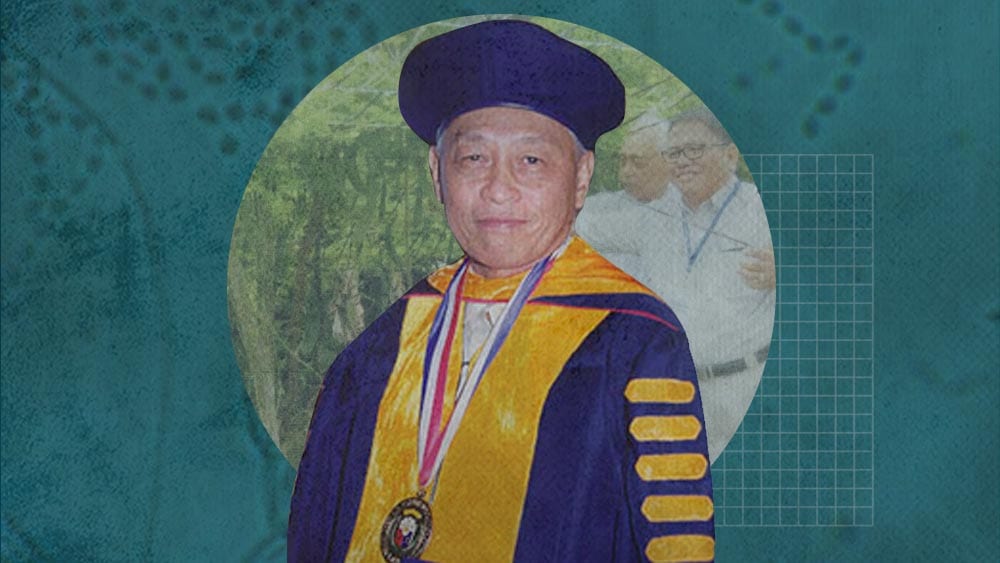
Agricultural scientist Dr. Romulo Gelbolingo Davide becomes the newest member of the Order of the National Scientists. Known for his pioneering work in the fields of nematology and plant pathology, Davide was bestowed the rank through Proclamation No. 643, signed on August 2, 2024. With it, the spotlight is shone on one of the Philippines' most celebrated agricultural scientists, an individual who dedicated his life to digging deep into microscopic worms and, of course, his social empathy.
Here, we look back on some of his greatest accomplishments. From discovering the first biological control agent against nematodes to being named a Ramon Magsaysay Awardee, his list of discoveries and accolades have led him to become the "Father of Plant Nematology." His work is rooted in a keen understanding of the plight of farmers and the greater struggles of the agricultural sector.
"There is no barren land, only barren minds."
- Romulo Davide
ALSO READ:
Teódula Kalaw África: The Unsung Filipina Chemist Behind Nata De Coco
Maria Orosa: The War Hero Who Invented Banana Ketchup
Who Is Dr. Romulo Davide?
Born on March 14, 1934, in Argao, Cebu, Davide was one of five children of public school teachers Hilario P. Davide, Sr. and Josefa Gelbolingo. He would start his fascination with the agricultural industries at his local public school grounds in Barangay Colawin. It was here that he started dreaming of his future, and how he hoped to someday improve the lives of farmers in the countryside. As a kid, he was exposed to the difficulties of tilling land, as part of his family's farming work. He wasn't the only one in the family, of course, to pursue such lofty goals for himself. Davide also happens to be the older brother of former Chief Justice Hilario G. Davide, Jr.
When it was time to choose a school, Davide ended up finishing a Bachelor of Science degree in Agriculture back in 1975 from the University of the Philippines-Los Baños. Eventually, he would pursue higher learning at Oklahoma State University, earning an M.Sc. in Plant Pathology. He then topped this off with a PhD in Nematology-Plant Pathology at North Carolina State University.
Davide would end up teaching Plant Pathology and Nematology at the Plant Pathology Department at the College of Agriculture in UPLB. In a 2017 feature with UP, Davide said of his early years as a scientist and professor: “I started teaching and research work in the laboratory. I did research, mainly to identify plant diseases caused by nematodes, those microscopic pests that attack the root system of fruits, vegetables, root crops, and other plants."
He would spend the early portion of his career focusing on biological control of plant parasitic nematodes. This would lead him to one of his first big breakthroughs, later on setting the stage for a career that spanned more than 60 years in the profession.
Scientist, Innovator, Philanthropist
Arguably his most important work remains his discovery of nematode-trapping fungi (P. lilacinus and P. oxalicum). This would lead to BIOCON, which is the first Philippine biological control product that targets nematode pests. Davide would go on to develop BICON and would soon have it registered and patented as Bioact. The said Bioact has manufacturing plants in Germany and even caters to markets in Europe, South America, and North America. This would catapult Davide into worldwide fame, becoming the first-ever Filipino to be part of the "Who’s Who” in nematology.
In 1994, he would be named “Outstanding Agricultural Scientist." He would end up using his research grant (worth about P500,000) to launch the corn-based "Farmer-Scientists Training Program" (FSTP). This was a project geared toward turning farmers into farmer-scientists, wherein they could do experiments and have meaningful interactions with experts to hone techniques, production processes, and their standing in the market.
FTSP would end up expanding to 35 Cebu communities and six other provinces, covering various crops like sweet potato, cassava, and banana. New intercropping and animal production technologies would even increase farmer's wages in the long run. The FSTP would become a nationwide implementation program under Executive Order No. 710, thanks to Davide's work with UP-Los Baños and the Department of Agriculture.
“We are glad with this nationwide coverage since we can now reach out to our poorest farmers, regardless of religion, creed, or tribal affinity. Thus we have now Mangyan farmer-scientists in the mountains of Mansalay, Oriental Mindoro, and the Blaan indigenous people in the mountains of Alabel, Sarangani Province in Mindanao,” Davide once said of the program.
In 2012, Davide became one of six recipients of the Ramon Magsaysay prize. He was cited for using "the tools of science and a great reserve of social empathy" to empower farmers. In a lecture he delivered at the Ramon Magsaysay Center in Manila, Davide explained: “We have so many studies on rice but there are not so much studies on corn even if 20 million Filipinos are eating corn. Even I am still eating corn.”
These days, Davide is celebrated by his peers for his groundbreaking research and his work with farmer-scientists in far-flung regions of the country. He is revered as someone who would uplift the lives of farmers. Even at the age of 90, he is still professor emeritus at UP Los Baños. If there was ever one quote that summarized his body of work throughout his storied career, it's this: "There is no barren land, only barren minds."
