

Today I Learned: The Philippine Peso is One of the World’s Most Counterfeited Currencies

It’s difficult to determine exactly how much of the world’s banknotes are counterfeits, but there’s no denying that counterfeiting is a global concern. In the United States alone, an estimated $70 million in counterfeit bills, or nearly a third of all currency in the country, are reported to be fake as of 2023.
This is the reason countries—specifically their central banks—are taking painstaking efforts to add more and more elaborate security features to their banknotes. While some national currencies have become successful in these efforts and have led to a significant decline in attempts to counterfeit them, others are still dealing with the issue.
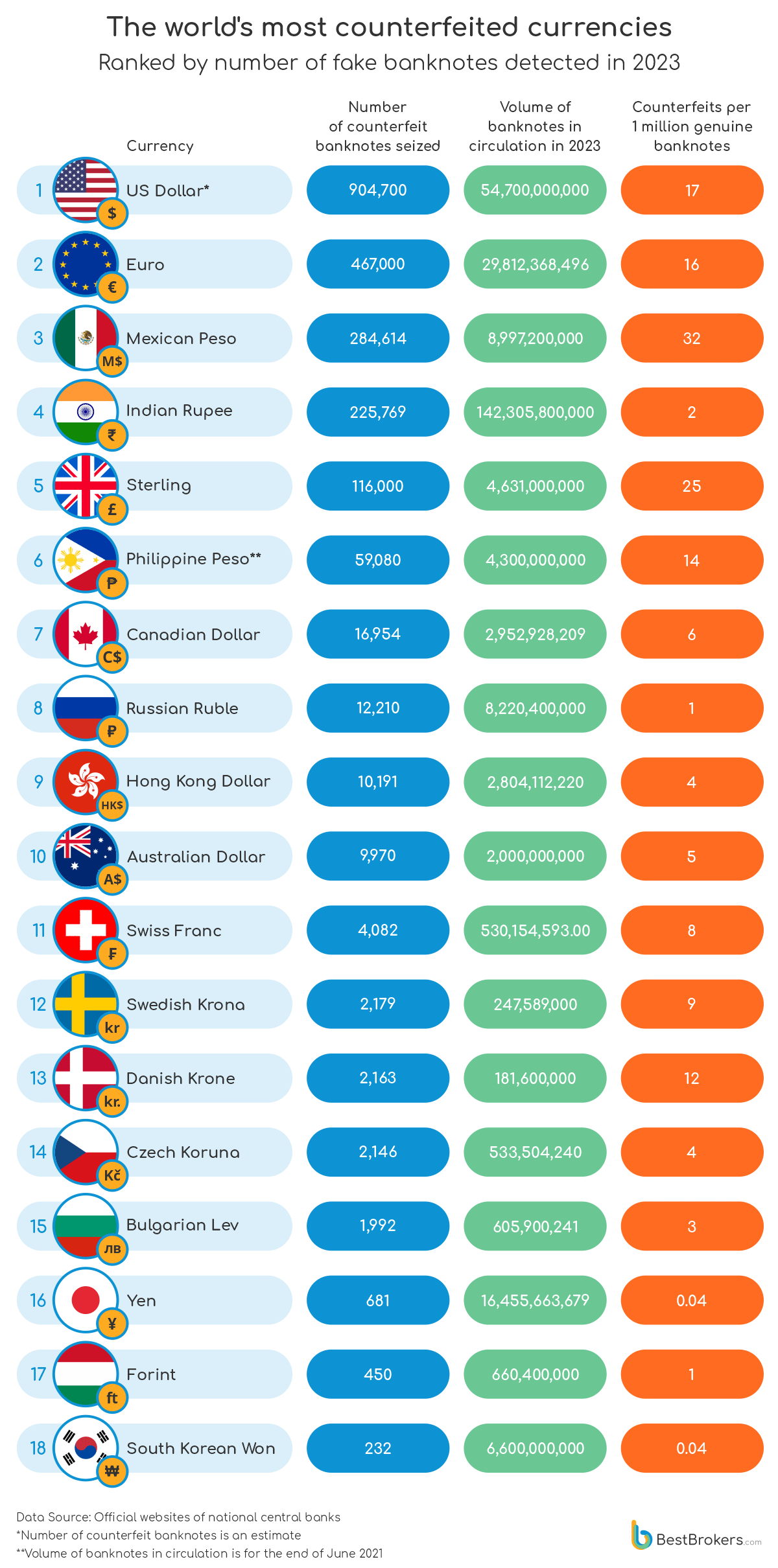
According to a study conducted by the website Bestbrokers, he U.S. dollar is the world’s most counterfeited currency. While the Secret Service, the federal agency responsible for suppressing counterfeit notes, does not publish details about the number and denomination of fake banknotes it encounters for security reasons, data the website collected from previous years suggest that at least 904,700 fake U.S. dollar notes were detected in 2023. With about 54.7 billion bank notes in circulation in 2023, that translates to about 17 counterfeits per one million genuine notes.
ALSO READ
BSP Defends PH Gold Sales: ‘We Took Advantage of Higher Prices and Generated Additional Income’
Based on Bestbrokers study, the U.S. dollar is followed by the euro, the Mexican peso, the Indian rupee, the UK pound sterling, in the rankings of most counterfeited currencies as of 2023. The Philippine peso, surprisingly, is at number six, although the data collected by the site is as of the end of June 2021. During that period, a total of 59,080 counterfeit bank notes were seized. With an estimated 4.3 billion bank notes in circulation as of 2023, that’s at least 14 counterfeits per one million real bank notes.
The Bangko Sentral ng Pilipinas (BSP) has taken clear and concrete steps to address the issue of counterfeiting in the country. Since 2010, the BSP has conducted operations that led to the confiscation of over P35 million worth of fake bank notes. It has also filed a total of 194 cases related t counterfeiting since 2010, leading to a conviction rate of 97.4 percent.
In 2023 alone, the BSP said it carried out 11 anti-counterfeiting operations that led to the arrest of 19 suspects and the filing of 25 criminal charges.
Following the Philippines in the list of most counterfeited currencies are the Canadian dollar, the Russian ruble, the Hong Kong Dollar, and the Australian Dollar.
In the Philippines, counterfeiting carries a maximum prison sentence of 10 years plus a fine.
Meanwhile, the Bestbrokers study also determined the world’s most secure currencies by ranking them based on the most number of security features on the most commonly used bank notes. This includes everything from holograms and hidden images to microprints and the use of color-shifting ink.
“To identify which banknotes are the most secure and which are most vulnerable to counterfeiting attempts, the currency team at BestBrokers looked at the 39 most traded currencies by value as of 2022,” the study said. “We identified the highest-circulating banknote in each country for 2023 and ranked these notes based on their number of security features. We also estimated how many counterfeit notes exist per million real ones across each nation. To see how much cash is there per person, we divided each country’s total value of banknotes by its population.”
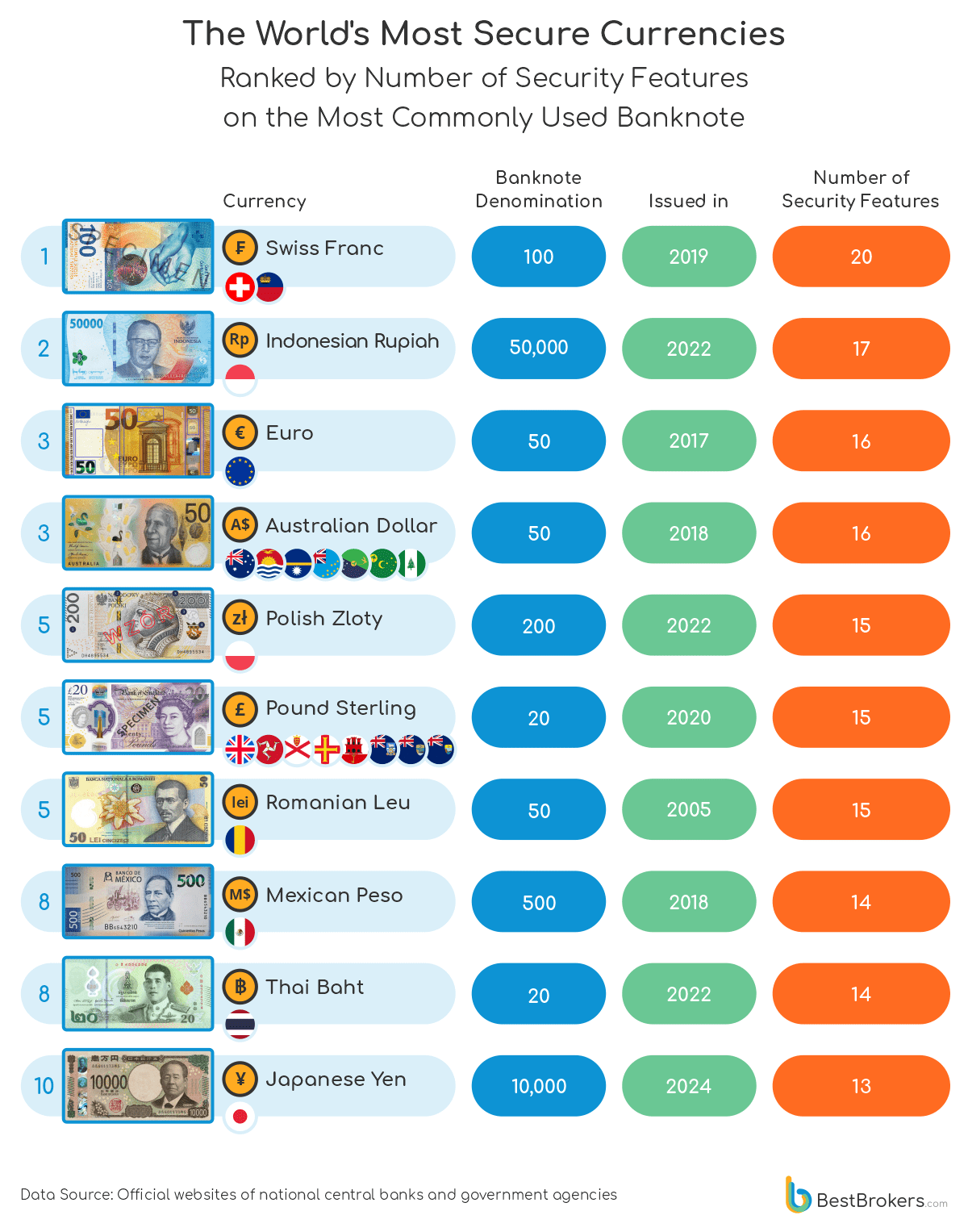
Based on these parameters the world’s most secure currency was found to be the Swiss franc, whose 100-denomination issued in 2019 was found to have as many as 20 security features. These include include a see-through register (a pattern printed simultaneously on both sides of the note), security thread, raised printing, watermark, micro-perforations, infrared properties, UV-visible elements and a pattern called EURion constellation. The Swiss franc also ranks as the eighth most traded currency globally by value.
Following the Swiss franc in the ranking of most secure global currencies are the Indonesian rupiah (specifically the 50,000 denomination), the Euro (50), the Australian dollar (50), and the Polish zlaty (200).
“(B)anknotes with fewer security features are often more vulnerable to counterfeiting compared to those with more complex designs,” the study said. “For instance, both the 100 South African Rand and the 1,000 Taiwan New Dollar notes have only nine security features, making them easier targets for counterfeiters. The same goes for the 5 Bahraini dinars and the 2,000 Argentine pesos as they too have only nine security features.”
The study also found that the most common security feature on bank notes is intaglio, or raised printing. “The technique creates a tactile texture you can feel by running your fingers over the note and is often found in areas like portraits or large numbers,” Bestbrokers said. “It is created using a high-pressure printing process, making the note harder to reproduce with regular printers.”
Other common security features for bank notes include watermarks, tactile features, colof-shifting, ultraviolet (UV) features, security threads, see through features, latent or hidden images, and holograms.
