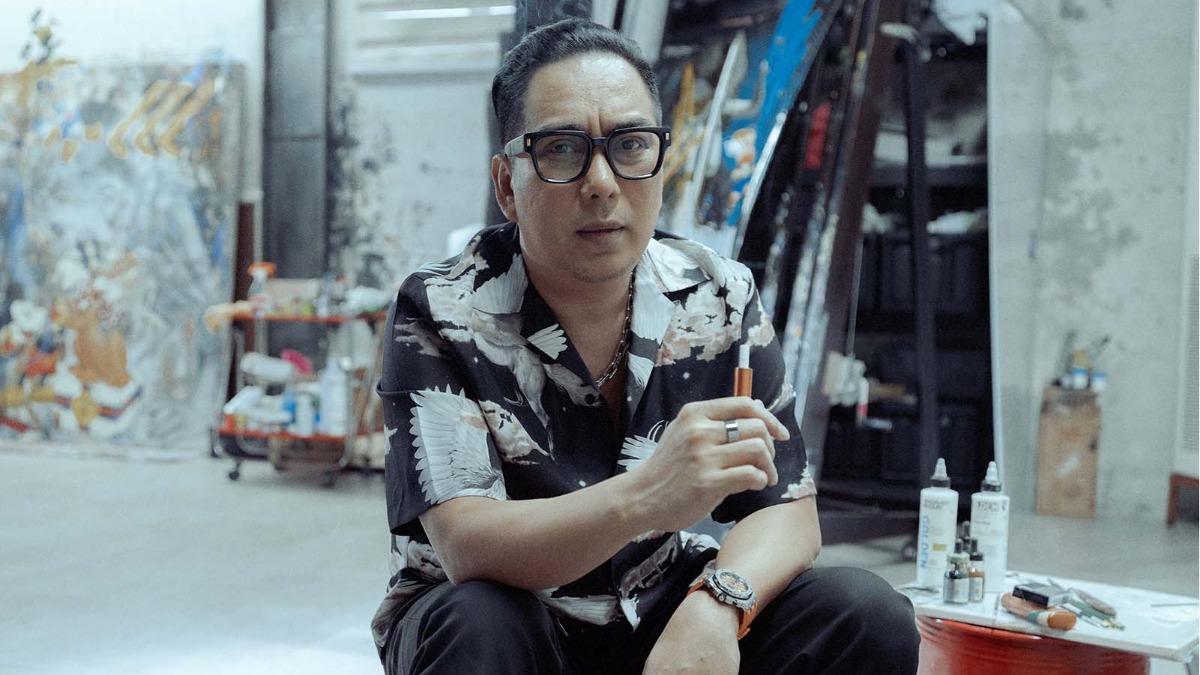
It’s a smoldering Wednesday in June and here we are on the rooftop of Ayala Malls Manila Bay. Towering over us is a gigantic graffiti mural dedicated to Filipino-American National Basketball Association player Jalen Green. Quiccs Maiquez, who helped turn this thing into a reality, personally wanted us to do the shoot here for obvious reasons. He, Egg Fiasco, and the rest of their friends from Pilipinas Street Plan and Hidden Fortress Manila did this mural around roughly the same time a year ago. It’s a marvel; a celebration of Filipino street culture that was meant to welcome one of our own to Manila. The scene illustrates the vibrancy of our local urbanities. It also highlights the godforsaken heat that permeates around this city.
ADVERTISEMENT - CONTINUE READING BELOW
Tagged on the walls, of course, are the graffiti artists’ names, as well as some familiar figures, like Egg Fiasco’s trouble monkeys and Quiccs’ signature TEQ63, and the special car Adidas made just for the event (with Kevin Garnett’s “Anything Is Possible” battle cry plastered on it).
“We basically represented ourselves through our own characters and our own names written on the walls,” Quiccs says of the project. Their imprints are all over this rooftop enclave, which has become an interesting marker by the Bay for those on a high enough level to see it.
“Back then, there wasn't any graffiti scene in the Philippines. You can say that I was a super frustrated graffiti artist, because I didn't have access to the culture yet."
There’s something to be said about street art, murals, and graffiti as landmarks in Metro Manila. They usually serve as cultural ambassadors for the unforgiving Manila cityscape. If we really want to know about the city, we don’t go inside its shiny new corporate buildings or cross its overpriced, outdated bridges. We go to its sides: the "Pundasyon" murals on 20-meter high underpass columns in Nagtahan Bridge are coded in Filipino revolutionary history, “Magsasaka” by Archie Oclos and Aleili Ariola are murals in Bonifacio Global City (of all places) that honor our farmers, “Ang Bakunawa at Minokawa” by Ang Gerilya along Gen. Luna Street in Intramuros is a retelling of Philippine mythological creatures.
CONTINUE READING BELOW
watch now
PHOTO: SHAIRA LUNA
Post a Comment
“[Graffiti] takes a different art skill to master--how to use the spray paint as a medium instead of using the paintbrush,” Quiccs emphasizes. “So that was a different skill set that I needed to learn on my own.”
Graffiti zags further than street art and murals, of course. It even predates street art, marked by having a letter-based form. Modern street art, for the most part, draws inspiration from the zeitgeist of graffiti today. Graffiti is shaped by vigorous self-expression that was once put down as subversive or was considered vandalism or, worse, criminal activity. But it was always something that negated the reinforcement of social norms, marked new territory, and made statements. It was an act of rebellion and still is. Yeah, no wonder graffiti artists are this cool.
“It's quite an easy transition for natural-born artists to do graffiti if they wanted to,” Quiccs posits. It's a younger community of disruptors, to say the least. And Quiccs was born at just the right time for its boom in the Philippines. From the late 1990s to the early 2000s, the artist was exposed to the graffiti culture in the United States and in Europe during his college days. Suffice it to say, it resonated with him.
ADVERTISEMENT - CONTINUE READING BELOW
“Back then, there wasn't any graffiti scene in the Philippines. You can say that I was a super frustrated graffiti artist, because I didn't have access to the culture yet,” he explains. “I had fun immersing myself into their graffiti culture. So when I got back to the Philippines, [I asked myself] what is [our graffiti] culture going to look like?”
“Art history dictates that it's the game changers who kind of become remembered the most. The rule breakers are the ones who stick out like a sore thumb. And if you aren't like that, then you're just following everyone else.”
It took him a decade to find out what that meant. “After 10 years, I started seeing that there were local artists emerging in Manila. And I was fortunate enough to meet Egg Fiasco, Trip Martinez, Jan Errol Orbida a.k.a. Chill, and Dennis Batoback in 2012. And since then, I became friends with them.”
Graffiti’s themes were always a function of modern iconoclasm in a sense, a valid reaction to unjust systems and messed-up norms from, well, rule breakers. Quiccs thinks of rule breakers as among our great innovators. “Art history dictates that it's the gamechangers who kind of become remembered the most. The rule breakers are the ones who stick out like a sore thumb. And if you aren't like that, then you're just following everyone else.”
PHOTO: SHAIRA LUNA
Post a Comment
In Quiccs’ work, we see a convergence of graffiti, Japanese robot culture, and hip-hop. "If you know my characters, you can see that they're always a combination of these three subcultures combined.” Quiccs and his brother grew up watching the likes of Voltes V, Daimos, Bioman, and Transformers as kids, and the shows had a profound effect on him. “And then through the 90s, it was Gundam and Evangelion. I had a natural love for Japanese robots. Me, being an artist. Early on, I was also experimenting with creating my own robots.”
ADVERTISEMENT - CONTINUE READING BELOW
Out of this came the artist’s signature TEQ63 character, which carries over from his graffiti all the way to his designer toys. “It's more of the fact that I wanted to represent myself as a character. And the formula I had was just to embody all of the biggest influences I had as a kid.” In 2016, the release of "The Ghost of Kurosawa" elevated his name to new heights. These designer toys were characterized by stylized versions of Samurai masks, reflective of a revered Japanese filmmaker’s aesthetics. The design was a nod to the late great auteur Akira Kurosawa, who had heavily influenced George Lucas in the development of Star Wars by way of the former's 1958 film The Hidden Fortress.
"If you see Star Wars: Episode IV - A New Hope, you're going to find that it's heavily based on The Hidden Fortress," notes Quiccs. It's long been apparent how (blatantly, I’d say) Lucas took from story elements and archetypes from Kurosawa's filmography. Both tell the stories of war between falling empires from the perspective of lowly characters. This is especially true for characters like C-3PO, R2-D2, and Darth Vader.
“Even the name Hidden Fortress is also relevant. Of course, the character is a combination of Star Wars, Darth Vader’s face, and Akira Kurosawa's samurai films, like Seven Samurai," he states, talking about TEQ63. "There’s also a little bit of World War II influences. So it's a whole mixture of these influences. But basically, it revolves around Star Wars and George Lucas.”
It was in the early to mid-2010s that Quiccs started to dabble in designer toys. He became an independent creator while working in Hong Kong as a creative director for a not-to-be-named fashion brand. In 2013, he customized a DUNNY and envisioned what TEQ63 would look like on its platform. That lit the fire. This was another creative frontier for Quiccs, one that was fairly young, too. He caught on the wave right as the art toy barrage came about. It also helped that his TEQ63 designs had quite the reception among gallerists, collectors, and enthusiasts.
“I wanted to show, I guess, a new path for people to take, especially now that they're on social media. I kind of wanted to send the message that you can do things on your own."
Interestingly, there was a time when the thought of "designer" toys in the art market was inconceivable. Before art toys like KAWS or Futura or Be@rbrick or POP MART and countless others were selling for as high as eight figures a pop, these items were on the outside looking in of the snobby fine art scene. Some 20 or so years later, these toys (if you still want to call them that) have been elevated to high art status. Hell, even a place with the cultural pedigree of the Museum of Modern Art has some of them in its permanent collection.
Quiccs remembers a time when the art toy scene was in its infancy at the turn of the 21st century. He had already been fixated on the potential of the movement in the early 2000s. It was at SM Megamall in Mandaluyong (what used to be the epicenter of the contemporary Filipino art scene) that he first caught a glimpse of Michael Lau’s figures. "Since seeing them in American Boulevard, I've always dreamt of creating my own versions someday," the three-time Designer Toy Awards Artist of the Year says.
PHOTO: SHAIRA LUNA
Post a Comment
The bustling art toy movement we see now owes its roots to groups in the urban counterculture of '90s Hong Kong and Japan. Back then, these toys were initially called "urban vinyl," a term derived from the material commonly used to make them and the intersect where these pieces operated; right in the middle of street culture, urban sensibilities, and a particular contemporary milieu bred by pop culture motifs and material only as strong and as resistant as the genius of what used to be the "lowbrow" creators who willed them into existence.
Lau, the godfather of urban vinyl, was one of the first artists who kickstarted this cultural phenomenon with the series of vinyl figures he did in that decade. His reimagining of G.I. Joe as a hip-hop character in streetwear labels and accessories might have put the idea of designer toys on the map. With the debut of his Gardener series in 1999, Lau cemented the prestige of these pieces in the art world. The book Vinyl Will Kill! notes that Lau's custom-made G.I. Joe figures may arguably be the granddaddy of them all, paving the way for the Be@rbricks and KAWS and Quiccs’ own TEQ63.
“I wanted to show, I guess, a new path for people to take, especially now that they're on social media,” Quiccs says. “I kind of wanted to send the message that you can do things on your own. But besides that, I really wanted to show artists that there are several paths for you to take to make a career out of art. That's why I chose the medium of doing designer toys because it was something that's highly unusual for artists to do. It's something that hasn't been done in the Philippines much yet.”
“One of the most integral foundations I had for my art career was to never follow the norm. I grew up being exposed to artists that had a specific direction of creating a name for themselves through gallery shows and doing paintings.”
Quiccs says that the art toy movement only arrived in the United States in the mid-2000s. The Philippines would follow the hype train a decade later. “We were kind of late in appreciating art toys. But it’s natural that they get attracted to local artists who create their own toys, too.”
“So I guess it's a natural progression for us. And we're not like the last or the last to get into it. Actually, I think Dubai is already starting to appreciate our toys right now, and a lot of countries still don't even know much about them," he says of the international art toy trade. "So I think [the Philippines] is ahead in that regard. And there's a lot of growth left for more people to appreciate.”
Local fans, collectors, and much of the general public can appreciate more of Quiccs’ designs through conventions like ToyCon Philippines and galleries like the Bigboy Cheng-led Secret Fresh Gallery (the lone local gallery that hosts Quiccs exhibitions) this month. Quiccs is celebrating his second solo show at Secret Fresh called MK02, which features the exclusive drop of the Final Metallic Encore Edition Set of "TEQ63: Manila Killa." Here, we see a good example of how graffiti and street culture have been elevated to high art. It’s emblematic of a time when the art scene has busted any distinctions between fine art and commercial art, too.
“One of the most integral foundations I had for my art career was to never follow the norm. I grew up being exposed to artists that had a specific direction of creating a name for themselves through gallery shows and doing paintings,” he says. So much so that he has broken global barriers.
“We're lucky enough to be in a time that graffiti, art boys, and even street fashion becoming mainstream enough to become appreciated even by the contemporary art scene and high art people."
He’s joined shows in the U.S., Japan, and the United Kingdom. International brands like Johnnie Walker, Nike, Sony, Marvel, and, of course, Adidas have come knocking on his door. At this point in his career, Quiccs says that he’s fortunate enough to now be in a position where he has full autonomy. Nevertheless, there is one common trait among all the decisions he’s made so far: It’s that each of them can be traced to his childhood.
Adidas was a brand he started wearing in grade school, back when RUN DMC made the Superstars cool. It’s his most cherished pair, by the way (he’s wearing them to the interview, too). “They've been an icon of the hip-hop culture for a while. That was an easy pick for me to represent. I'd always sign the shoes with three stripes just as like a tribute to my favorite shoe brand.” True enough, he would sign an exclusive two-year deal with the sneaker brand. Quiccs would design new Superstars for its 50th anniversary.
Smart, on the other hand, hits close to home because his father worked at the PLDT Group of Companies for 35 years, up until his passing in 2014. His sister, Luday, spent some time working with Smart and Talk N Text, as well. Johnnie Walker made sense because, duh, it’s Johnnie fricking Walker. “They're all close to my heart or have a part of my life or present an aspiration that I really seek.”
We can’t limit or reduce the artist to age-old boxes, like graffiti or art toys in fine art. This is what Quiccs has always advocated for since seeing the possibilities of his fame. “We're lucky enough to be in a time that graffiti, art boys, and even street fashion becoming mainstream enough to become appreciated even by the contemporary art scene and high art people. So we're just lucky to be at this time.”
We all are. It was Lau who once said that all art is toys and all toys are art, and Quiccs is still toying around with the possibilities of this grandeur. The artist says that he has a lot more going on in the future as the Chief Executive Officer, designer, and creative director of QUICCS Trading and Burnwater Design Studios.
TEQ63 is going to be around for a long, long time, too. His maker, Quiccs, on the other hand, is going to continue designing clothes, toys, and liquor labels, doing graffiti art, and building up the same community of artists that empowered him. Street art and graffiti have now become quite the institution. Art is no longer confined to white walls, banquet halls, and the annoying highbrow.
Quiccs, however, looks at it differently. "I think it's not that the boundaries are gone," he says of the old ways we used to separate fine art and commercial art. "It's more of how the appreciation for such spreads.
“So if you see the artistry in the iconoclasts, you know that the rule breakers always get appreciated, no matter what; because the stuff they do is revolutionary and changes things even after they die. And if you're lucky enough, you get to live through those times when your art form becomes appreciated by more people."
Story: Bryle B. Suralta Photos: Shaira Luna Styling: Paolo Chua Grooming: Muriel Vega Perez Editor-in-Chief: Paul John Caña Production: Paolo Chua Creative Direction: Igi Talao Design Direction: Bacs Arcebal
We use cookies to ensure you get the best experience on Esquiremag.ph. By continued use, you agree to our privacy policy and accept our use of such cookies. Find out more here.