

Today I Learned: The History of the Philippines' Most Populous Barangay

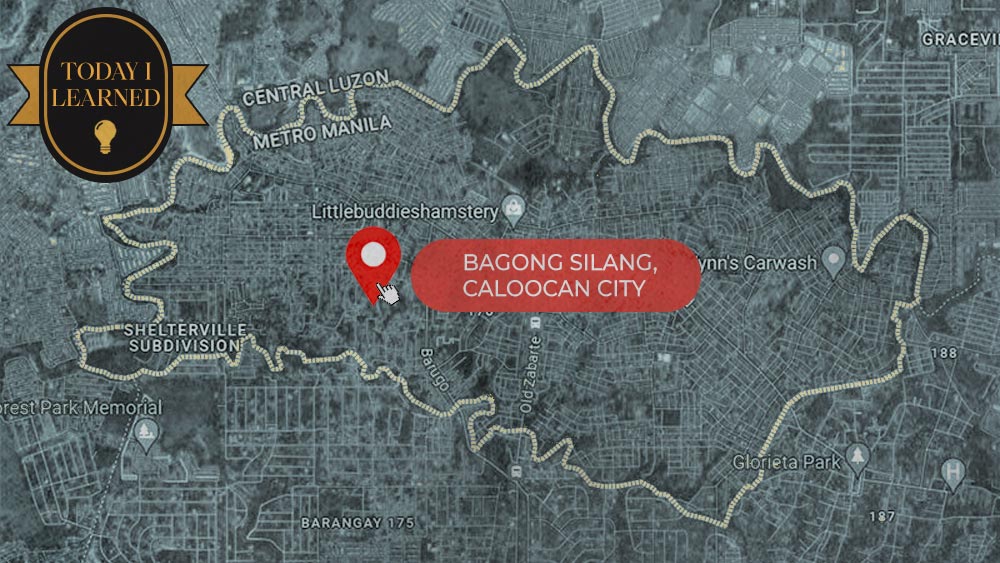
It finally happened. Caloocan City voters have spoken: the Philippines' biggest barangay, Bagong Silang or Barangay 176, will now be divided into different barangays. The plebiscite was held to ratify Republic Act No. 11993, which would become law on April 3, 2024.
This marks the end of a barangay with a complicated history that has come to define Manila's overpopulation problem and severe housing deficit, from its origins at Tala Estate to its reestablishment under the first Marcos administration to its eventual split.
Bagong Silang has been the stuff of legend for these reasons. The segregation of the 574-hectare land has been in the works since the late '80s to early '90s, going through a series of failed resettlement plans and attempts at division.
Among the issues cited by the people who lived there for the split were the land area and population density (as they should) and the fact that government services weren't enough to meet residents' needs. The distribution of goods and services, as well as the enforcement of laws, also became a struggle. In 2022, Caloocan 1st district representative and former mayor Oscar Malapitan introduced a bill for the partition. Finally, the same barangay that former President Ferdinand Marcos' Sr. established would finally be divided into six smaller barangays.
ALSO READ:
Today I Learned: The History of the Multi-Billion Peso ‘Payanig sa Pasig’ Lot
An Art Deco Masterpiece: Remembering the Crystal Arcade, Manila's First Mall
A Deep Dive on the History of Bagong Silang
With a population of over 260,000, Barangay Bagong Silang actually has more residents than roughly two-thirds of cities in the Philippines. To put things into perspective: San Juan City in Metro Manila, for instance, only has a population of 126,347.
Situated on land that borders San Jose del Monte, Marilao, and Meycauayan, Bulacan, as well as Rodriguez, Rizal, Barangay Bagong Silang's location is tricky. The Caloocan barangay doesn't even belong to the city itself, mind you. The city has administrative authority over the barangay, yes, but it is the Roman Catholic Diocese of Novaliches that apparently "owns" it, based on a decree by the Vatican in 2002.
Bagong Silang's story starts with the 2,000-acre Tala Estate. The barangay was one of the first four haciendas that made up the then-town of Novaliches back in 1855. It was a part of Bulacan in 1855 before switching to Manila for another three years in 1858, and then eventually becoming part of Rizal from 1901 to 1903.
When Tala Estate was acquired by the Philippine government in 1938, it was supposed to be used for a leprosarium. Such a facility doesn't exist as much anymore thanks to the advancement of modern medicine, having a place to isolate and treat people with leprosy was once a necessity. (The Culion leper colony in Palawan, interestingly, was one of the largest well-organized leprosariums in the world at one point, but that's a story for another day).
Only one-third of the land at Tala Estate was used for the proposed leprosarium, as segregation was slowly phased out. The plan then evolved instead into the Central Luzon Sanitarium or the Dr. Jose N. Rodriguez Memorial Hospital. This failed proposal would lead to further housing and urban development.
From the '50s to the '70s, Bagong Silang, much like any other provincial or provincial-boundary area near Metro Manila didn't exactly attract that much attention in terms of relocation potential for families. It was as rural as it got: picture old homes within stuffy greenery, weeds, and fruit trees. It was known as a barrio because, well, it technically was historically a barrio in the eyes of the national government.
When President Ferdinand Marcos Sr. came into power, Bagong Silang became a point for resettlement. This is actually where it gets its name: Silang, or the Tagalog word for borth, is from those who had lived in the original slum areas of Tondo in Manila or Commonwealth in Quezon City and other overcrowded cities in the National Capital Region (NCR), found themselves moving there.
Marcos' wife, Imelda, had her own vision for the place. In the '70s, the First Lady asked the National Housing Corp. (NHC) to turn a large chunk of Tala Estate into a plantation. This would have been an area dedicated to tree species, which would be used for log concessions. The timber that was to be produced here would then be used for the materials needed for the construction of low-cost housing divisions for the homeless in the NCR. Leading the project for low-cost housing would be the NHC.
Again, that plan failed. Months turned into years before any intervention was done. Soon, the population of the barangay over the Marcos period steadily grew. By the time President Corazon Aquino's term came along, the barangay's segregation was already a subject of debate.
This would be compounded by R.A. No. 6714, which effectively reduced Caloocan's barangay from 188 to 60. In the case of Bagong Silang, it would have been divided into five separate barangays. But when the plebiscite happened, a majority of voters rejected the proposal. More informal settlers came in from different parts of Metro Manila to populate the already-crowded barangay. Before anyone knew it, it became the most populous barangay in the Philippines.
Another 35 years passed before the next plebiscite. This brings us to the present day. Barangay Bagong Silang will now be divided into "phases:" 176-A, 176-B, 176-C, 176-D, 176-E, and 176-F. This officially marks the end of the most populous barangay in Philippine history, a settlement that will perhaps never (or shouldn't ever) exist again.
