
Opinion: The ‘May Smaller Bill Po Kayo?’ Culture Needs to Stop

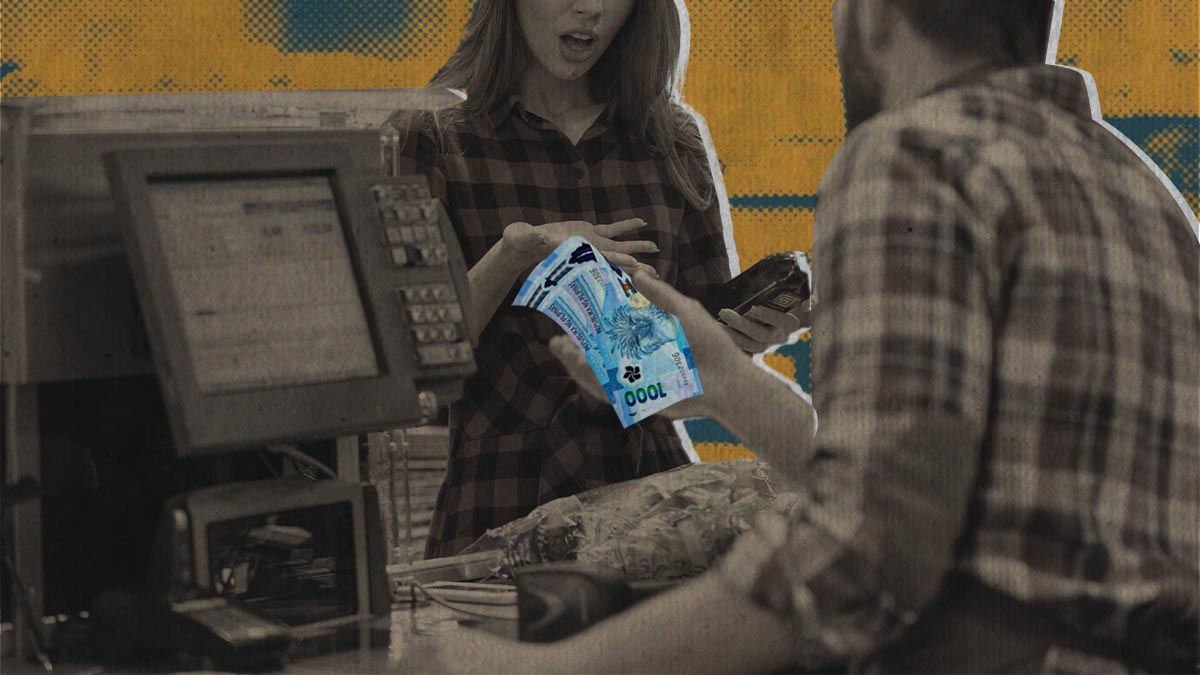
I decided to get lunch at a fast-food store near my house late last week. My bill amounted to P275. I handed the cashier a crisp P1,000 bill, and, as expected, I heard those five words thrown back at me:
“May smaller bill po kayo?”
I was ready. I gave her a huge smile and said, “Sorry, wala e. Kulang na.”
I’ve never understood this culture of asking customers if they can pay for their purchases with the bill closest to the actual amount. Yes, clearly, the merchant or business wants to make sure that they have enough to hand over as change to the next customer and the one after ad infinitum, but since when was it the customer’s job to make sure that happens? When did the burden to provide a seamless, uncomplicated transaction shift from the merchant to the consumer?
As a customer in this hyper capitalist society we’re living in, I’ve always thought my only responsibility when making any purchase for a product or service is to pay for them with the agreed-upon amount—the one indicated in the price tag. The merchant sets the value of the item and if I or other customers want it, we shell out the required sum. If we happen to have the exact amount in cash on us, great; we hand it over and the transaction is complete. But if we don’t, which is often the case, it’s the seller’s responsibility to give us back the difference. Right?
ALSO READ
Today I Learned: The Philippine Peso is One of the World’s Most Counterfeited Currencies
Everything You Need to Know About the New Polymer Banknote Series
That’s the ideal. But what seems to be happening now and over the last few years, at least, is that merchants, specifically the cashiers manning the payment counters, often ask—sometimes even demand—that customers hand over “smaller bills.” “Wala po kayong smaller bill?” has become a common refrain, from sari-sari stores to salons and fast-food chains and even in supermarkets and groceries. It’s gotten so bad that establishments sometimes even post handmade signs advising customers to “Prepare Exact Change,” or “Small Bills Only Please,” or the classic, “Barya Lang Po Sa Umaga.”
It wouldn’t even be an issue if cashiers and business owners are self-aware and polite about it. There have been instances when it’s the merchants who are haughty and arrogant about asking people for small change, sometimes making their customers feel like it’s their fault for not having a P100 bill for a P65 purchase and instead handing out a P500.
And what happens when customers don’t have the requisite amount? Sometimes it becomes a stare down contest, with one side waiting for the other to blink first. Customers can sometimes dig through their purses and wallets (or pretend to do so) in a largely performative act of giving in to the cashier’s demand, but often they’ll do what I did and just say, “Sorry, wala e.”
When that happens, the hapless cashier will often heave a visual, not to mention loud, sigh of exasperation and end up magically producing the change anyway. In extreme cases, sellers will signal the shortage of change with a pleading look and an apology, and in those cases, either the customer will submit to not getting their correct change or the transaction will be canceled altogether. (In some establishments, the change difference is offered in another item of commensurate value, or, in the case of sari-sari stores, candy, but that’s another story).
I’ve traveled to quite a few other countries over the years, and I have never encountered this “small bills only” culture anywhere else. Or, at least, not quite as pervasively as here in the Philippines. That has often led me to wonder where the problem lies. Are there not enough bank notes and change in circulation? Is the government not providing enough currency to its citizens? Are some people hoarding fiat currency, dropping them in their little piggy banks at home and therefore adding to the change shortage? Or are some establishments just naturally inclined to pass the burden on to consumers?
Whatever the reason, the issue has become so widespread and problematic that hardly anyone thinks to bring it up anymore. Many people just accept it as a fact of the Filipino’s way of life—like monstrous traffic jams, gossip on social media, and corrupt politicians—that no one bothers to take a step back and consider how truly anti-consumer this culture really is.
Are all of us now obligated to carry P20s, P50s, and P100s every time we want to make a purchase? Do we just accept the offer of small pieces of candy when the store doesn’t have enough to give back to us as change? Do we then have to ask other people—our companions or the people next to us in line—for smaller bills when the cashier says they don’t have enough to give back to us?
Fortunately, this issue is precisely a pain point that cashless transactions are trying to address. Credit and debit cards and e-wallets have objectively made payments more seamless and convenient—no more worrying about looking for P1 and P5 coins, and yes, smaller bills. But, not to spoil the march to high-tech modernity, but these things aren’t entirely without their issues. Many establishments aren’t yet plugged in and don’t accept cards as payments. E-wallets are entirely dependent on mobile phone signals and whether or not the app is being cooperative. I’ve lost count how many times I’ve encountered stores that have advised customers that their e-wallet terminals aren’t working. In these instances, cash is still king.
On the flip side, there are establishments that have begun to roll out completely cashless transaction systems, especially overseas, so no “small bills only” problems there. But until that happens here in this country, it looks like we’re going to have to deal with this issue for the foreseeable future.
I don’t have a solution, except maybe to advise establishments to keep small bills and change handy for the day’s transactions. Cashless transactions definitely help, but if there’s no other choice but to go with cash, the least these stores can do is to make sure they have enough for the day, and not to pass the burden on to consumers who are patronizing their business. And in the worst-case scenario, when cashiers really don’t have enough change, they need to figure out a solution that doesn’t aggravate or add unnecessary stress to the customer (and hopefully that doesn’t involve exchanging candy for the change difference). And please, for the love of god, they don’t have to be rude or passive-aggressive about it.
