
Taragis Na 'Yan: On the Scams and Stupid Things We Do For Virality

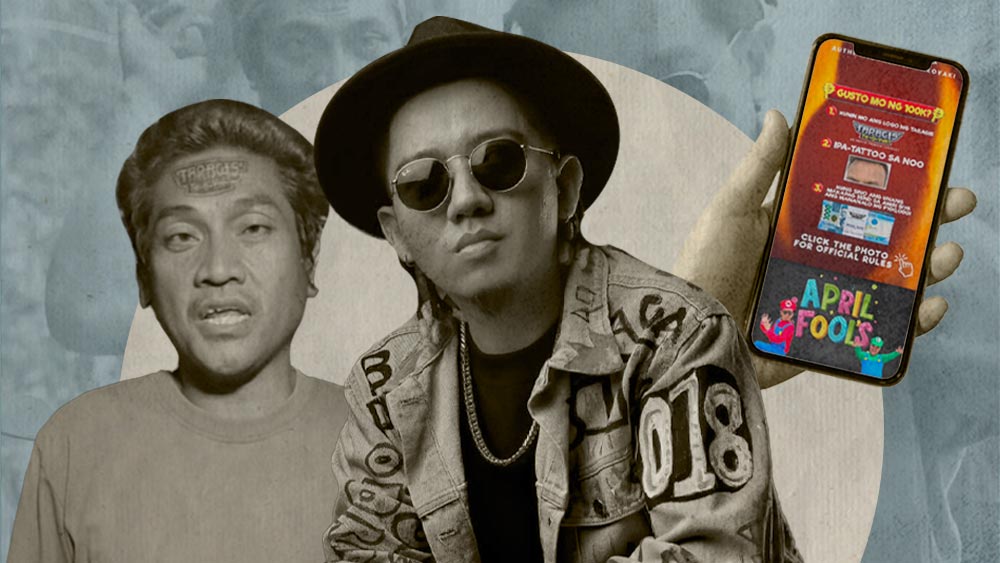
The joke's on us, but nobody's laughing. Carlo Quion, the founder of Taragis, finally admitted that the whole week-long tattoo fiasco was all but an elaborate April Fool's marketing stunt. Who would've thought that a takoyaki shop would get this much national attention? It drew in more critiques than your average Presidential press conference. So I guess it worked.
Quion's big reveal came in a taped announcement atop his fancy leather throne. He apologized, yes, but then proceeded to position himself as an innovative entrepreneur who architected this brilliant scheme that racked in the views, incidentally boosted other brands, and of all things saved a man in crisis. We can now all join hands and celebrate this triumph of internet marketing.
Yet, we aren't. It's hard to smile when we see a man's forehead tattooed with "Taragis" out of desperation. Quion emphasized that Albano consented, so we shouldn't blame him, and that because of it (i.e. the stunt), Ramil Albano (Tatay Ramil) got more than what he bargained for after agreeing to the pact. Tatay Ramil was said to have received upwards of P200,000 in gifts and donations. So the Taragis founder framed this "marketing feat" as an act of kindness, too, one that showcased the force of our bayanihan, as if saying that the tattoo just had to happen for Albano to deserve aid. It's a kind of delusional savior complex that comprises one branch of the corny kangkungan-millionaire-mindset-bro cult of personality (these so-called young "grindset" businessmen talking to each other in circles and spitting out the most generic advice on TikTok).
Really, was all this notoriety worth the humiliation and capitalization of a desperate man? There's something amiss in all this. Some people still view consent as an easy yes-or-no answer, I see. "But he consented!" Well, yeah, he did. But the thing is, all this reeks of coercion. Our system has obviously failed Albano and his son. They are left vulnerable to these propositions. They don't seem to have many options. These make them the perfect bait, the ideal pawn. How can he say no to such a rotten deal?
ALSO READ:
Now There's a Course That Teaches You How to Be a Social Media Influencer
An Influencer Tried to Get a Free Stay at a Luxury Tagaytay Hotel. It Did Not Go as Planned
That's the thing when we frame digital content as charity. We ignore the material conditions of people for engagement and reach. We dehumanize them and ask them to show us how badly they want it (i.e. the incentive). This dynamic is built on a pyramid of meritocracy that lets every one of us down to varying degrees every day. It isn't enough that they're (people like Albano) struggling. They have to struggle some more. The more struggles we are willing to endure, the bigger sacrifices we make, the more tasks we do, the more we're rewarded.
This is bullshit, of course. Quion could've helped Albano without the tasteless fuss, but hey where's the fun in that? In Albano's case, he's going to have to live with being branded like cattle, captured for everyone to see, so he and his son could have a better life. And it's allegedly funny. Allegedly.
Horrible, all this. This is marketing done in bad faith. Quion told us that it took a year to plan all this out, as if the painstakingly long timeframe makes the ruse savvy or the goodness genuine. This piece of information makes it worse. All that time to sit, breathe, think, reflect, reassess, reorganize... and they still had to go through with it. It just had to be a face tattoo. It just had to be the forehead. It's good for the brand, dummies.
Nevertheless, Quion and Taragis achieved what they set out to do. I see some people unfortunately calling the ploy smart, too. The followers followed, the subscribers subscribed, the influencers influenced again, the brand and all the others that rode the Taragis hype train got their money's worth. A smashing success. It was the ultimate prank-slash-campaign in an age where virality is an even more precious commodity than gold. The layers upon layers of gotcha moments wound up mirroring some tragic contemporary realities. But not in the way Quion, his cohorts, and his apologists might think.
The gambit is a culmination of different elements of brand awareness, influencer marketing, and content marketing strategies, among others. Although I will add that I cannot understand, for the life of me, how the stunt is meant to add value to Taragis. It could be argued that a thing like this could be detrimental to the Taragis name despite the robustness of the metrics Quion mentioned. Doesn't this sow distrust among its customer base? Should we be cheering this on? Is that where the value lies? In the applause? In the disdain? Is this made to enrich my life? Albano's life? Is the exploitation supposed to make the takoyaki taste better?
But then again, I've always been suspicious about this talk of "adding value" in corpospeak. It has always struck me as an attempt to mask the volume of meaninglessness in our content. The sheer quantity and immediacy of worthless content is only going to get worse from here. And the more docile the consumer is, the better. Marketing and advertising campaigns are up against fresher hells of this nature soon. I mean, how do you cut through the relentlessness of the automated content stream? Hell, traditional media people know this problem better than anyone.
Perhaps gimmicks like this are the new cost of visibility in the age of hyperconsumption and excess. People are demeaned, used, pleasured, distracted, enticed, and coaxed into a level of submission to achieve the ephemeral (i.e. more views, followers, subscribers, etc.). This leaves them with no room to sit with themselves and even think a proper thought. In the aftermath of the golden age of social media, the condensed attention spans, deeper alienation from society, randomness of the algorithm, and limitless self-referentiality have pushed us to a point where we can't recognize an image of dystopia even when it's tattooed on a poor man's forehead.
