

What Was the 1986 Snap Election Really Like?

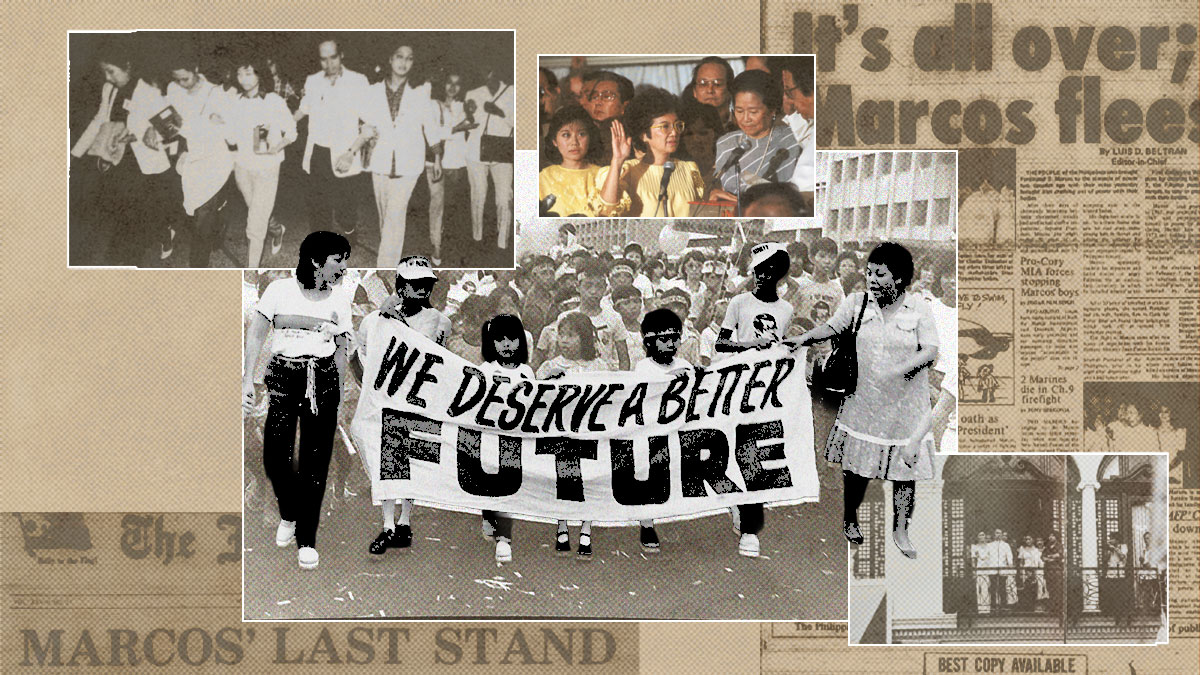
In early October, Senator Allan Cayetano jumped into the news cycle when he controversially called for a snap election. Seemingly by design, this move triggered comparisons to the historical precedent that changed the course of Philippine democracy. But where the 1986 snap election ushered in the People Power Revolution and toppled the Marcos dictatorship, Cayetano’s gambit has been dismissed by many as political theater.
Still, the term "snap election" carries weight in the Filipino psyche. Years of historical revisionism have muddied the collective memory of what 1986 truly felt like. In 2025, everyone under 40 will have had no first-hand experience of Martial Law or People Power. It’s therefore essential for our elders to pass down their testimony so that our generation, whose hands this country’s future is in, can be equipped to face those who may want to exploit our limited understanding of history for their own ends.
To revisit those pivotal days, we spoke to four people who were in their twenties in 1986, scattered across the country, each with a front-row seat to the energy, anxiety, and gravity of a nation on the edge. Their voices serve as living witnesses to a time we, as a country, dare not forget.
ALSO READ:
General Ver's Daughter Reckons with Her Father and the Legacy of Martial Law
On Bongbong Marcos and Martial Law Amnesia
Nino, age 23 in 1986
"There was already a groundswell of discontent against the Marcos regime from the grassroots before the snap elections. Still, the announcement from the dictator came as a surprise. Marcos called for a snap election after his live interview on American media. And it became a welcome opportunity for the opposition to make a significant change, even if they knew that they would be cheated out of it.
In Leyte, particularly in Tacloban, I participated in rallies and other activities moving for the change of leadership. There was a pushback from the [Marcos-related] Romualdez-controlled local government, with subtle threats against individuals. Someone told me I was on the black list in the governor’s office, though I couldn’t confirm this. But the groundswell couldn’t be stopped.
Unlike in 1986, the proposal for a 2025 snap election is a really stupid and desperate attempt by Allan Cayetano to change the narrative against plunderers. But Cayetano is being called on his bluff by his own brother: Resign first, be the example."
Meg, age 25 in 1986
"When Marcos declared the snap election, none of us thought anyone would stand a chance against him, least of all [Cory Aquino,] a shy, religious woman with almost no political experience. But there was really no one else. And when Chino Roces started the petition that practically begged her to run against Marcos, everyone immediately got on board and became unofficial foot soldiers for the Cory for President movement.
By everyone, I mean everyone in my family (including family members who weren't speaking to each other), neighbors, friends, students and faculty at all the Baguio universities, the nuns and priests that my Lola and Lolo knew, the Baguio market vendors, bank tellers, supermarket employees, the pony boys at Wright Park, the gogo dancers at the dive bars, the Dangwa bus drivers. We were all sick of Marcos and his gang of thieves, exhausted with fear and uncertainty, and desperate to have someone—anyone—lead us even if we had no guarantee they were up to the job.
While political rallies were energizing to attend (as long as you took all the promises with a grain of salt), it was the signature-gathering and canvassing at the grassroots level that really energized me and my friends. It was eye-opening to see how people, especially those on the margins, lived; to see how they managed on so little, to listen to what their hopes for a future were.
My Lola's way of getting people to listen to her was by feeding them, and what a shrewd and effective tactic that was! To this day, I still don't miss pancit after the marathon pancit cooking sessions I got roped into.
It was when the soldiers assigned to keep the peace in the mountains started trickling into town that I sensed things might be changing. The military under General Ver hadn't paid these soldiers their meagre salaries in many months, and they were bedraggled and starving and just right for turning.
We held daily vigils and protests around the Baguio cathedral to coincide with the ones at EDSA, and I still remember wonderful moments in the large feeding station in front of the post office (where Lola and her formidable cohort of other titas and lolas had moved their cooking/feeding operations) and seeing the most unlikely band of volunteers—among them nuns, street sweepers, teachers, sex workers, nurses, students, gay hairdressers, even expat wives—all chopping, stirring and cooking together because our collective future depended upon it.
I left the Philippines at the end of 1986 and have now lived away longer than I lived there. I personally see today's Pinoys as too fragmented and perhaps too lazy and apathetic to muster the same levels of energy and commitment that ousted Marcos Sr. in '86. But as I no longer live there and can't see the bigger picture, I would very much like to be wrong."
Ed, age 22 in 1986
"My feelings [during the 1986 snap election] were a mixture of anger, fear, and hope. Looking back, I realize it was trauma. The uncertainty was paralyzing. I guess at 22, the future looked so grim. I was planning out how to survive if a violent civil war broke out. So I volunteered for NAMFREL [National Citizens' Movement for Free Elections], went to the streets, prepared for violence, and made sure we had access to money, food, and a secure home.
At the same time, I did not have any trust in the politicians on both sides. As the events progressed, I became more hopeful that we would be more free and progressive, and better. But no, the old feudal and warlord values of the Filipinos kicked in. So here we are again.
As for the proposal for the 2025 snap elections, I think this is an attempt to stage a coup by the Duterte people and not a real grassroots movement by the people. It is just typical drama that I hope the Filipinos will not fall for again. A snap election is not the answer to our issues. The answer is actually holding to account the corrupt people.
The '86 snap elections came about because of pressure from the public and the international community. This one is a stunt from an opposition group. These guys are playing a game and hoping we are still gullible. The issue is not snap elections or stepping down from positions; it is the need to be held accountable for their actions and punished accordingly. Even if [politicians implicated in corruption] resign or step down, they should still be prosecuted."
Jojo, age 27 in 1986
"I was all for it. The public called for snap elections, and Marcos initially resisted to heed the public call. The country had been in great turmoil since Ninoy was killed in August 1983. Around that time, the economy tanked, and we failed to meet our obligations to the IMF for our debts. All our foreign loans became due and demandable. Military repression continued, and many were being arrested without warrants.
We were always on the streets for rallies and demonstrations. That was our existence when the government agreed to the snap election for February 1986. So we just went on with our lives, putting pressure on the dictator to leave the scene. Not much preparation was needed as the whole political and social milieu was amped up and groaning against the dictatorship after almost two decades of Marcos' [Martial Law]. Shortly after the election, the EDSA revolution happened as Marcos rigged the result of the election against Cory.
In 2025, I don’t think the call for a snap election is a serious attempt at cleaning government ranks. It is a Cayetano stunt whose goal is to get public attention and media mileage. The call for current politicians not to run in the election, while inviting, is unconstitutional, as we cannot legally prevent qualified candidates from running in elections.
In the Philippines, elections happen every three years. Back then [during Martial Law], elections also happened, but they were sham elections—rigged and controlled by the dictator. The proposal now to hold one is a distraction to the impunity of the Dutertes and the corruption in the Senate and the House. Let’s focus on the accountability of the guilty ones first.
Our generation handled our business then. Although we failed in ensuring that the following generations would learn the lessons of 1986. This new generation must now step up to deal with the current rot of our politics and society. My generation is senior citizens, but we’re still joining rallies and speaking truth to power. All generations should continue or learn to do the same to root out public evil and corruption."
What now?
The voices of Nino, Meg, Ed, and Jojo, while shaped by varying geographies, ideologies, and degrees of participation, converge on a set of hard-won truths. Their lessons have been forged both in hindsight and from first-hand experience in a moment when the future of the nation was genuinely uncertain.
First: that a call for a snap election must come from the people. Second: that distractions—no matter how emotionally resonant or headline-grabbing—should never pull our focus away from the issues at hand: corruption, impunity, inequality, and the erosion of democratic institutions. Third: that actual accountability must have legal repercussions, not just political and professional consequences. That is, the corrupt must face the law, not just the court of public opinion.
And finally, that the youth of 1986 have worthwhile lessons to impart to younger Filipinos today. They understood the stakes, saw through political theater, and demanded more. Our generation must stay just as sharp, just as critical, and just as unwilling to be manipulated by those who hope a vague memory of history is easier to exploit than an informed, engaged public.
History, when remembered clearly, provides a well-lit path to progress. At this crucial moment in our country’s history, forgetting is a cost we cannot afford.
