
Financial Adviser: 5 Business Lessons Everyone Can Learn from Olivia Limpe-Aw, Chairman and CEO of Destileria Limtuaco & Co.

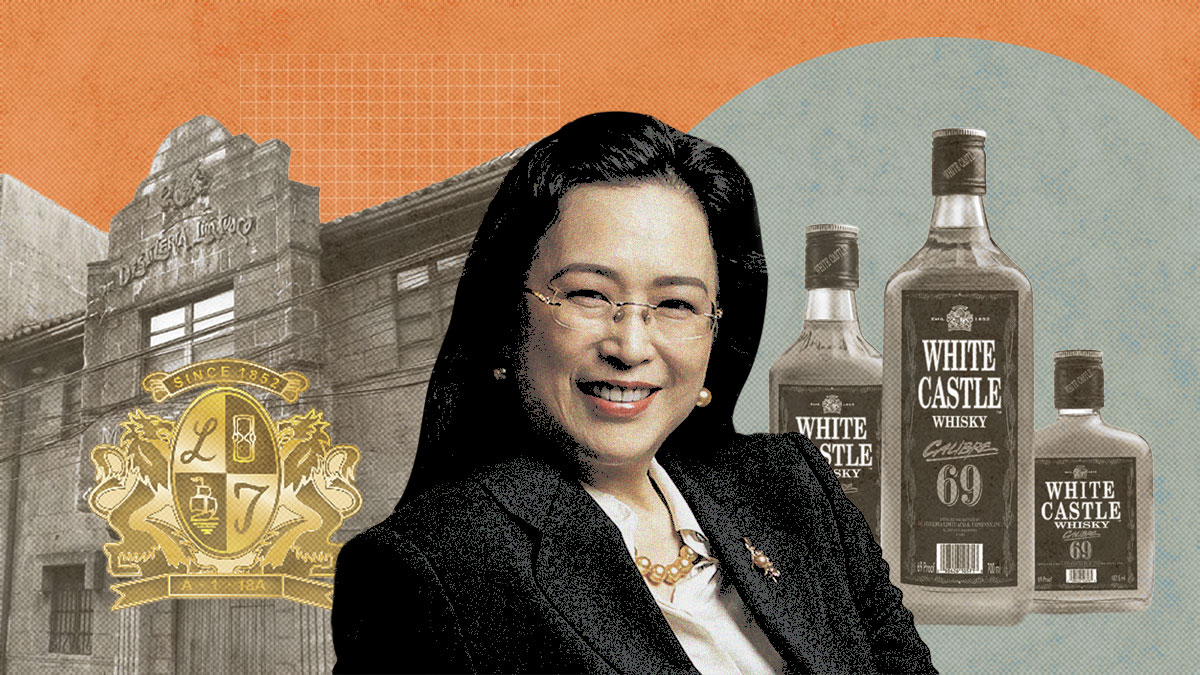
ILLUSTRATION: Igi Talao
Olivia Limpe-Aw stands as a trailblazer in the Philippine liquor industry. As the fifth-generation president and the first female chief executive of Destileria Limtuaco, she carries on a legacy that began more than 170 years ago while also steering the company into modern markets with innovation and a global outlook.
Born into a family business that has endured the test of time, Limpe-Aw grew up witnessing both the strengths and struggles of running a heritage brand. Her grandfather and father were central figures in scaling up operations, expanding the product line, and imprinting White Castle Whiskey into the Filipino consciousness through its memorable advertising.
By the time she officially joined the company in the 1980s, she had already been immersed in the business. This hands-on experience gave her a comprehensive understanding of the distillery’s inner workings.
In 2004, Limpe-Aw formally assumed the role of president. She succeeded her father, who had guided the business for more than four decades. Under her leadership, she professionalized systems, introduced ISO-based quality standards, and built a culture that combined instinct with control.
Recognizing that the liquor market had become more competitive and fragmented, Limpe-Aw led the company to diversify beyond mass whiskey. She spearheaded the creation of the Philippine Craft Spirits line, using distinctly local ingredients such as mangoes, coffee, calamansi, dalandan, and cacao.
Today, Olivia Limpe-Aw is recognized not only as the face of the country’s oldest distillery but also as an advocate of Filipino craftsmanship and women’s leadership in business.
Under her leadership, the 170-year-old heritage brand transformed into a modern enterprise that blends tradition with innovation. Her story reflects not only the preservation of legacy but also its reinvention as a symbol of national pride and global recognition.
How did Limpe-Aw take on the responsibility of leading Destileria Limtuaco after her father and grandfather? What major challenges did she face in keeping the company alive and competitive during her early years as president?
Here are the five business lessons everyone can learn from Olivia Limpe-Aw, Chairman and CEO of Desteliria Limtuaco & Co:
ALSO READ
1| Know how to grow a family business across generations
A family business often carries the values and traditions of its founders. Sustaining it across generations means preserving not only the products or services but also the story, identity, and reputation built over decades. Beyond being the cornerstone of generational wealth, a family business also instills responsibility in the next generation to protect and grow something larger than themselves.
The survival of Destileria Limtuaco was not just because the business was handed down. It endured because every generation contributed something unique.
Don Bonifacio brought the founding recipe, Lim Chay Seng navigated Spanish trade and diversified into gins and rums, James Limpe modernized operations with Western practices and introduced whiskey, while Julius Limpe industrialized production and created memorable branding. This layering of contributions meant the company never stood still. It was constantly adapting to the times.
A recurring theme in the family’s leadership was the balance between heritage and progress. By mixing tradition with forward-thinking innovation, the business avoided being trapped by its legacy.
The family members who took charge were not only custodians but also builders. They had vision. James brought modern business practices from abroad while Julius combined artistry with industrial invention. This dual mindset of vision and execution allowed the company to grow beyond survival into market leadership.
The key lesson is that a family business survives across centuries when every successor adds value, adapts to crises, and honors tradition while embracing change.
“We are the oldest distillery in the Philippines,” Limpe-Aw says. “We were established in 1852. The man who started it all was Don Bonifacio Limtuaco and he was our great-great-grand-uncle. He brought with him to the Philippines a family recipe, a secret family recipe for a Chinese herbal tonic called Sioktong. This later became the generic term for Chinese medicinal wine, but originally it was our brand name.
“It became very popular, and of course, when it became super popular, we had a lot of competition. They copied it, and eventually, parang Colgate, which became the generic for toothpaste, Sioktong became the generic term for Chinese medicinal wine. So the business was given to the son, but I think the son died young, ahead of him. So it was my great-grandfather, the nephew Lim Chay Seng, who took over the business. He became the second generation.
“Pamangkin siya. I'm not really sure exactly, but I think he bought the company from the uncle. Kasi wala naman descendants. And then, as part of Philippine history, we also became part of the commercial history of the country.
“During the Spanish time, it was said that he knew how to speak Spanish. He was a businessman dealing also with the Spaniards. And from there, we learned how to make Ginebras, the gins, the rums during that time.
“Then it was passed on to his son, James Limpe, third generation, my grandfather. He was one of the few Chinese back then who was able to study in the United States. He graduated from the University of Washington. And because of his exposure to Western culture and Western business practices, when he came back to the Philippines, he brought more modern ways of doing business. From his connections in the US, he was also able to work with an American company, and they introduced whiskey to the Philippines.
“So it was the brand Three Feathers Whiskey. He was the one who popularized whiskey in the Philippines. And during the war, this is also why we have a museum in Intramuros, he was one of those incarcerated in Fort Santiago. His name even appears in the roll call, as one of the prisoners of war during the Japanese time.
“Kasi there was an order, parang they heard that the Japanese wanted to take over all the distilleries. But there was an order from General Douglas MacArthur not to allow the Japanese to do that. So he was the only one who actually disposed of all his inventory. And for that, he earned the ire of the Japanese, who incarcerated him in Fort Santiago. Kasi nga, he didn’t follow the Japanese.
“So after that, the business was passed on to my father, the fourth generation, Julius Limpe. My dad naman was the eldest in a family of eight, the eldest son and the eldest child. And at that time, most of the business was passed on to the eldest. But he really wanted to be a research doctor. He was also an artist, as you can see from the paintings in the office, most of the works here are his. He was an artist and also wanted to be a research doctor.
“After graduating from the University of Indiana, he came back to the Philippines. Eventually, they asked him to take over the business. So he poured his passion for research into action in the field of liquor making. He even held patents under his name. He was the patent holder for the acceleration of aging of spirits, and this was not only patented in the Philippines but also in several other countries. So, he was an inventor. He was also the one who industrialized the company. I mean, he was truly an industrialist and the one who grew the business into what it is today. He was also credited for introducing whiskey to the masses through our flagship brand, White Castle Whiskey.
“And of course, the iconic advertisement of the girl on the horse, that was really his creation. He was truly a marketing man. Parang he was really like a renaissance man, kasi so many fields eh. Imagine, he could play the piano by ear and other instruments. But aside from that, he was also very hardworking and had a clear vision for the company.
“I think it was in the 1950s. Ilang taon na ba siya in the 50s? Ah, he was in his late 20s. The other siblings were doing their own thing. Kasi actually, when he inherited it, the business wasn’t so big yet. But he was really the one responsible for running the business. He was actually the one who really made it big. Siya talaga. He was the one who grew the business. I think he was more than a salesman. He was a very good marketing man, and also very good in operations and logistics. Pero salesman, okay din, he knew how to sell. Pero his love was really marketing. And he was also really strong in operations, magaling siya. He scaled up the business, he was really good in that.”
2| Know how to train successors from the ground up
Preparing family business leaders from the ground up is essential because it turns inheritance into true leadership. Successors who start at the bottom and move through different roles develop an understanding of operations and gain credibility with employees who respect leaders that have “walked in their shoes.”
This approach teaches humility, as authority rests on competence and effort rather than entitlement. It also gives them adaptability, since direct experience allows them to respond effectively in times of crisis.
Most importantly, this method lets them honor the values and traditions of the founders while also having the confidence to innovate. In this way, the next generation does not merely inherit a business, they become capable stewards who sustain and grow the family legacy for the future.
Limpe-Aw’s father prepared her not through formal grooming but through necessity. A workers’ strike in 1989 devastated White Castle’s market share and nearly crippled the business. Many companies closed, but her father insisted, “We will never close.” This principle framed her training that she was not being prepared for a smooth transition; she was forged in a crisis. The strike became the catalyst for hands-on succession.
Limpe-Aw did not step into a leadership role simply because she was the heir. Her father put her through a ground-up process. This immersion had two effects: first, it gave her practical understanding of every part of the business; second, it built humility. Authority became something to be earned through competence, not assumed through entitlement.
Limpe-Aw highlighted that her father had seven daughters and no sons, which was unusual in a Chinese business family where leadership traditionally passed to a male heir. Instead of abandoning the business or hiring outsiders, her father doubled down on training his daughters. This decision showed that survival mattered more than tradition, and his insistence on preparing her despite cultural norms revealed foresight.
“We had a very bad strike,” she says. “A very bad labor strike during the time of Cory Aquino. That was the time of militant labor, yung mga KMU. So our plants were closed for almost six months. And at that time, it wasn’t in fashion to have logistic centers in different parts of the country. Hindi pa uso nun. So although we had stocks in the market, it wasn’t enough to sustain demand for more than four to five months.
“Eventually, when you don’t have enough stocks in the market, there will be like…a black market for the brand. So the price went up too high and it was priced out of the market. And we lost almost all of our market share for White Castle. When we came back, after we started operating again, of course it wasn’t easy.
“At that time, a lot of companies closed down. But his motto was, we will never close. We will continue for the sake of the company, the family, and the people who were working for us so we had to continue no matter how difficult it was.
“He was already in his early 60’s during the strike, pero we really tried to bring it back. It was very difficult. That was 1989. We tried to revive the business. Although I saw the peak, I also and experienced the ebb. After some years, he asked me to take an active role. He asked me na to take over certain responsibilities. Kasi before, pa-easy-easy lang ako. I was still young.
“Since I graduated in 1983 officially, although even when I was young, I was always with him. During summer, he would bring me to the office. This was my playground, you know, I would just run around the office, parang I was his gopher. Naging secretary ako, basta every summer I was with him, so I thought he just wanted to bring me along kasi I wasn’t doing anything.
“But I guess it was already partly training and exposure to the business. Even when I was in college, even on weekends, he would still ask me. At that time, wala namang computers, you had to take down dictation when they wrote letters. I was still doing that for him. Even on weekends, on holidays, or during summer breaks. When I graduated, immediately I started working.
“I started as his secretary. My official job was his secretary. And then afterwards, he asked me to learn production. I went to the shop, to the production floor. I remember I was pregnant pa nga. I was learning production, buntis ako. I was there in the shop floor, and then I learned cashier work, treasury, purchasing, HR, finance. I did the rounds. Finally, after learning all the admin work, he said, ‘It’s time for you to learn sales.’ Sabi ko pa noon, ‘Parang I don’t want to do sales.’ At that time, I felt sales was embarrassing. I thought, ‘Let me do anything but sales.’ But sabi niya, ‘No, you have to.’ Sabi niya. Ah, okay. So I learned sales.”
Before the strike, I was just helping. Actually, I was doing a lot of finance stuff, mga simple things lang like checking vouchers, and then I would join him during meetings. I wasn't really responsible for anything, for any department. I was just learning the ropes by observing, by watching.
He had seven daughters, no sons. I’m the fifth in the family. Of course, in Chinese culture you want to pass it on to your son, but he had no sons. So it’s not the usual story.”
3| Know how to balance legacy and chance in a family business
Respecting family traditions while modernizing the business is important because it secures both continuity and growth. The old ways carry the values and credibility that form the foundation of the business. These traditions preserve identity and trust, which are difficult to rebuild once lost. At the same time, professional systems bring structure and efficiency and adaptation to new markets keeps the company competitive.
When these elements are balanced, the business avoids two dangers: being stuck in the past or abandoning its heritage. Instead, it builds on legacy while staying relevant in a changing world.
Limpe-Aw did not inherit the business with the mindset of copying her father’s methods. She understood that succession required discernment by keeping what worked from the past but discarding what no longer fit the present. This approach protected the company from stagnation. Her insight that “each generation will have to adapt” shows she treated tradition as a foundation, not a ceiling.
Balancing legacy and change meant facing resistance. Her father, a proven success, believed strongly in his ways. Instead of outright rejection, Limpe-Aw introduced changes with conviction and proved their worth through outcomes. She realized that in family businesses, persuasion does not come from argument but from proven improvement. This method allowed her to win her father’s respect without breaking family bonds.
Limpe-Aw also recognized that leadership is not static. Just as she pushed her own ideas against her father’s, she now accepts challenges from her children. By encouraging them to take ownership of decisions, she shows a willingness to let the brand evolve with each generation’s perspective. This openness keeps the company fresh while keeping the family’s presence intact.
“Succession is really like that, di ba?” she says. “Of course, my dad wanted me to do it his way. But I realized that each generation will have to adapt, take what was good from the previous generation and then adjust to what is happening today, and evolve. And when you become the older generation, you also have to adapt, kasi their generation will be different, too.
“It also depends on who is at the helm. Because each person is different. Even if we are our father’s daughter or our father’s son, we all have our own interests, our own ideas, our own temperament, and our own analysis of what’s happening and strategies on how to move forward. So we cannot totally adopt what our predecessors want. But we also cannot completely disregard what they have done. It’s a continuing thing, it’s evolving.
“So I introduced a lot of changes in terms of professionalizing the organization. Because we were really more like an entrepreneurial organization. After the strike, I saw there were cracks in the system. If it were really perfect, then we wouldn’t have suffered the strike.
“Those cracks meant there were things we needed to mend, things we needed to change for us to move forward. And of course, being the success that he was, I understand that my dad felt his way was the best, but you just have to stand your ground. If you feel strongly about something, you have to do it. Kasi even if he didn’t agree at first, once you show results that improve the performance of the company, eventually they will also learn to appreciate it.”
“I came in during the strike. We had so many people. When I took over, I was reducing the workforce, not adding. So from the best, we had to train them lang. I wasn’t really able to hire new professionals. I used a lot of my dad’s people. I chose the better ones, trained them, and eventually we hired more new people. It’s a process. You cannot do it na overnight.
We introduced quality systems. We tried to standardize with ISO 9001 in 1988. That was a long time ago. My dad was so mad about that ISO 9001 quality system. Sabi niya ‘What’s that ISO, ISO?’ Pero for me, I appreciated it. At least I wasn’t starting from scratch. I had a template to follow. It made my transition more organized, not so chaotic.
“If I did it by trial and error, I would have made more mistakes. So adapting to certain standards is a good way if you want to improve. Although the change part is difficult, the change management part is always the hardest. But imagine if I were creating my own system with so many mistakes while also dealing with change management, it would never have happened.
“Those were some of the things we did. In marketing, syempre, gusto niya yung way niya. But I felt my way was better because we were marketing to younger people. I was closer to that market. He was the older one. Pero now it’s reversed, ako na yung older, my children na yung younger. I wanted them to be here, to bring in fresh ideas. Sometimes they say my style is baduy.
“Sabi ko, ‘Fine, if it’s baduy, okay.’ I learned kasi we used to fight about that a lot. Now I try not to fight with them. I always tell them, ‘If you don’t like what I’m doing, and you have a better idea, then do it. Because if you just tell me you don’t like it and expect me to correct it, I can’t. I’m no longer your generation.’ There will always be generational gaps and you have to accept it.’
Kunyari because I’m a woman, the products I made are things I liked but maybe they weren’t necessarily what the hard drinkers liked. And so now, they’re making the stuff that they like, as more of the hard drinkers. So iba-iba talaga.”
4| Know how to reinvent a legacy after setbacks
A legacy carries heritage and identity, but when crises hit, whether through market loss, strikes, or shifting consumer tastes, that legacy alone is not enough to ensure survival.
Reinvention gives the enterprise a second life by aligning tradition with new realities. It allows the business to convert its setbacks into lessons, use its reputation as a foundation, and rebuild strength in areas where the old model no longer works. Without reinvention, even the strongest legacy risks fading into irrelevance.
After the strike nearly destroyed Destileria Limtuaco’s position in the mass market, Limpe-Aw understood that chasing low-price, high-volume customers was no longer viable.
Instead of clinging to the past, she reframed the company’s strategy by shifting toward mid-range and premium products where margins were healthier and the business could compete without the massive ad spend required in the mass segment.
Exports became her recovery engine, not only generating much-needed cash flow but also serving as a market laboratory where she could test consumer preferences abroad and bring those insights back home.
From this experience, she built a unique value proposition by creating the Philippine Craft Spirits line, which are liquors anchored in local ingredients such as mangoes, coffee, calamansi, dalandan, and cacao.
These products carried cultural stories that justified premium pricing and gave the company a distinct identity no competitor could easily copy.
Limpe-Aw also looked inward and realized the business had underutilized assets like Maria Clara Sangria, El Hombre, and Tosca Vodka. By promoting these existing brands more aggressively, she boosted margins without the burden of heavy new investments.
Her ability to leverage family-held formulas and patented processes functioned like a luxury house protecting its craft. At the same time, she aligned strategy with resources by recognizing that limited capital required discipline in choosing which battles to fight.
“Kasi before, we were really more of a mass product company. Tapos after the strike, we shifted to mid-range and up. Oo. Now we’re trying to rebuild kasi we lost our market share in the mass market. The mass market is really the cheaper brands. So when you lose it, it’s because the customers already shifted. It’s hard to win them back in value.
“It’s also because we couldn’t keep up with the demand. When we came back, we didn’t have as much marketing nor the capital to create. Kaya nga, it’s not only the length of time. When you suffer a setback like that, it’s like being devastated by war. So what do you do? Parang nag-break siya. We had to reinvent ourselves.
“You have to look at what you can and cannot do. Look at your resources. We went into exports. We exported our liquors. We exported a lot to Taiwan and then created more brands. We had brands, but mostly mass brands. So we had to shift to mid-range exports. Kasi when you’re a mass brand, you need volume. The margins are smaller, but you make up for it in terms of volume.
“But if you don’t have volume, how can you survive. We had to look at mid-range. Then we exported a lot of our liquor. We asked, what do we have? What can we do? We exported, we learned how to export. Then we created more products na, kasi from our export experience, we found out what people were looking for, so we created these mga specialty drinks na.”
“The biggest brand was Maria Clara Sangria. But that was my father’s creation. Then we had other drinks for Horeca, like El Hombre. We have Tosca Vodka. We have our line of Cordials and Spirits. All of these were my father’s brands. But before, we weren’t really promoting them. Now we have to promote them. Kasi, we have better margins, and there’s an opening there parang there was a chance to dominate that market.
Syempre, we’re the oldest distillery, we know how to make good liquors. And because we’re the only ones still owned by the family, our formulas, our patented processes and techniques, and our manufacturing processes are still with the family. So we know what we’re doing. It’s like a luxury house where they keep everything within the house. It’s easier for us to innovate and come up with new things.
“Before, all the liquors were really just more standard drinks. Now, we use real mangoes. This is the line we call Philippine craft spirits. We coined that term, meaning it’s a craft-made product using real ingredients found in the Philippines.
“People would always ask me: what can you offer us that’s uniquely Filipino? So I thought, I should come up with something that you can't question me why I'm doing it. Because it's something the Philippines is known for, like, I put together mangoes, which is I believe we have the best mangoes in the world. And because we're a sugar-producing country, we use rum as a base. And it started that. And after that, we came out with coffee, Amadeo Coffee Liqueur. We use the four kinds of coffee beans found in the Philippines. Yung Arabica, Robusta, Iberica, Excelsa. And then, we have Manila Liqueur De Calamansi. It's like limoncello, but instead of using lemons, we don't have really that much. We use what's endemic to the Philippines, which is calamansi.
“And then, we came out with dalandan. Tapos, we have yung Intramuros Liqueur De Cacao. We thought, why not chocolate naman? So we use the real cacao beans made into a chocolate base. And we use brandy as the base for the liquor. And we called it Intramuros because it was the seat of power during the Spanish regime. We use what, there's always a story behind it. We use brandy because it was what was introduced to the Philippines by the Spaniards. And they were also the ones that introduced cocoa, that chocolate to the Philippines. Chocolate talaga. In fact this one, this is the best chocolate liqueur in the world kasi we use real ingredients. We use real cacao. You get what you pay for. You want the real thing, you want real ingredients. It's more expensive talaga.”
5| Know how to preserve a good name above all else
Protecting one’s reputation is important because it is the foundation of trust in business and in life. Wealth or assets can disappear in a crisis, but a respected name continues to open doors, attract partners, and command loyalty.
A good name signals integrity and reliability, which are qualities that set a business apart in any market. It also carries weight across generations. Once a name is tarnished, rebuilding trust becomes far more difficult than recovering money or assets. By preserving a good name, a business safeguards its most enduring asset, which is the confidence of its people, its customers, and the community it serves.
In Limpe-Aw’s account, the preservation of a good name was never left to chance. It was embedded in how the family ran the business. She entered the company not for status but out of duty to lighten her father’s burden, which signaled stewardship rather than ambition.
This sense of responsibility shaped credibility with employees and partners, who trusted her intent. The family also practiced strict rules on risk, always keeping backup plans to avoid catastrophic failures that could tarnish their reputation.
Financial prudence reinforced this approach, which ensured obligations to workers and suppliers were met consistently. In negotiations, the principle was to be fair but firm by walking away from one-sided deals that could compromise trust. These habits which are passed on to the next generation, ensured continuity of values across leadership changes.
“If I had a choice, I would have been in the beauty business, not the liquor business,” Limpe-Aw says. “What I really wanted at that was just to help my dad. I just really wanted to help lighten the burden and help him. That was all.
“My mom always pushed me to help my dad. It was really my mom who kept telling me I should help him. My mom played a very important role. She would always say, ‘Your father has no sons. If this business doesn’t succeed, people will say it’s because he had no sons. We don’t want that.’ So she was really the one who pushed, and really put some sense into my head that I should do it. Not because I wanted anything grand, but just to help my dad who sacrificed so much for the business.
We always take calculated risks. Oo. And we don’t invest in something na, if this fails I have no use for it na. You must always have a backup plan. If this fails, what will I do with it? If you’re just banking on an investment in something, and if that fails, it’s zero na, zero option—that’s not a good investment. You must always have a what if. The failure thing should always be there, and the option thing should always be there. So you don’t really lose your shirt.
“The number one thing my dad always taught us was the best thing you can leave your children is a good name. That is what I always remember. Whatever you do, you must make sure you never tarnish your name. That was his guiding principle. And he always took good care of his people kasi even if you’re the best businessperson, but you don’t have a good team and you don’t take care of your people, you’re nothing.
“I think those were the two most important. He was always better than me. He remembered all their names pa nga, eh. He would go to the factory and remember the names of the factory people. And then the third, management by walking around. He would always do inspections.
“In terms of money, I always advise my children to never spend more than what you can afford. Kasi dangerous yun. Conservative kami when it comes to money. Always be fair pero don’t be bullied naman. Always try to make it mutually beneficial. Minsan, if it’s too one-sided, just walk away. It’s okay. The point is to do business, but if you’re not making money na, then why?”
