

Financial Adviser: 5 Business Lessons Everyone Can Learn from Margarita Fóres, Founder and CEO of CIBO

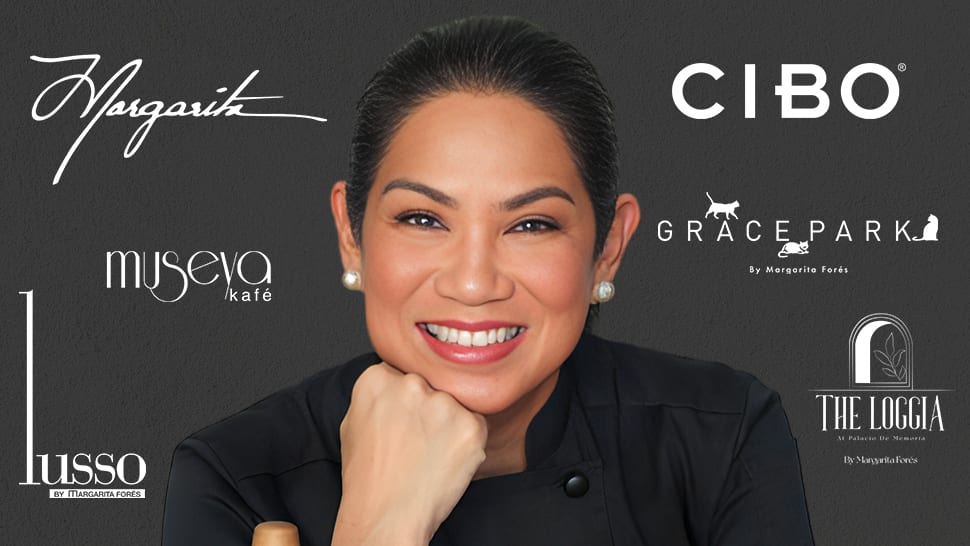
Margarita Fores, who was once hailed as “Asia’s Best Female Chef,” has made a significant impact in the culinary world with her innovative approach to both Italian and Filipino cooking and her relentless quest for excellence.
As a culinary icon, Fores has remained true to her roots while continuously pushing the boundaries of Filipino cuisine.
Fores grew up as part of an Ilonggo family, where food and gathering around the table were central to their lives. However, when her family went into self-exile during Martial Law, they moved to the diverse culture of New York City in the 1970s.
Fores was fascinated by the advanced and trendy food scene in New York, particularly the influx of young Italian chefs and restaurants serving modern Italian cuisine, rather than the traditional Italian-American fare. This exposure to Italian culinary culture greatly intrigued her.
When her family returned to the Philippines in 1985, Fores decided she wanted to seriously pursue her interest in Italian cuisine. She traveled to Italy, took cooking courses, and immersed herself in the regional food cultures, particularly in Florence, Rome, and Milan.
Upon her return to Manila in the 1990s, Fores began experimenting with new food ideas at her uncle’s restaurant in Cubao, which helped her launch her catering business. After 10 years of growing the business, Fores decided to open her own restaurant called Cibo in 1997.
Cibo quickly became very successful in its first year, with customers willing to wait in line to experience the new authentic Italian café. The success of Cibo encouraged her to expand her outlets every year.
Today, Cibo is one of the largest authentic Italian cuisine restaurants in the country with 30 outlets. Over the years, Fores also developed other culinary concepts by reinventing traditional dishes with her signature flair, such as Lusso, Grace Park, and her signature restaurant, Margarita.
How did Fores successfully transition from a catering business to opening her own restaurant, Cibo? What strategies did Fores implement to maintain the quality and authenticity of Italian cuisine across multiple outlets of Cibo while scaling up her business?
Here are the five business lessons every entrepreneur can learn from Margarita Fores, founder and CEO of CIBO:
ALSO READ
1| Know how to follow your passion and adapt
Following your passion in business is important because it fuels your drive, motivation, and commitment to what you do. When you're passionate about your work, you're more likely to persevere through challenges, innovate, and strive for excellence. Passion can also inspire others, attract customers, and differentiate your business in a competitive market.
Because the business landscape is constantly changing, adapting allows you to stay relevant and seize new opportunities. It also enables you to respond effectively to changes in the environment and maintain your competitive edge.
Fores followed her passion by immersing herself in the vibrant food culture of New York City. Despite being uprooted from her familiar surroundings in the Philippines, she embraced the diversity and innovation of New York's culinary scene. Her exposure to the Italianization of New York, with its modern Italian restaurants and concepts, further fueled her interest in Italian cuisine.
Moreover, Fores adapted to pursue her passion by cooking for her friends at night, despite her primary focus on the fashion aspect of her job during the day. This duality in her interests and activities showcases her ability to balance her professional responsibilities with her personal passions.
Fores also demonstrated adaptability by seizing the opportunity to pursue her newfound passion for Italian cooking by taking the initiative to travel to Italy, where she enrolled in cooking courses and immersed herself in the regional food cultures of Florence, Rome, and Milan. Her solo travels allowed her to deepen her knowledge of Italian food and culture while contemplating her future career path.
“I was a regular young Filipina from Assumption and was a super food lover because my family is Ilonggo, so our lives revolved around Ilonggo food and celebrating around the table,” she says. “When my family went into self-exile during the martial law years, it was kind of like a whole new experience because we were transplanted from the Philippines, and New York was such a big melting pot.
“Whatever it was that you wanted to see about, let's say, food, New York would probably be the most advanced. They had everything, all the trends, all the new places in New York City, so I think that was a real blessing because I experienced a lot of things.
“During that time in the early 70s, there was also kind of an Italianization of New York. Things were not great in Italy so a lot of young Italians were moving to New York, doing things not like the typical Italian-American restaurants with Chianti bottles hanging from the ceiling or garlic and the red and white tablecloths. They were doing modern stuff like thin-crust pizza restaurants, fresh pasta and northern Italian concept restaurants, and that kind of piqued my interest while I was there.
“Then I was able to get a job and work with the team of Valentino. Working for such an iconic Italian brand taught me a lot about how to build a brand, and it also made me fall in love even more with Italian culture and the Italian sensibility.
“I met a lot of Italians who were working for Mr. Valentino, and my jobs were like odd jobs. I was like a desk girl. I would cut the clippings from Women's Wear Daily every morning, the tags and anything related to Valentino. That was my job. At the same time, if Mr. Valentino was in town and he needed flowers or food for his dogs in his apartment, we would take care of that, so I think that, just being around in that environment, I kind of fell in love with everything Italian.
“And what happened was, at nights, I would cook for my friends. I always wanted to try to make pasta. It was really funny because I love the fashion part of the business, but what I was doing at night was what really made me happy, whether I was setting the table and cooking for friends or going to my grandfather's place in upstate New York on the weekend and inviting friends over so we could cook, go to the market, buy things, and cook and set the table. I think that was what really got me in the gut. That's what really excited me, so that was when I was starting to really fall in love with what I was doing.
“And then in November of 1985, suddenly my grandfather passed away so we all kind of uprooted ourselves again and went home to Manila. I kind of felt, ‘oh my God, it stopped everything that I was doing, everything that I was getting excited about.’
“After my grandfather passed away in November, we were there during the months leading up to the revolution in February. That was an incredible time to be in the Philippines. After that, when the revolution was already done, I told my mom, 'I really want to do this cooking thing.' I said, 'Will you allow me to find a teacher in Italy that I can learn from and maybe see if I can take cooking courses and see if this passion for making Italian food is something that I really want to pursue?' So that's what happened.
“I went to Florence. I was there for only four months, from September up to December, and I took a cooking course for about three and a half weeks. I would do the cooking courses in the morning and then in the afternoons do language courses or go to the market.
“After the three-week course was over, I traveled around the area by myself. I would drive, so I took a course with another signora in Rome, a little bit south of Florence, and then at another time, I went up north to Milano.
“These regions of Italy were the ones that I really fell in love with. What was more effective in making me fall in love with what I was doing was that I was by myself during a time of introspection. I was 24 years old at that time, and I would escape and drive by myself, learning so much more about Italian food and culture, but at the same time, thinking about what I wanted to do.
“I love fashion, but I think the feeling I got every time I was in front of a stove cooking for people was real. It was a way for me to fulfill the maternal instinct within me as a woman—the idea of being a nurturer and making people happy through food. It was the passion that made me truly happy.
“Fashion was great, and I learned a lot from my mom. I loved it, but it didn't give me as much fulfillment and happiness as cooking a great plate of pasta and serving it to friends did.
“Maybe it was because of my exposure in New York during that time when Italian cuisine was hot and hip. I don't know, maybe, as I always say, I was Italian in my past life. It was always Italian at the start. So I think maybe I was drawn to the culture.”
2| Know how to identify market trends and convert them into profitable opportunities
Being able to identify emerging market trends allows businesses to stay ahead of the competition. By recognizing shifts in consumer preferences early on, businesses can adapt their products or services to meet evolving demands, gaining a competitive edge in the market.
Market trends often signify changing consumer. Leveraging these trends enables businesses to innovate and develop new products or services that address emerging requirements. Innovation drives growth and helps companies stay relevant in dynamic markets.
Fores identified emerging trends by observing the modern Italian café culture during her time in Italy. She noticed the rise of panini and short-order restaurants, which were gaining popularity in cosmopolitan cities like Milan. Her ability to recognize the potential appeal of this concept in Manila demonstrated her visionary approach to business.
To prepare for this opportunity, Fores engaged in hands-on experience at her uncle's Italian restaurant, where she experimented with innovative culinary ideas. This entrepreneurial trait of experimentation and willingness to explore new ventures underlined her proactive attitude towards business development.
By conceptualizing a unique café concept that combined Filipino authenticity with Italian cuisine in Cibo, Fores showcased her ability to identify market gaps and capitalize on them effectively. The overwhelming success of Cibo's inaugural year affirmed Fores' business acumen.
“When it was time for me to come home to Manila, I went to my uncle Jorge, the brother of my mom, who had an Italian restaurant at that time in Ali Mall. It was called Trattoria Uno. I told him, ‘You know, I have all these new ideas. If you want, I'll work in your kitchen and I'll do the new food and serve it there’, so that's where I started.
“I was very lucky because after a few months the general manager of the Hyatt invited me to organize a food festival and that kind of launched my career. The festival actually became so successful that the hotel decided to do another run six months after.
“Everybody was super impressed with my food, so that's when I started my catering. Actually, it was small-scale catering. I would cook in people's homes and host intimate dinners, just with me and an assistant bringing all the ingredients to cook on-site. But, of course, at that time, I mean, I was getting so much attention. People were saying all about my food, how good it was, etcetera, but that's when I learned the hard lessons about this business—that it's not all about the glamour in the front of the house.
“The business is all about discipline and hard work, so there were times when I would be late for work, especially for catering jobs, which was very embarrassing. I'm just really lucky that many of my clients at that time were very understanding and supportive.
“So eventually, I went through a period of introspection, asking myself, 'Am I just going to continue partying, or am I going to turn this into my career?' This was in the late 1980s and early 1990s, and my catering business was still small and erratic. It was then that I realized, 'Oh my God, I have to either get my act together, or if this is just playtime, I need to stop.' If I truly wanted to pursue this as a career, I knew I had to commit.
“So that was also the time when I had my son. In 1990, Amado was born, and I think that also kind of brought me down to Earth and made me realize I'm now responsible for another life. Right? So that's when I really became more judicious and more hardworking. I decided to reorganize my business. My catering business started to grow, and it took me 10 years to decide to open my restaurant, Cibo, in 1997.
“Opening a restaurant was always in the back of my mind. During the time I was in Italy, the Italian café culture was just starting. The modern Italian café culture with panini and short-order restaurants. You see, Italian food is so traditional. They like to eat only the way they like to eat, so even lunch or dinner is very traditional—long meals, etc.
“But the café culture was starting in Milano because it became super cosmopolitan. It was a business city, where panini culture started. When I experienced that while I was there, I really wanted to bring that to Manila.
“So I started to conceptualize a café concept. I got the space in Glorietta to do Cibo. It was an open-area café in Glorietta. It was the first of its kind, actually, because at that time in the malls, most of the restaurants were like TGI Friday's and other American franchise concepts.
“I really wanted to create a Filipino homegrown concept but with authentic Italian cuisine. When it opened, the store did so well, and we were very happy with the market’s response to the concept. I was super overjoyed. We had lines and we gave people numbers to hold because they were willing to wait in line. I think the market in Manila was very appreciative of something new. The success of Cibo in its first year in 1997 was very important for me, and it was a real dream come true.
“Spinach dip, Penn al telefono, and Tagliata di manzo are the three iconic recipes that I started with when we opened Cibo, and I think it's just wonderful that it validates the fact that those key recipes from the beginning are really the ones that have become the cornerstone of the business.”
3| Know how to develop a brand focused on consistency and authenticity
Consistency builds trust with customers. When a brand delivers consistent experiences across all touchpoints, customers feel confident in the brand's reliability and credibility. Authenticity further strengthens this trust by demonstrating honesty and transparency in brand messaging and actions.
Consistent and authentic branding promotes customer loyalty. When customers know what to expect from a brand and feel a genuine connection to its values and identity, they are more likely to become repeat buyers and brand advocates.
Despite facing pressure to compromise on the product, Fores remained steadfast in her commitment to authenticity. She insisted on maintaining the integrity of the food and ensuring it stayed true to its Italian roots.
Her dedication to quality and authenticity was a key factor in the success of Cibo. In a market saturated with Americanized versions of Italian cuisine, Fores recognized the value of offering customers a genuine, unadulterated Italian experience. She understood that compromising the authentic Italian flavors and preparation methods would undermine the very essence of what she was trying to create with Cibo.
Recognizing the importance of consistency in building trust with customers, Fores implemented systems and processes to ensure that the quality of food and service remained consistent across all Cibo branches.
From the beginning, she prioritized building a strong service culture that would set Cibo apart, investing in training and developing her staff to deliver exceptional service, which contributed to the overall customer experience.
“’Cibo’ means food in Italian,” Fores says. “It means sustenance. I also chose it because it sounds like ‘chibog’ from the ‘70s. When I showed that name to some Italian friends in the late 1990s, they said it wasn't a term Italians would use as a brand because it’s parang so generic.
“It means food lang, you know, Italians often prefer names like a person's name or ‘Osteria Antica’ or something similar. But it's funny, after 27 years of Cibo, so many other Cibos have come up, even in the States. In airports, in New York, there's a brand called Cibo.
“There was always a big temptation to compromise on the product because I had a lot of clients who would say, ‘Bakit hilaw yung pasta nyo? Bakit matigas? But that's Al Dente right?’ At the same time they would say, ‘Yung Bolognese, bakit hindi matamis?’ You know naman Filipino palate likes a sweet meat sauce? But I was very kind of adamant about being true to the concept and to making the food very authentic. I was very strict about that.
“And I think it paid off and people appreciate Cibo for its consistency. I believe that if you visit any Cibo branch, you'll hear people say that the quality is consistent system-wide. I think what's more important than just the food quality is the kind of service we provide to our clients.
“We've built a service culture from the beginning, and it makes me happy when people tell me, ‘Oh my gosh, your waiters are just amazing!’ It's challenging to maintain that level of service culture across 27 stores. I think that's what's even more important to me—not just that the food is consistent and good—but that the whole experience, because of the service, makes it a brand that people really look up to.
“That’s why we've created a system already. We make sure that the consistency is maintained store-wide. I work with the team as well, and we've also hired some other people to strengthen the back of the house. We have an executive chef who's young and who knows exactly how I want things done. We’ve also hired other specialists, like nutritionists, to make sure that the food composition and nutritional facts are in place. At the same time, we also make sure the concept is vibrant, so we always add new food items every few months.
“We also do a lot of research. We travel to Italy quite often, and I bring the staff with me. I believe it's important for them not only to experience the food culture in Italy but also to understand why they do what they do. I mean, I can give them cookbooks and recipes, but it will never be the same as bringing them there and letting them experience the culture and see the value of ingredients. This helps ensure that they can translate that knowledge here in Manila for our clients.
“Quite often, I would bring my staff when, for example, we had a lot of clients telling us, 'Oh, why don't you do pizza?' So I said, 'Well, you know what, I'm not going to do pizza until I learn from the source.' We went to Ischia to learn from a pizza master, and I brought our team with us to learn how to make the dough and understand how the climate affects your product, etcetera, because making pizza in Italy is very different from making pizza in the Philippines.
“I've always integrated taking trips to bring our staff there. It's a big investment, but for me, it's so worth it because when you bring them back, I feel like I've made little versions of myself, right? To help execute the food the way I would.
“We're very lucky to have a lot of food importers as our partners with whom we work closely. We've built relationships with them for many years since we started. There are certain brands that we don't compromise on. We work only with certain brands.
“For example, De Cecco for our pasta, Lavazza for our coffee, and Baloney for our prosciutto. We're fortunate that their Filipino counterparts bring these brands in, and I feel that they are cornerstones of our business because they're iconic Italian brands. I would never exchange them for anything else just to cut costs. I find that there are certain things that you need to invest in, and using these iconic brands is of utmost importance in the business.
“I think we know where to work on cost with the ingredients that we get locally. There are already many producers who supply us with greens, herbs, vegetables, fruits, and meats. So it's really just a matter of being open and always being willing to try new suppliers and work with the farmers as well. We're always open to new producers who come along.”
4| Know how to lead with humility and cultivate a growth mindset
Humble leaders acknowledge that they don't have all the answers and are open to learning from their experiences and from others. This mindset fosters a culture of continuous improvement, where individuals and teams are constantly seeking ways to enhance their skills and performance.
A growth mindset encourages adaptability and resilience in the face of challenges or setbacks. Leaders who embrace this mindset are more likely to view failures as opportunities for learning and growth rather than obstacles.
Despite her years of experience, Fores remained open to new ideas and evolving practices. She acknowledged the need to adapt and evolve with the changing times, demonstrating humility by recognizing that what worked in the past may not always be effective in the present.
Fores prioritized long-term sustainability over short-term gains, showing humility by prioritizing values and principles over immediate profitability. By investing in organic produce and promoting sustainable practices, she not only led by example but also inspired others in the industry to follow suit, contributing to broader positive change.
“Well, if I didn't have a great team to whom I could cascade everything, I don't think I'd still be around,” she says. “It's important to ensure that my team understands me and knows how I think, and I make sure to touch base with them consistently. Many of them have been with me for a long time, so they know how I want things done, which really helps.
“The ones that don't fit well with us always end up leaving. So it's the ones that endure and stay, those who are proud to be part of our team. We have a lot of people who have been with us for a long, long time
“I think that as a leader, my management style is focused on engaging their participation, always encouraging them to give me suggestions on how to improve things. I believe that the best lessons we can learn are not so much from our successes, but mostly from our failures. The lessons we learn from failures are the bigger lessons that endure and can help us move forward to be successful in everything else that we do. I always emphasize that learning should never stop.
“I think the minute you believe you know it all, that's the end of your growth. I'm also very happy that we've invited a lot of younger people to join our team because the market is young, and they think differently. I'm 65, and my son is 33. I feel that, for example, watching how my son runs his business teaches me a lot. It's always great to remain open to learning because the world has changed so much.
“I can't keep thinking of the way I used to do things from the beginning. I believe you need to evolve and see what works for today. So, I think that kind of openness will allow you to stay in the business for a much longer time.
“We always feel it's important to try to use what's internally generated. We don't really like to expose ourselves too much, and I think that's pretty much what we've been doing in the many years that we've been in business.
“There are other things, though, like when Cibo started using organic produce. Of course, the bottom line is always what you're watching, but sometimes there are things where the bottom line may not be the most important thing.
“So if your costs go a little bit higher because you're using products that are healthier and more sustainable, I think that in the beginning, it's always good to invest in that. Because what happens is, if you help lead the industry in that aspect, eventually the costs will go down because if more people use it and you encourage and inspire other people to use it, then it becomes more easily accessible.”
5| Know how to instill time-honored values and work principles in business
Businesses grounded in humility, hard work and passion promote a culture defined by integrity, resilience, and purpose. These foundational values not only fortify the organization against challenges but also empower it to flourish over time.
Fores instills the values learned from her parents by advising her son to remember his roots and approach business with humility and hard work. Despite her father's dream for his children to pursue medicine, Fores followed her passion for cooking, demonstrating the importance of doing what makes one happy.
Similarly, when her son decided to venture into the restaurant business despite not being a cook himself, Fores supported him and provided guidance when needed, reflecting her belief in following one's interests and making the most of opportunities.
“My mom was very liberal, and so were both my parents,” Fores says. “They never really forced us to do things. My father, Raul Fores, was a surgeon, like his father. He was the medical director of Makati Med. Of course, his biggest dream was for one of his children to become a doctor. I'm sure it broke his heart that none of us ended up pursuing medicine. In the end, I guess all of us found our own passions.
“I just wanted to do what made me happy, which was to cook for people. That's really how I started. All my life, I was never a planner; I just make the most of whatever is in front of me. Wherever the world takes me, I follow my heart a lot, and I just make the most of whatever is there.
“I was quite surprised when my son decided to open a restaurant because he doesn’t cook. He just hires good people to cook for him. He asks me for advice when he needs it, especially because his main restaurants are Italian. A Mano serves fresh pasta and pizza, and then there's Ramen Ron, which is Japanese. Recently, he opened a steak restaurant called Steak and Fries.
“He studied political science in college. So I guess his interest in the business was born out of exposure to me. He feels that he can also make his mark in the industry. Apart from what he learned from me, I think he also has many ideas for improvements. I help, but mostly in the background, only when he wants advice.
“What I always advise my son is something I learned from my grandfather. Remember how you started and where you came from, number one. The other thing would be to do things with a very humble heart. There's always a tendency, especially when you're successful, to forget that the business only succeeds with a lot of discipline and hard work. It's not about the accolades from the front. So, always be humble and willing to work hard.
“And he does. He works very hard, which is great to see. I don't even have to tell him because he realizes that success in business entails a lot of hard work.”
Henry Ong, RFP, is an entrepreneur, financial planning advocate and business advisor. Email Henry for business advice [email protected] or follow him on Twitter @henryong888
