
For Members Only: The Splashy Opening and Slow Collapse of the Playboy Club in Manila

Some might argue that the glory days of Playboy are behind it, but no one can dispute its influence on many facets of our culture. The magazine that was started in Hugh Hefner’s garage and kitchen in the 1950s has become a multimedia empire, launching the careers not just of the women it featured, but also of artists, writers and photographers.
Also read: The Haunting Story Behind the Mansion in Silay City, Negros
It wasn’t long before the brand soon branched out into numerous other pursuits—television, film, books, and eventually, even Playboy Clubs.
The first Playboy Club opened in Chicago in 1960. The idea was simple: bringing what the magazine offered to life, and giving men the chance to live and breathe it for themselves. Within a year, some 50,000 people signed up for a membership at the club.
A Vanity Fair article on the history of the Playboy Clubs quoted an informational packet sent to members of the New York club during its heyday in the 1960s: “Step into the Playroom”—one of the multi-leveled club’s different areas—“and the wonderful world of Playboy is yours! Against a background of brilliant, illuminated covers from Playboy, the joie de vivre depicted within the world-famous magazine’s pages comes to life.”
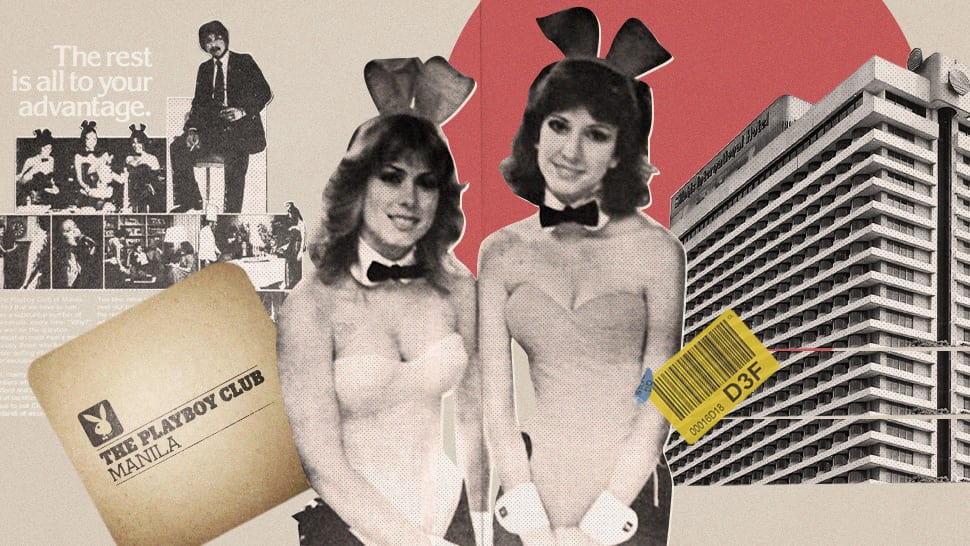
The old Silahis Hotel in Manila. You can see the playboy Club to the right

Playboy Clubs mushroomed all over the United States and the world soon after—in places like New Jersey; Wisconsin; Los Angeles, California; London, England; Nassau, Bahamas; four locations in Japan; and one in Manila.
Playboy Club in Manila
The Playboy Club in Manila opened on August 26, 1978 at the old Silahis Hotel along Roxas Boulevard. Designed by prominent Filipino architect Francisco “Bobby” Mañosa, the club's opening was a splashy affair attended by the who's who of Manila at the time. The Silahis Hotel’s owner, Leandro “Biboy” Enriquez, secured the local franchise in what was to become the only Playboy Club in Southeast Asia for many years. According to the book, Teacher to Tycoon: The Life and Times of Trinidad Diaz Enriquez, the idea to franchise the club was born out of a trip to the 1977 convention of the National Restaurant Association in Chicago.
Like other clubs in the world, the Playboy Club in Manila was members only. Memberships were offered and sold to businessmen, executives, diplomats and other VIPs.

“From 5,000 applications, an initial 3,000 members were approved,” according to Alex DR Castro, in his blog Isa Munang Patalastas. “Members were asked to abide by the rule: ‘Just look, don’t touch.’”
The strict rules didn’t just apply to patrons, but also for the so-called Playboy Bunnies—the women who entertained and served the club’s (mostly male) customers. The Bunnies had a very specific uniform—bunny ears, a fluffy white tail on a tight corset that showed off an hourglass figure, bowtie, collar, cuffs, and black pantyhose. They went through rigorous training and were told to watch their weight.
“You had to stay within five pounds of your hiring weight,” former Bunny Pat Lacey told Vanity Fair. “[If you went over] you would be asked to lose whatever the amount was—and it would be documented. Everything was. But you were always given time to correct the situation.”
“In our day, you could be dismissed for being too fat, too thin, too old,” added Marilyn Cole Lownes.
And it wasn’t just the weight. “According to section 520.2.7 of the Bunny Manual, (there could not be) “mingling, fraternizing, socializing, any physical contact, dancing or any other form of mingling by any female employee with any patron or guest,” under penalty of dismissal,” according to Vanity Fair.

Exacting standards
The club itself was divided into sections, each one offering its own attraction. There was the Cabaret, where entertainment programs were staged; The Playmate Bar, a lounge that was “the perfect setting for private talks;” the VIP Grille Room, which was a venue for “world-class cuisine;” and the Bunny Bar, for a more casual, laidback atmosphere.
There was also a health club, complete with a gym and swimming pool; a game room; boardrooms; an outdoor terrace; and a gift shop.
The club boasted of its “exacting” membership standards.

“We want members who are in a position to afford and truly appreciate the kind of facilities and services unique to our club,” an old newspaper ad said about its membership requirements. “Men whose standards of excellence are as exacting as ours.”
Apparently, the club was so glamorous and ostentatious that, for a long time, it was the only Playboy Club ever featured on the prestigious magazine Architectural Digest. (The reopened club in New York in 2018 has since been featured as well).
Because the Playboy Club in Manila was the only one in the region, it was also patronized by gentlemen from neighboring countries. Of course, most of its clientele were the elite from the Philippines’s own business, political, and diplomatic circles.
“Ferdinand ‘Bong Bong’ Marcos, son of the former president, was seen often in the club's Cabaret Room,” said this old article from the now defunct news wire agency UPI. “Other well known politicians and businessmen trysted with their mistresses in the notorious Playmate Bar.”
Beginning of the end
The Playboy Club in Manila thrived for years, but the 1980s brought with it new winds that upended the Playboy business on multiple fronts. Competition from other magazines gave the flagship Playboy title a run for its money, and almost every other subsidiary—publishing, films, music, even a modeling agency—had been losing money. That included the clubs.

The end began on July 1, 1986, when Playboy closed its last three company-owned clubs in New York, Los Angeles, and the original in Chicago. Franchised clubs held on for a few more years, including the one in Manila.
In August 1988, soon after the last Playboy Club in the US—in Lansing, Michigan—closed its doors, only the clubs in Japan and Manila were open. But even then, the Manila location was already showing signs of wear and tear.
“On a recent Saturday night only 20 to 30 patrons were in evidence, served by a disconsolate trio of bunnies, two of whom needed a drastic redistribution of weight to fit the Playboy image,” writer Jervina Lao wrote for UPI. “Service was slow and surly. Instead of society figures, the customers were middle-aged, middle-class male tourists hosting cheaply dressed bargirls from the neighboring red-light strip.”
An interview with the former club manager Sylvia Rushbrooke revealed that job security had made the Bunnies “sloppy and lax toward their customers.”

“Here you end up getting girls who are 32, 33 years old who are not really suitable as bunnies any more,” she said. “There is also the problem of older bunnies bullying younger bunnies.”
Rushbrooke also said Enriquez, the club’s owner, refused to put up money for redecorating and promotion.
“It's a shame because it's really a very nice club and it's being wasted,” she said. 'The lighting, the music, the sheer space—it’s got a lot of potential."
“As Playboy Clubs around the world go,” one member told Lao, “it's a dump.”

Despite the dwindling business, the Playboy Club in Manila ran for another three years. It finally closed down in 1991 after 13 years, one of the longest-running Playboy Clubs in the world.
In an attempt to bring back the so-called “glory days,” new Playboy Clubs have opened (and closed) in the years after, in places like Cancun, Mexico (opened in 2010, closed in 2014); Las Vegas, Nevada (opened in 2006, closed in 2012); Macau (opened in 2010, closed in 2013); London, England (opened in 2011, still open); and New York (opened in 2018, closed in 2019).
