

Why the Tourism Industry Must Focus on Keeping Staff, Not Just Hiring Them


The global travel and tourism sector is hurtling toward a massive labor crisis, facing a projected worldwide shortfall of 43.1 million workers by 2035, according to the latest report from the World Travel & Tourism Council (WTTC), "The Future of Work in Travel & Tourism." With the hospitality sector alone facing an 8.6 million worker gap (reported to be 18 percent below demand level), the industry's response can no longer focus solely on recruitment; instead, possible solutions are in the aspects of employee retention and development.
As Gloria Guevara, WTTC Interim CEO, noted, the sector learned a painful lesson post-pandemic: "while losing millions of workers can happen in a flash, bringing them back—hiring and training them at speed and at scale—is a journey." To successfully navigate this, the WTTC report outlines a shift in focus to three key pillars: fostering career growth, providing competitive benefits, and embracing technology.
The report included a survey, where 30.5 percent of 349 respondents were from the Asia-Pacific region, 55 percent were companies with 50 or less employees, and the highest representation was from the accommodations sector at 17.8 percent and tour operators at 15.9 percent.
ALSO READ:
DOT Launches Five-Year Roadmap on PH Gastronomy Tourism
Business Travel Spending Has Breached Pre-Pandemic Levels, Says World Travel and Tourism Council
Growth and Opportunity Among Tourism Workers
One of the most effective strategies for retention is proving to staff that a job in tourism is a long-term career. Based on the survey response, the WTTC recommends that companies implement leadership development programs and provide clear internal promotion pathways to encourage staff to stay long-term.
Working with a younger generation, for instance, allows Sheraton Manila General Manager Anna Liza Vergara to better "match" the expectations of modern travelers, many of whom belong to the same age group. Aligned to this, Royal Caribbean Cruise Line has launched an e-learning platform that focuses heavily on soft skills, or "power skills," such as cultural awareness and effective communication.
Competitive Benefits
While competitive pay remains essential, the report stresses that businesses must also offer decent working conditions, inclusivity, and non-traditional benefits to retain staff.
Tet Romualdo of Linden Suites, for example, shared a successful strategy: providing accommodations for staff and managers who live far from the hotel. She noted that this benefit has made a significant difference, helping employees rest better, saving travel time, and serving as one of the main reasons they choose to remain with the company. Creating a supportive, inclusive company culture and working to improve the perception of the sector as a positive career choice are equally vital components.
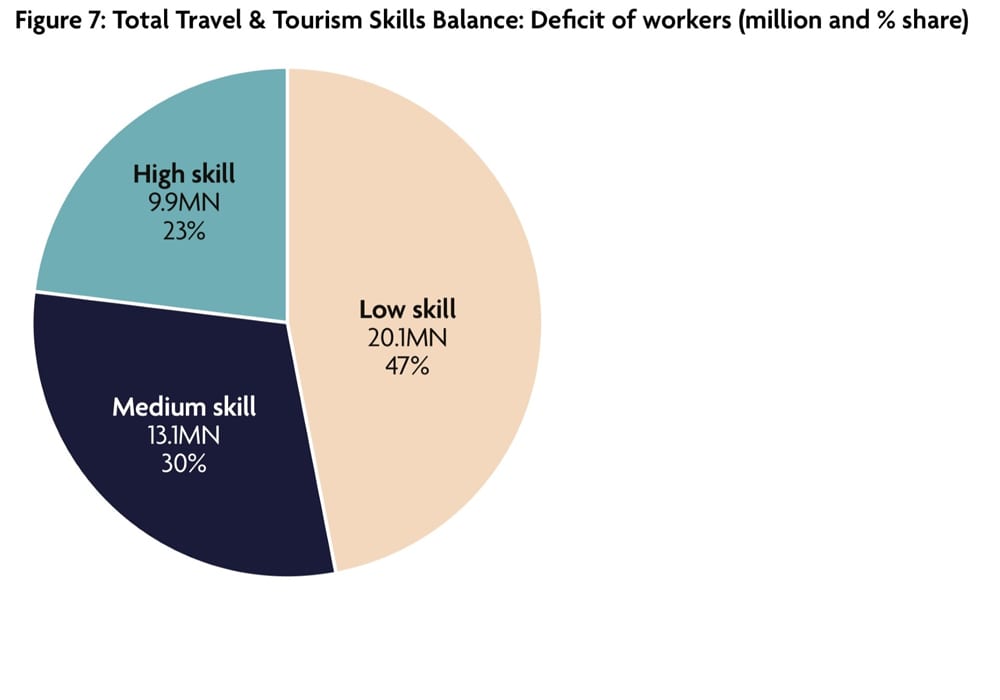
The most severe skills shortage by 2035 is expected at the low-skill level (20.1M people), although gaps are also significant at the medium (13.1M) and high-skill levels (9.9M).
Upskilling and Digital Integration
Skills mismatch is also a factor in the looming worker shortage. The WTTC study identified an urgent need for workers to improve their Technological and Digital Literacy. For managers and executives, Critical Thinking and Analytical Skills are vital, while the industry must also focus on fostering Creative Thinking for the coming decade.
Companies are advised to embrace technology and use advances like Artificial Intelligence (AI) to boost productivity and aid staff training. This integration is already underway in many regions; Philippine Tourism Secretary Christina Garcia Frasco confirmed that local hotels and resorts are implementing AI for virtual assistance, smart hotel technology, and food waste management.
By combining these strategies—investing in clear career progression, offering valuable non-wage benefits, and focusing on upskilling through technology—the global tourism industry can actively fight to bridge the 43.1 million worker gap and ensure its long-term stability.
The full report by the World Travel & Tourism Council is available on their website.
