Japan's Ground Forces Hold Largest Drill in 30 Years

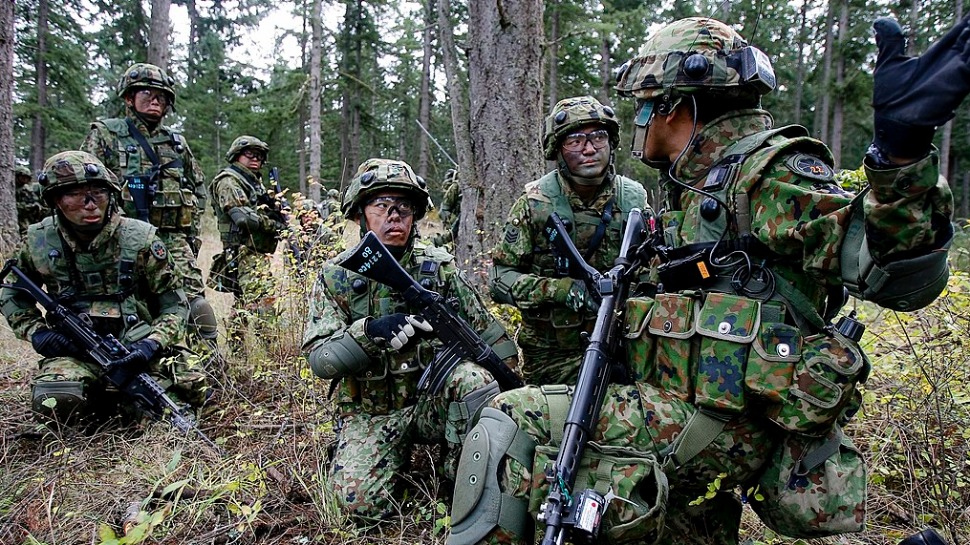
Japan has adopted a pacifist constitution since World War II.While iIts “military” has been reduced to a self-defense force, it is still a force to be reckoned with. Although Japan is prohibited from acquiring weapons for offensive military strikes (such as ICBMs and large aircraft carriers), its Self-Defense Forces are considered one of the world’s most efficient.
Japan raised eyebrows around the world when it decided to hold its largest-ever military exercise in almost 30 years.
It is no coincidence that the drills come at a time of heightened tension in the Asia Pacific region. China is increasingly projecting and exercising military power over the vast swathes of ocean beyond its borders, alarming its neighbors.
Japan’s spokesperson for its Ground Self-Defense Forces (GSDF) told CNN that the exercises aim to improve the country’s deterrence capabilities.
"This Ground Self-Defense Force exercise is truly focused on improving operational effectiveness, deterrence and response capabilities," said Col. Noriko Yokota, GSDF spokesperson.
"Each unit is conducting the exercise with an eye to what is necessary to achieve this goal. They are preparing themselves so that they can respond with confidence when they are forced to take further action."
Involving over 100,000 personnel, 20,000 ground crafts, and 120 places, the exercises make it appear like Japan is preparing for war but the GDSF maintains it is not a preparation for conflict against any particular country.
According to CNN’s Blake Essig, the training environment where the one of the drills is taking place resembles the harsh geography of the Senkaku Islands (China calls it Diaoyu Islands while Taiwan refers to it as Tiyaoyutai), a collection of rocky islands in the East China Sea. It is administered by Japan but China and Taiwan are also claiming it.
The Senkaku Islands’ Location

The Rapidly Changing Balance of Power in Asia
Traditionally, U.S. influence and military presence in the Asia Pacific region has largely remained unchallenged. That narrative changed in 2012 when China aggressively took over Scarborough Shoal—a reef belonging to the Philippines, America’s oldest ally in Asia. Since that incident, China has militarized seven reefs in the South China Sea and the West Philippine Sea with little opposition from the West.
Although China has not dared to enforce its Nine-Dash Line claims on Japanese waters, the latter is not taking any chances.
Japan has deployed up to 100,000 personnel to participate in nationwide drills since September. The massive Self-Defense Forces drill is largely seen as a response to the rapidly changing balance of power in the region.
"The current security environment surrounding Japan is extremely severe," said Lt. Gen. Yuichi Togashi, Commanding General of the 2nd Division GSDF in the CNN report.
"We, the Self-Defense Forces, are required to enhance the effectiveness of operations."
Why Japan Has No Military
After being defeated by the Allies in World War II, Japan was forced to sign a surrender agreement with General Douglas MacArthur in 1945.
Japan was deprived of any military capability after being defeated by the Allies in World War II and adopted a pacifist constitution in 1947. Article 9 of the Japanese constitution outlaws war as an instrument of settling disputes.
Below is the official text of the English translation of Article 9:
(1) Aspiring sincerely to an international peace based on justice and order, the Japanese people forever renounce war as a sovereign right of the nation and the threat or use of force as means of settling international disputes.
(2) In order to accomplish the aim of the preceding paragraph, land, sea, and air forces, as well as other war potential, will never be maintained. The right of belligerency of the state will not be recognized.
Article 9 of Japan’s Constitution not only forbids the acquisition of offensive military hardware such as intercontinental ballistic missiles and aircraft carriers, but it also forbids the country to maintain a formal military consisting of an army, navy, and air force.
Nevertheless, it is believed Japan has the capability to assemble a nuclear weapon if it wants to: It possesses the technology, raw materials, and enough capital to build them within months.
Japan also operates the world’s fourth-largest fleet of attack submarines, according to The Diplomat.