
U.S. Tariff Impact: Philippines May See Gains, but Growth Prospects Still Face Challenges

The Philippines' strong domestic consumption base likely offers a buffer against the United States' "Liberation Day tariffs." Oxford Economics points out that this internal demand protects the economy despite nearly 20 percent export exposure to the U.S. Interestingly, the Philippines, initially slated for a 17 percent tariff, lower than the over 27 percent average for most ASEAN nations, could even see a slight upside as businesses relocate within the region to avoid higher levies. The implementation of these tariffs is currently on a 90-day hold.
ALSO READ:
The U.S.-China Tariff War: Impacts and Repercussions
Trump Is Ignoring the Climate Crisis—Here’s Why That Sucks for the Philippines
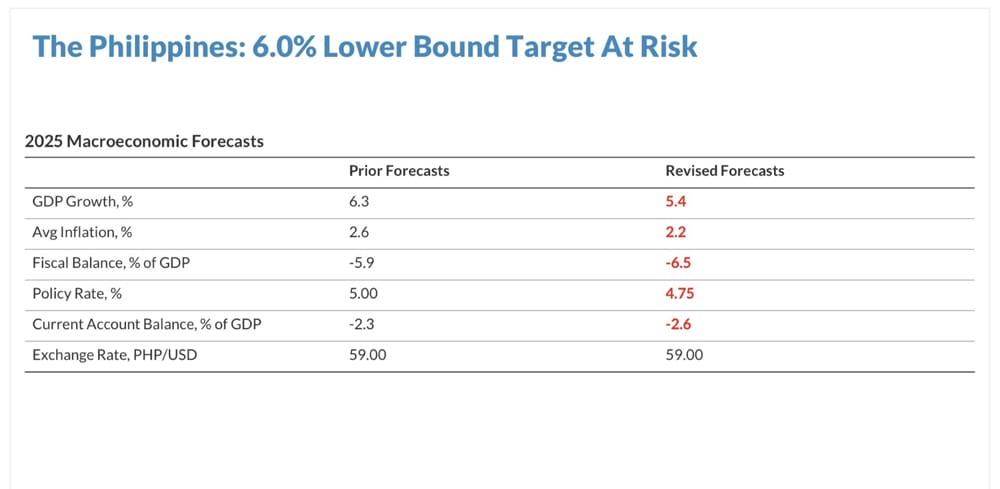
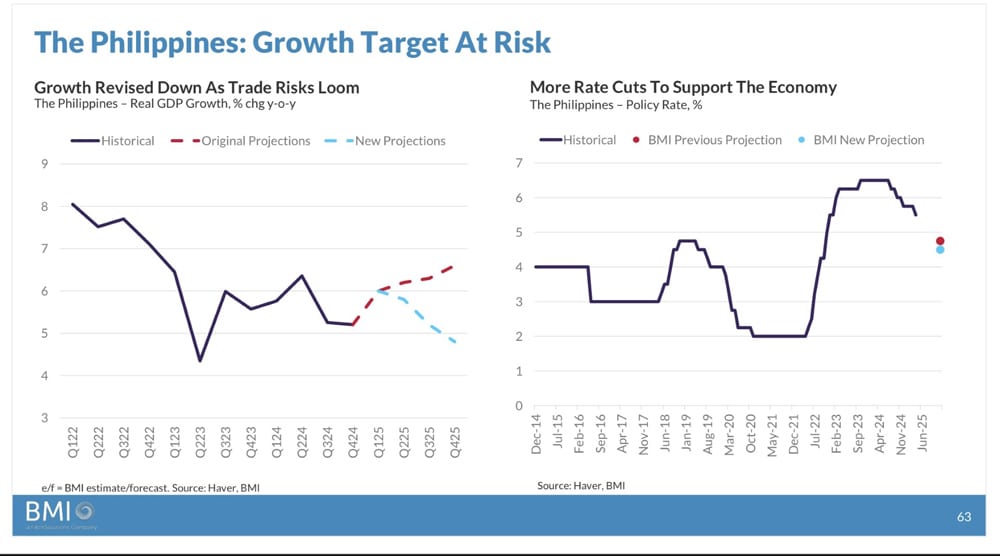
Still, there will likely be a slight impact on the Philippines’ economic growth this year, according to BMI Research, a unit of Fitch Solutions, which projected a slowdown to 5.4 percent in terms of gross domestic product (GDP), from last year’s 5.6-percent growth.
In a webinar on Tuesday, April 22, BMI Research Asia Risk Division analyst Low Shi Cheng said, "Our ballpark estimate suggests that the 17-percent tariffs imposed by the US will subtract around 1.1 percentage points from real GDP growth. Although the tariff rate on the Philippines is comparatively lower than that of its peers, almost four percent of the value-added output serves U.S. market demand."
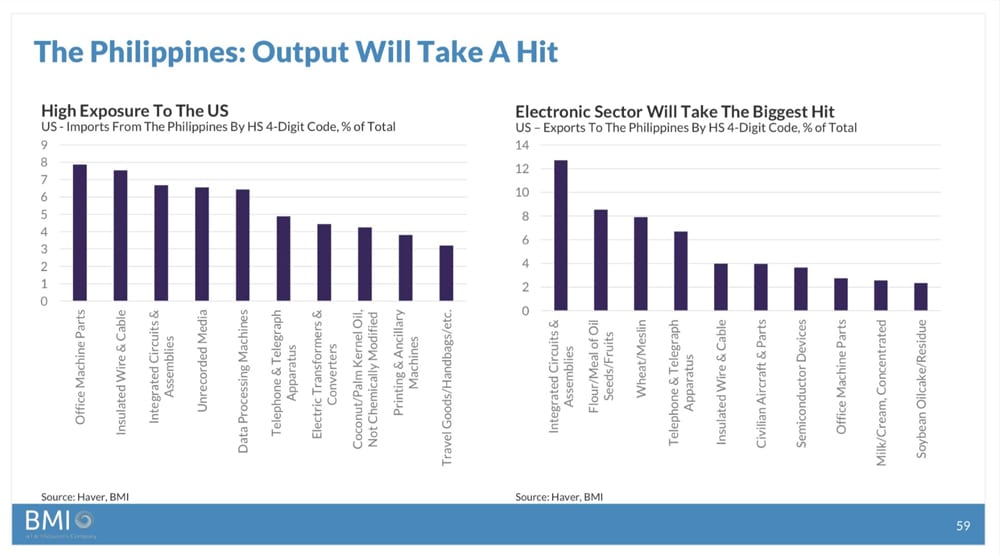
The Philippines: Output Will Take a Hit
"Countries like Vietnam, South Korea, and Taiwan are particularly vulnerable due to their trade dependencies. Conversely, India and the Philippines may be better insulated from the tariff shocks," Innes McFee, Managing Director of Macro and Investor Services, said in Tariffs and Their Global Impact: A Note from the Desk of our Chief Economist, published by Oxford Economics on April 8.
What Happens to the Philippine Economy When the U.S. and China Are at War
Government economic managers had projected the economy to expand by six percent this year, while BMI's original growth prediction was 6.3 percent.
Of the total electronics exports of the Philippines, the U.S. accounts for 22 percent, while the country’s largest import from the US is integrated circuits.
BMI added that the Philippines will also be impacted by the slackening in the respective economies of the United States and mainland China, which are currently engaged in a major trade war. "The Philippines’s exposure to both China and the U.S. economies is pretty balanced. With both economies likely to slow over the next few quarters, the Philippines will definitely follow suit," added Cheng.
To mitigate the impact of substantial tariff hikes on nations like China (145 percent), Vietnam (46 percent), and Cambodia (49 percent), production shifts to lower-tariff countries are a possibility. Nevertheless, Oxford Economics notes that not all companies have the capacity for diverse production, and relocation costs are considerable. Moreover, the detrimental effect of extreme trade policy uncertainty will depress business investment, irrespective of any future reduction or cancellation of these tariffs.
The Philippines: 6.0% Lower Bound Target at Risk
Low Wages: A Philippine Advantage
The economic advisory firm highlighted that the permanence of these tariffs would likely expedite the relocation of manufacturing from China to ASEAN nations, driven by the significant tariff disparities. This trend is already taking shape, as evidenced by a recent The New York Times profile of Chinese investor Liu Gang. He began moving his electronics factory from southern China to a Batangas economic zone in 2018, coinciding with the initial trade tensions between the US and China under President Trump.
The NYT article from April 9, 2025, further noted a surge in interest as companies are increasingly looking to the Philippines as they search for factory locations beyond Vietnam and Thailand.
"At least half a dozen companies with customers in the United States have made inquiries in the last few weeks with Mr. Liu’s factory and his neighbors in one area of Batangas province that is a 90-minute drive south of Manila. Some have made commitments to shift production. It’s an unexpected turn of events for a country that has long lacked the manufacturing prowess that has pulled many other Asian nations out of poverty," the article added.
Oxford Economics suggests that the interconnected production networks within ASEAN, particularly in the semiconductor sector, could benefit the Philippines. They propose that lower-end chips produced in China or Malaysia might increasingly be packaged in the Philippines or Vietnam before being shipped elsewhere in Asia for final assembly into consumer electronics.
A key competitive edge for the Philippines lies in its lower average monthly wage of U.S. $239. This contrasts sharply with China’s $962, positioning the Philippines favorably compared to most neighbors, ranking just below Vietnam ($346) but above India ($222) and Indonesia ($199).
The Philippines: Growth Target at Risk
Further Cuts in BSP Rate Seen
On April 2, the so-called "Liberation Day," Trump announced a slew of "reciprocal tariffs" across the globe, even on countries with which the US has a trade surplus, but the immediate blowback from its bond market and fall in stock prices convinced him to pause the full implementation of the new policy for 90 days.
The pause bodes well for the Philippines, with tariff rates back to 10 percent for 90 days, said BMI’s Cheng. "We think that the Philippines will be successful in keeping them at this level. At the very least, [the country remains] an important security partner for the US, especially as Washington is working to counter Beijing’s expanding reach in the South China Sea. So therefore, we think that this will give [the Philippines] at least a bit of leverage," he added, describing the tariff impact on the country’s growth as "less severe" owing to its "captive" domestic activity.
Despite the slowdown in growth this year, BMI sees headline inflation in the Philippines rising by just 2.2 percent, compared to its initial projection of 2.6 percent, which is still well within the government economic managers’ target of two to six percent.
This will give the Bangko Sentral ng Pilipinas (BSP) ample room to further cut its key policy rate "by 75 basis points" to 4.75 percent from the current 5.5 percent, said Cheng. A low-interest rate regime reduces borrowing costs for businesses, thus allowing the economy to keep growing.
The BSP’s policymaking Monetary Board still has four key meetings for the rest of the year.
