
Trump Is Ignoring the Climate Crisis—Here’s Why That Sucks for the Philippines

Every year, powerful typhoons, rising sea levels, and extreme heat threaten the Philippines, displacing communities and destroying livelihoods. While our country is no stranger to these disasters, there is nothing normal about these events exacerbated by the accelerating effects of the man-made climate crisis. It's not even a crisis anymore; it's a climate emergency.
And yet, on the other side of the Pacific, President Donald Trump consistently dismissed climate change as a hoax, rolled back environmental policies, and pulled the U.S. out of global climate agreements. In fact, he made a promise during his inaugural address last January 20 that America "will drill, baby, drill," referring, of course, to an all-out support to increase drilling for petroleum and gas.
For a country like the Philippines, this is more than just a poorly written episode of the reality show that is Trump's second administration—it's a matter of survival.
ALSO READ:
UN to World: The Climate Emergency Is No Longer Emerging, It's Here
These Are the Highest At-Risk Philippine Provinces for Climate Change-Driven Disasters
The Philippines' Vulnerability in the Global Climate Emergency
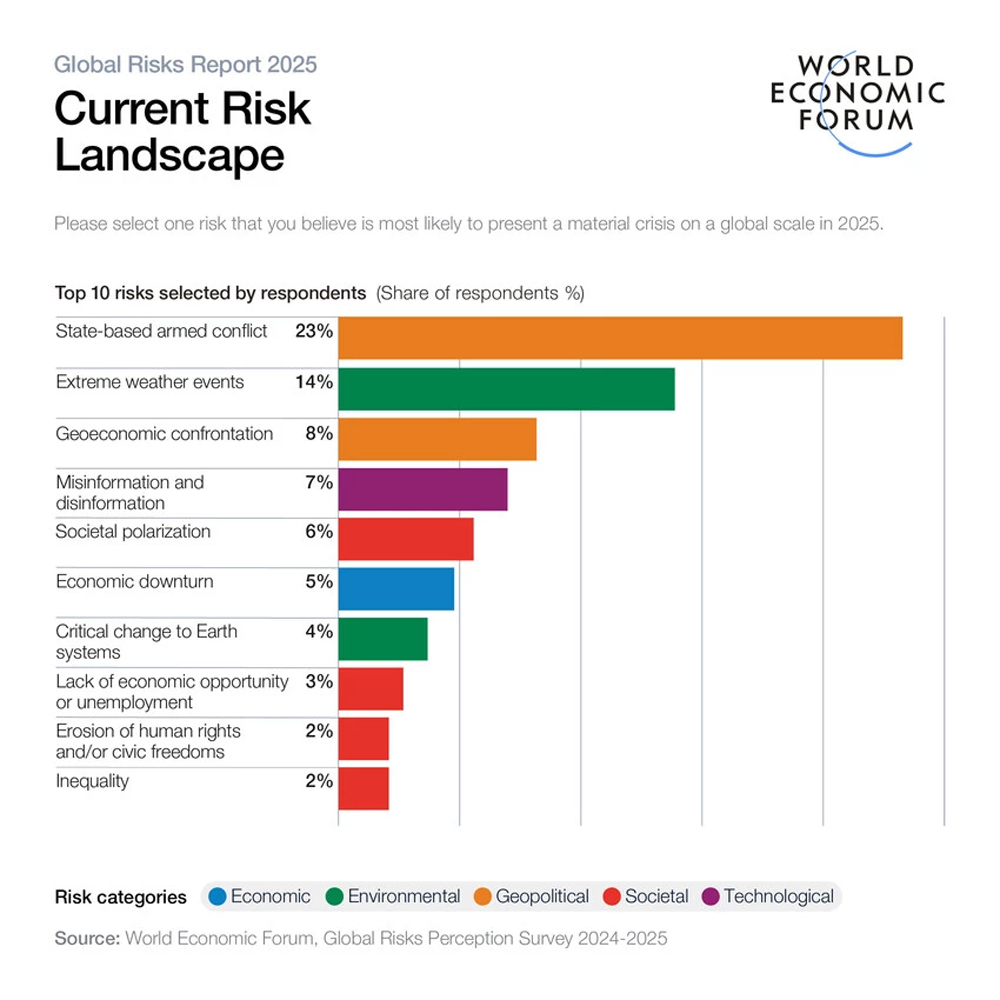
The World Economic Forum (WEF), in the Global Risks Perception Survey 2024-2025 released on January 15, 2025, said that extreme weather events are believed to be the second most likely to present as a material crisis on a global scale. Up to 14 percent of respondents said so, just after the state-based armed conflict, which earned a 23 percent share of the respondents. It also ranks second in the list of short-term global risks (two years) and first in terms of long-term global risks (10 years). In other words, more and more people finally agree that everyone's lives will be turned upside down by extreme weather events in the foreseeable future (as we all should).
Current Risk Landscape
The World Meteorological Organization (WMO) also confirmed that 2024 is the warmest year on record, and we have just surpassed the pre-industrial temperatures by about 1.55 degrees Celsius. If the number sounds familiar, that's because it's the magic number agreed upon by 196 parties in the Paris Agreement (2015). Its overarching goal is to hold "the increase in the global average temperature to well below 2 degrees Celsius above pre-industrial levels" and pursue efforts "to limit the temperature increase to 1.5 degrees Celsius above pre-industrial levels." Less than 10 years later, here we are, breaching the 1.5 degrees Celsius mark.
While extreme weather events affect all countries, Global South countries are expected to bear the brunt in the next 30 years, according to the WEF. And, yes, the Global South includes the Philippines as well as the regions of Africa, Latin America and the Caribbean, Asia (excluding Israel, Japan, and South Korea), and Oceania (excluding Australia and New Zealand). We mostly know these territories as "Third World Countries" or "Developing Countries," with many of them current or former subjects of colonialism—the very reason they remain in a constant state of 'developing.' It's no secret, after all, that most of these colonized countries experienced exploitation of resources, like the conversion of arable lands to plantations and over-mining of metals for the benefit (and wealth) of the colonists. As a long-term effect, colonies are now dealing with the destruction of the natural environment, especially after hundreds of years of colonization.
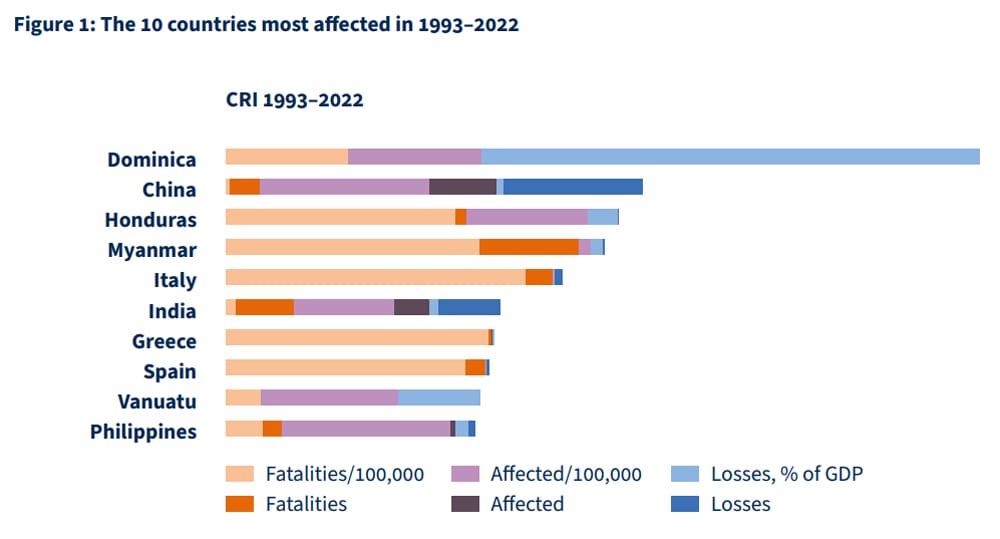
In the Climate Risk Index published by GermanWatch, the Philippines is the 10th most affected country from 1993 to 2022 in terms of climate change's consequences, which manifested in the increased intensity and severity of extreme weather events. It "ranks high mainly because of its relative number of people affected, accompanied by relative fatalities and economic losses." Apart from exceptionally devastating typhoons, including Ketsana/Ondoy (2009), Bopha/Pablo (2012), Haiyan/Yolanda (2013), Mangkhut/Ompong (2018), and Goni/Rolly (2020), the Philippines was hit by multiple other tropical cyclones in every year between 1993 and 2022.
Even the El Niño phenomenon, which began in the country in July 2023 and persisted until June 2024, is worse than ever. The National Disaster Risk Reduction and Management Council reported agricultural damage of over P9.496 billion, a declaration of a state of calamity in 432 cities and municipalities due to drought and water supply shortage, and effect on about 1.22 million families.
Countries Most Affected By Extreme Weather Events in 1993-2022
Trump's Climate Policies: Making a Bad Situation Worse
Meanwhile, as the Philippines continues to grapple with the dystopic realities of the colonialism of the past and capitalism of the present, the U.S. president seems to be forgetting that we're all living on one planet and that everything is interconnected.
On his first day in office, Trump signed an executive order directing the U.S. to again withdraw from the landmark Paris climate agreement, citing that the Western country's "successful track record of advancing both economic and environmental objectives should be a model for other countries." This means withdrawing from an agreement that pushes them to limit greenhouse gas emissions.
In case you skipped your environmental science classes in grade school, remember that greenhouse gas emissions are the release of gases that trap heat in the Earth's atmosphere. It's named after the greenhouse in gardens and farms, where the structure is designed to regulate temperature and humidity to protect the plants under its roof. Now, imagine a huge greenhouse structure enveloping Earth, including humidity and high temperatures close to the ground.
With this, rising temperatures cause the rapid melting of glaciers near our poles. While these glaciers are miles away from the Philippines, we should not forget that melting of ice causes sea levels to rise; and, considering that 71 percent of the Earth's surface is covered in water, that also means a rise in water levels. The Philippines' Climate Change Commission reported that the sea level has risen by 5.7- 7.0 millimeters per year over certain parts of the country from 1993 to 2015, which is approximately double the highest global average rate of 2.8-3.6 millimeters per year. At present, several habited islands in the archipelago are now permanently submerged in water, such as the Batasan, Inanuran, and Bilangbilangan Islands off the coast of Tubigon, Bohol.
Trump, via the National Emergencies Act, also ordered the government to use private land and resources for the production of oil and gas. Exploring and drilling for oil poses a threat to land and marine environments. And, once again, the impact on one species can ripple across an entire ecosystem, which—in turn—can start a domino effect on other ecosystems.
Another rather specific thing: It seems that the U.S. president loves plastic straws so much that he issued an executive order on February 10 to end the procurement and forced use of paper straws. Plastic straws are among the top 10 contributors to plastic marine debris across the globe. They kill seabirds, fish, manatees, dolphins, and other marine animals when lodged in their noses, throats, and stomachs. How many times have we seen videos and photos of sea turtles with straws stuck in their nostrils? Bear in mind that sea turtles are keystone species, meaning they are an important part of an ecosystem, and their dwindling number can easily disrupt the natural order of things. Some species of sea turtles regulate the amount of jellyfish in the ocean through feeding, while others help maintain reefs, which serve as home to marine creatures. Sea turtles also graze on seagrass, which also benefits other marine species.
With this in mind, former President Joe Biden's administration committed to gradually phasing out federal purchases of single-use plastics by 2027 and from all federal operations by 2035.
But it is 2025, and Trump has taken over.
Unfortunately, much like the domino effect of every disruption in the planet's environmental stability, other nations' actions (or inactions) create a ripple effect on other countries across oceans. If powerful nations continue to prioritize short-term interests over global survival, it’s not just vulnerable countries like ours that will suffer—it’s the entire planet.
