To mark the 40th anniversary of the release of the first Swatch watch line-up, we revisit Richard Benson's long-read on the rise of The Swatch Group from the Big Watch Book 2017.
"The thing about Switzerland," says Carlo Giordanetti, the impeccably dressed and very Italian creative director of Swatch watches, "is that it values tradition. I mean, really values it. And Swiss watchmakers never set out to just fill up small containers with mechanisms. They set out to make things that have souls. They believe the mechanical movement of a watch has a soul, because it is a living thing with an emotional connection to you, because you're the one who gives it energy by winding."
Giordanetti—tailored mid-blue jacket and pocket square, tasteful spectacles, fervently demonstrative—is explaining the existential nature of the "quartz crisis" that led to the creation of the revolutionary Swatch brand in 1983. The basic business story—Far East manufacturers almost eradicate Swiss counterparts with cheap quartz wristwatches in the Seventies; maverick businessman Nicolas Hayek saves day by reinventing Swiss watch as fashion accessory—is well known. But, says Giordanetti, there was more to it than business.
The question was never, "Can you make a Swiss quartz watch to compete with Citizen and Seiko?" but rather, "Is it possible to make a cheap, mass-manufactured product that inspires the personal attachment and 'soul' associated with handcrafted equivalents?"
As he points out, the answer formulated by the Swiss and expressed in the form of kooky-looking plastic would exert a profound influence not only on wristwatches, but on the way businesses think about brands, technology, and customers. And this year it has been enjoying renewed interest from a new generation of watch-watchers.
In 2017, Swatch means more than the single original brand whose first modestly sized range of 12 watches was launched in spring 1983. In 1998, it gave its name to the conglomerate from which it originated, and today the Swatch Group owns 18 watch brands; super-high-end names like Breguet, Blancpain and Longines and more affordably priced lines such as Rado, Tissot, Mido, Calvin Klein and Flik Flak, with Omega said to generate the most revenue.
The group owns 17 movement and component producers, including ETA, Switzerland's largest supplier of mechanical and quartz movements. Like all Swiss manufacturers, the Swatch Group has been losing ground recently; in 2016, sales were down 10.6 per cent to 7.5bn Swiss Francs (£5.9bn), with profits falling 44.5 per cent to CHF805m (£635m). In 2017, however, two developments have prompted excited talk among commentators of a Swatch-led revival for the whole sector.
Firstly, CEO Nick Hayek reported an upturn in sales and predicted an increase of up to nine per cent by the end of 2017. Second, he announced the group was working on its own smart watch operating system to compete with Apple's watchOS and Android Wear when it is released in a Tissot in 2018. This is a bold and important move, given that non-Swiss smart watches have taken substantial sales from Swiss manufacturers' mid- and lower price ranges.
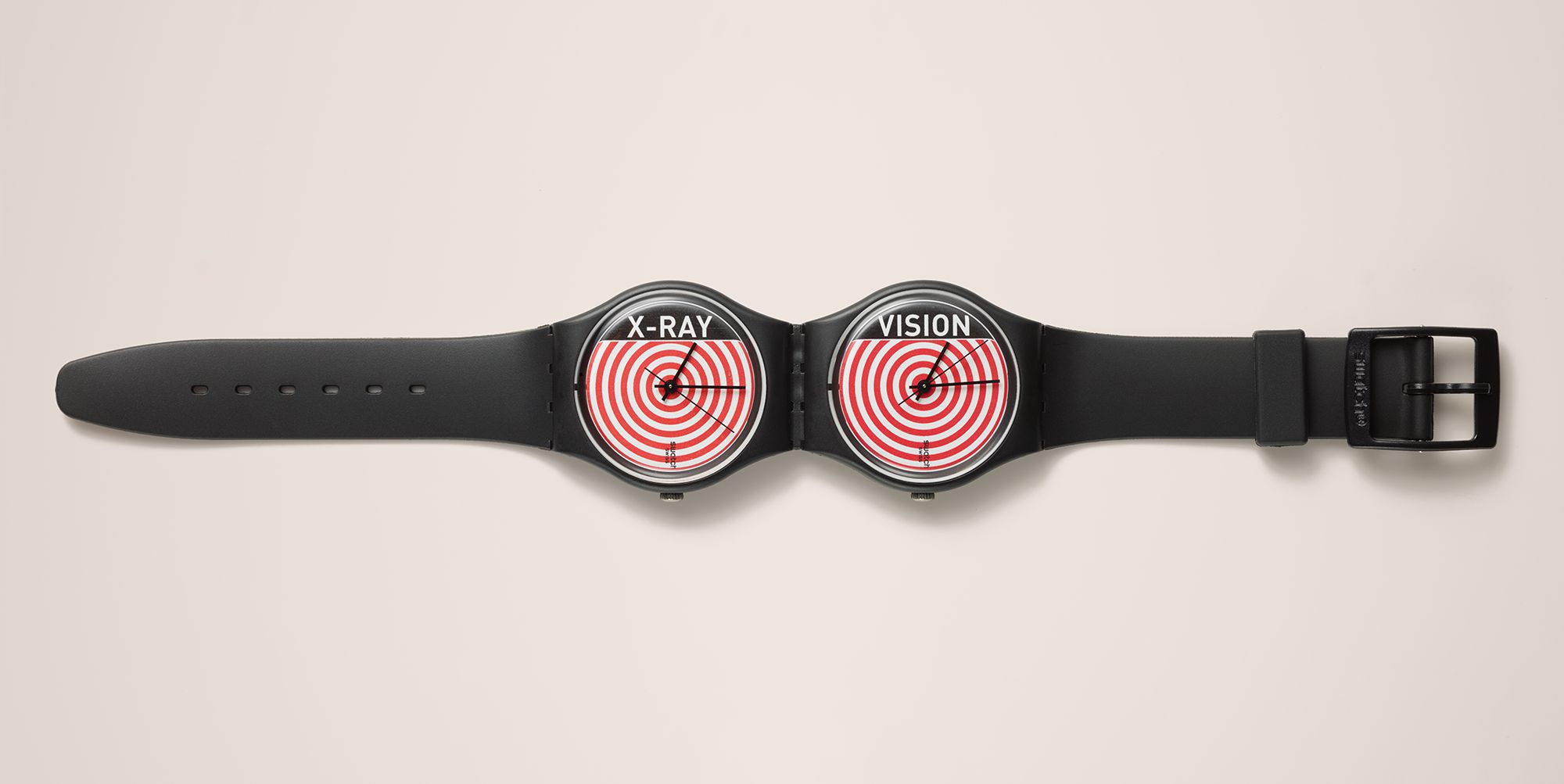
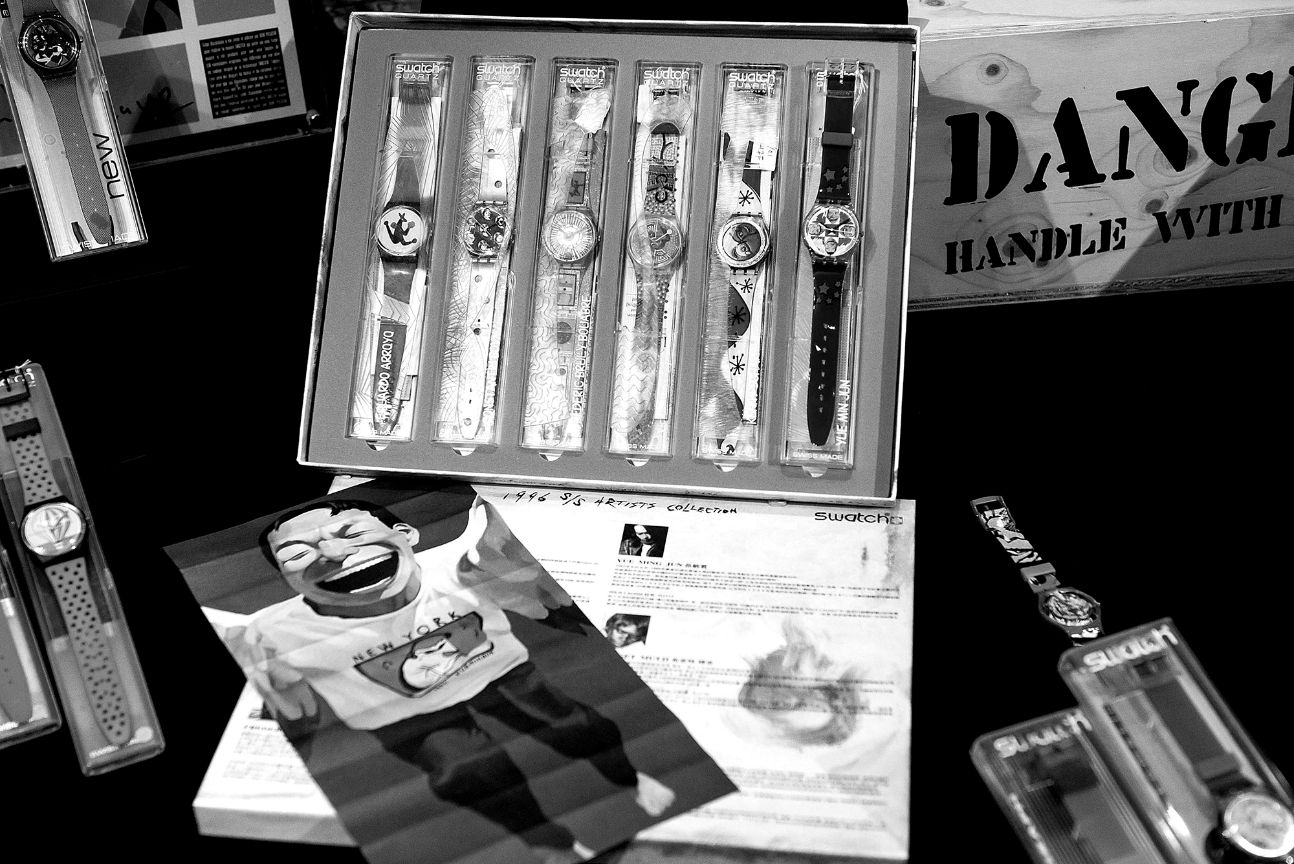
The buccaneering spirit inherent in the independent Swatch OS rather recalled the early years of the brand, with its new watchmaking paradigm and pioneering experiments with electronics (old-timers may remember the Beep pager watch of 1991, for example, or the groovy Musicall, with embedded Jean Michel Jarre track, in 1993). It kind of helped that the company had been in the news a couple of years earlier, when, in spring 2015, Sotheby's sold the largest collection of Swatches ever auctioned, a 5,800-piece lot amassed by European collector Paul Dunkel, for $6m (£4.5m), five times the estimated price (the buyer was an unnamed "European institution"). In autumn that year, the auction house sold another collection, this time of more than 4,000 pieces owned by Swatch designers Marlyse Schmid and Bernard Muller, for almost $1.3m (£980,000).
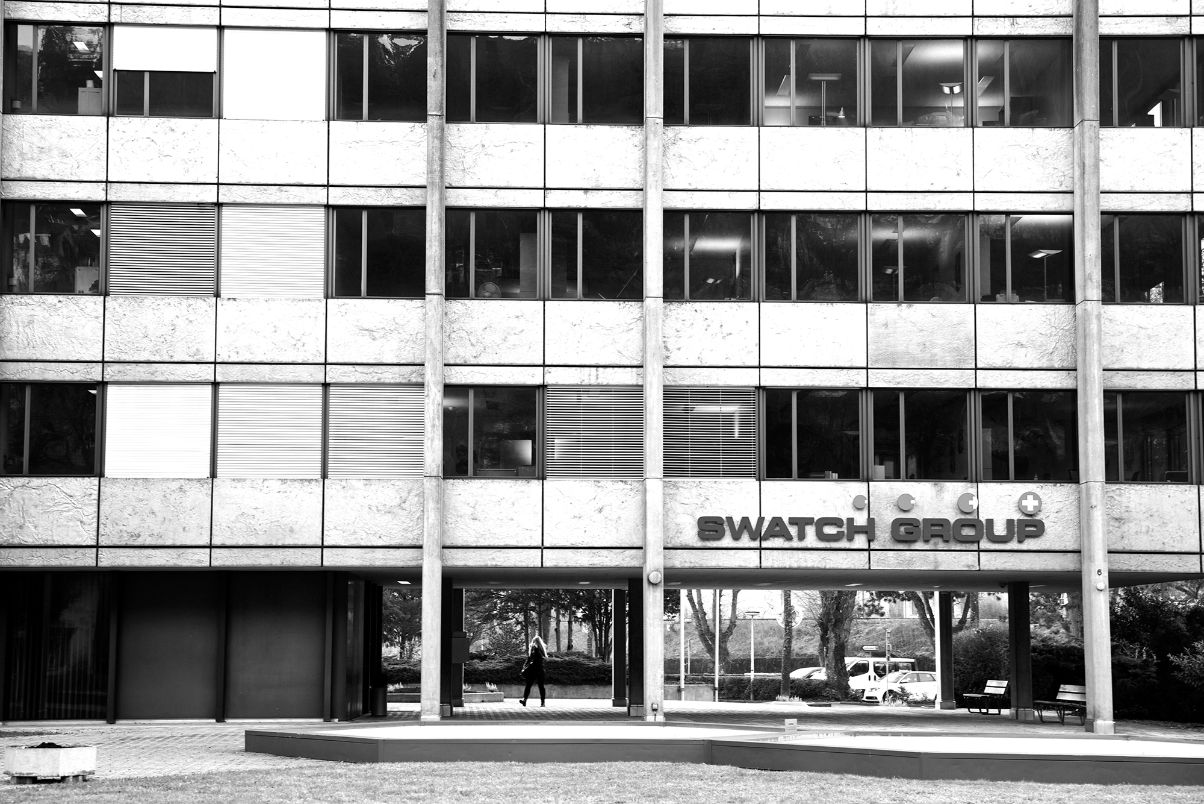
When we meet at the Swatch Lab where Swatch's creative and planning work is done—a somewhat secretive, low-rise converted bank in central Zurich, marked only with a discreet nameplate at the door—Giordanetti allows me into the basement to look at Swatch's archives, which contain versions of many of the models sold in the auctions. It's incredible, a sort of pop-art version of the Crown Jewels. To see these tiny, Fisher-Price-toy-coloured plastic treasures together is to marvel at how memorable so many of them are, but also to wonder at the magic that gave them so much value and, indeed, soul.
Dunkel called his sale, "A true testament to the universal appeal of Swatch," and no one could argue. Down here among the art and the plastic, it's easy to see why, as the company that once saved Swiss pre-eminence faces a new challenge, the world may once again look to Swatch for inspiration.
The story of Swatch begins with Switzerland's quartz crisis, and the story of the quartz crisis begins in the Fifties. In World War II, Switzerland's 2,000 or so watchmakers had prospered because their nation's neutrality meant they could carry on watchmaking while their foreign competitors were contributing to war efforts. Consequently the Swiss dominated the post-war watch market, and enjoyed a near 50 per cent share of global sales.
The watches in question were mechanical, powered by hand-winding; or automatic, powered by the movement of the wearer's wrist, with the energy converted by a rotor. Starting in the Fifties, there was interest among watchmakers in making timepieces that might use a battery as a source of power, as this would make the watch more accurate, and cheaper. When you wind a mechanical watch, you essentially stretch a spring which, on contracting, turns a tiny wheel (the balance wheel), converting the energy into a regular movement. Engineers realised that the spring-balance wheel could be replaced by a tiny quartz crystal, because when quartz vibrates at high speed, it produces electricity at a very precise, regular frequency. Make quartz vibrate with an electrical signal from a battery, and it will drive a cheap mechanism that does what
a spring wheel does, but more accurately.
Through the Fifties and Sixties, Swiss, American and Japanese watch and electronics companies competed to perfect a quartz wristwatch. There were several attempts and in 1967 the Swiss Centre Electronique Horloger, funded by major Swiss manufacturers, presented a fully developed Swiss quartz movement for a wristwatch. The major Swiss manufacturers then more or less ignored it while the Japanese and Americans seized their opportunity.
In December 1969, Japan's Seiko released the Astron, the world's first commercial quartz watch, and a couple of years later Hamilton of the US put on sale its Pulsar, the first electronic digital model. Other Far East and US companies such as Citizen and Texas Instruments began converting production lines. In Switzerland, Omega made a few, but really that was about it. When you ask people in the Swiss industry today why the old guard were so slow off the mark, they get a bit conflicted. Suggest it was because of a noble attachment to the old ways, and they'll say no, they were just being typically insular. ("Switzerland is very self-contained, surrounded by mountains, and one of the issues in this market is that a lot of people tend to think this is the world," says Giordanetti. "The quartz phenomenon was growing outside the borders of Switzerland, and until it really came into the market, it didn't hit them.") But say the old guys seemed to be stuck in the past, they'll answer, well, yes, but you have to understand.
"Those [cheap imported quartz] watches were just stainless steel containers—sometimes not even stainless steel!" says Giordanetti, making a contemptuous flourish with his right hand, as if the idea is a personal affront to him. "They were just containers with a chip inside. There was no soul."
Souls and mountains notwithstanding, once the Americans dropped out of the race in the late Seventies, cheap quartz watches from the Far East inflicted on the Swiss watchmakers the sort of decline that we in the UK associate with shipbuilding and coal mines. By the early Eighties, the Swiss had fallen from first to third in the international sales league, behind Japan and Hong Kong. Between 1977 and 1983, their share of the world market went from 43 per cent to 15 per cent, and the workforce declined from 90,000 to around 40,000. About 1,000 brands, including venerated companies such as Cortébert, Marvin and Enicar, disappeared, while others desperately amalgamated to try to survive.
In 1979 (some sources say 1980 but official Swatch history suggests it must have been earlier), the banks that were effectively keeping the Swiss watchmakers afloat brought in Nicolas G Hayek as chief advisor, the founder and CEO of Hayek Engineering, a management consulting firm based in Zurich.
Hayek, a charismatic Lebanese businessman then in his early fifties, had founded Hayek Engineering in 1963, and earned a reputation for reviving European corporations. This time he was essentially charged with writing a report about the disposal of the remains of the industry, and his response would go down in business lore as one of the great examples of successfully ignoring a brief.
Hayek believed that if the businesses were rationalised and the brands reinvigorated, the industry could be saved. The precise dates and details of what happened are extremely difficult to pin down because of conflicting accounts; some (including Swatch itself) say he was directing developments that led to the creation of Swatch from 1979, while others like the Harvard Business Review report that he didn't take control until 1985.
What is clear is that his chief concerns were two companies, the Allgemeine Schweizerische Uhrenindustrie AG, or ASUAG, and the Société Suisse pour l'Industrie Horlogère (SSIH). ASUAG owned, among other companies, Longines, Rado and Eterna, and SSIH had Omega, Tissot and Hamilton. Rather than file a report explaining how best to sell off their brands to the Japanese, Hayek oversaw their amalgamation into a new company (Société Suisse de Microélectronique et d'Horlogerie, or SMH), took a controlling stake himself and brought in a consortium of new investors.
Once in charge, he quickly moved SMH's famous brands such as Omega and Longines upmarket, increasing their retail price and adding the words "Swiss" or "Swiss Made" to the pieces' dials to emphasise the heritage. However, what he really needed was a mountain of ready cash, and a gentle move upmarket was not going to generate that.
"You have to understand, they were in deep shit," says Giordanetti, who joined the company in 1987. "It needed to turn around fast. Yes, they could have made watches in stainless steel and sold more, but they needed to sell huge numbers, so many that they would create enough cash to transform the whole system of making and selling Swiss watches. So, how do you make and sell a volume product in large numbers? You lower the price. How do you lower the price? The easiest way was to reduce the number of components. But watch movements are complex, even in a quartz watch. So how could this be done?"
The answer lay with a small group of engineers at ETA who, since the late Seventies, had been locked in a nerdy, unofficial competition with counterparts at Seiko to create the world's thinnest watch. It had become known as the "Delirium Tremens" project, after one them referred to the quest as "un delirium très mince" ("a very thin delirium"). The ETA team had won, getting below 2mm by placing some components on the case back—effectively doing away with the case as a separate, thickness-boosting element, making it a part of the movement. It was made of gold, the only acceptable material with the necessary strength and flexibility, and put in a Concord-branded "case", priced at $10,000, and launched in 1979, whereupon it enjoyed decent but unspectacular sales in the US.
Noticing the Tremens project soon after it launched, Hayek gave the engineers a new brief. They were to design a watch that was cheap enough to compete with the Far East; had fewer components, but didn't compromise Swiss quality; could be adapted to a range of products; was tough and waterproof, and was profitable. As Frank Edwards, author of Swatch: A Guide for Connoisseurs and Collectors, says, Hayek knew "that these criteria made it impossible to solve the problem by conventional watchmaking methods". The point was to force them into coming up with "a completely new solution" that would change the paradigm of Swiss watchmaking.
The project was led by a manager and Hayek lieutenant called Ernst Thomke, with two young engineers, Elmar Mock and Jacques Müller, working under him in the ETA office. Mock and Müller hit on the solution after about 12 months, referring back to the Tremens. Their case would have every immobile part of the quartz movement attached to it, reducing the usual 100-odd components to 51. As they couldn't use gold, they asked what other materials could provide the necessary flexibility, workability and strength to make such a case. The answer was wood and plastic, and they chose the latter, specifically an injection-moulded thermoplastic specially created with chemical engineers from one of Switzerland's many chemical companies.
"The case is the real innovation Swatch was built on," says Giordanetti. "It changed the whole paradigm of watchmaking, because with conventional watches, you begin by assembling the movement. With this, you began with the case. It was the opposite of what anyone had ever done before. That and the plastic meant it could have a low price and the low price helped drive the sales."
Swiss feelings about said plastic may be revealed by the project's initial name of Delirium Vulgare, but Hayek approved. According to Swatch's official history, it was he who saw the potential for a "second watch", a watch that would not be the heirloom piece of Swiss tradition, but "a new, fascinating way to say who you are and how you feel". He ordered prototypes to be made, and the first arrived at ETA in mid-1981, now under the name "Delirium Popularis".
Initially—and, it seems now, incredibly—the idea was to follow ETA's usual model and supply unadorned watches to someone else who would brand and sell them. This strategy idea was abandoned after a trial distributing the watches in Texas in 1982 turned into, as Giordanetti says, "the biggest failure ever! They sold hardly any. After that, they realised that Texas and Middle America was not the target market, and this needed to be a product for customers who understood lifestyle and the evolution of taste."
Which is how the Swatch brand came to be invented. According to The Innovation Factory, a book co-authored by Elmar Mock and academic Gilles Garel, the man with the greatest influence on the branding was a Swiss marketing consultant called Franz Sprecher, who had been brought in by Thomke. According to Mock, it was Sprecher who came up with the name, after spotting people in the company's US ad agency SSC&B Lintas abbreviating "Swiss Watch" to "Swatch" (some sources claim it was intended as a portmanteau of "Second" and "Watch"). It was Sprecher, too, who devised the strategy of marketing the watch as if it were a fashion item, with two new collections of watches a year, to be supplemented by occasional "specials".
The idea of collections to be augmented by one-off limited editions was a marketing paradigm-changer to match the engineering innovation of the case. Up until the early Eighties, the practice of limiting an edition of a consumer durable had existed only in the world of premium, luxury goods. Swatch would take the idea and, as Giordanetti says, "make it democratic and fun, taking the language of luxury and applying it to plastic. It was a part of how we created 'fashion watches' as a new category in the market. Until then, no one had found the courage to say that watches could be about fast consumption, trends and fashion."