Jose Rizal Made This Rare Sculpture in the Last Years of His Life

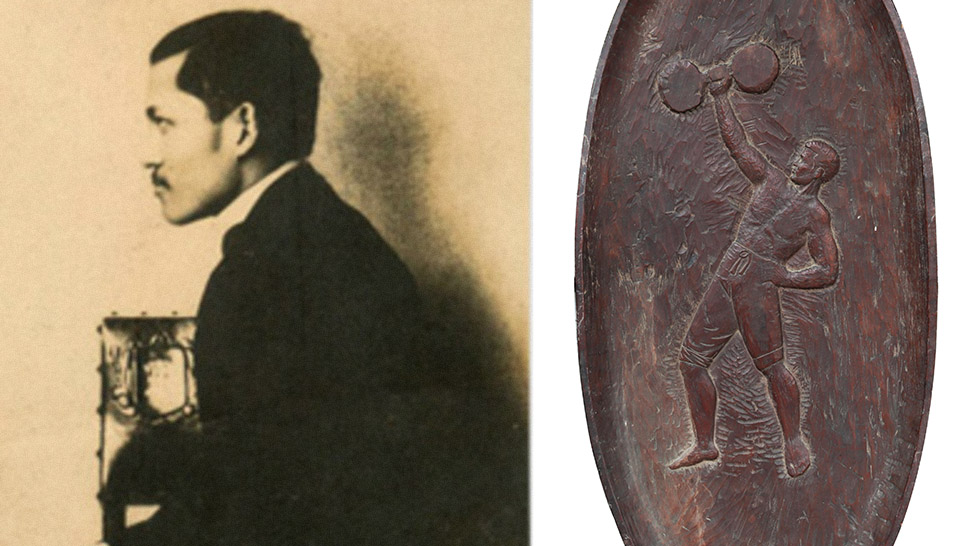
At Leon Gallery in Legazpi Village,
It is also a rare manifestation of the frustration experienced by the sculptor:
“The way the wood is being incised and chopped, you can see that he’s mad. He’s angry. He wanted to put that across.”
The work, dubbed The Filipino, is remarkable for its lack of polish. Unlike previous sculptures
“The way the wood is being incised and chopped, you can see that he’s mad. He’s angry. He wanted to put that across,” she says. “Now, he’s in Dapitan. He’s marooned. He’s probably, in his mind he’s thinking, he’s full of things that he wants to express. And because we know he wrote Indolencia, we know that that topic has been percolating in his mind.”

Extremely rare and historically important wood sculpture by Jose Rizal
Nakpil is referring to Sobre la Indolencia de
The essays were written in 1890, just two years before he was apprehended by Spanish authorities and sent to exile in Dapitan. His ideas, Nakpil suggests, were still fresh on his mind as he worked on The Filipino. She points to subject’s clothing and posture as an explanation.
"Imagine Rizal in exile for four years! It’s terrible. And they didn’t want to kill him. They tortured him first.”
“He’s wearing European exercise clothes. He’s not, as most half-naked Filipinos at the time were shown, in loincloths; no, this is a drawstring to-the-knee pantaloons. We’re not carrying spears or shields; it’s a European barbell. Now, he’s showing, we’re actually strong. We’re not savages.”
“What is unique about this piece,” she adds, “is that while the others he made during this time are sort of like little snapshots of his life in Dapitan, this is the only piece that we know of that actually has a meaning aside from being a snapshot. It’s about what Jaime calls ‘the ideal Filipino by the greatest Filipino.’ It’s a pseudo-Olympian; it’s a Greek strongman’s corpus

Rizal in profile bears a striking resemblance to the athlete in his sculpture.
The frustration in the piece, Nakpil opines, was also a reflection of the significant life changes Rizal had gone through in the early days of his exile before he’d been able to adjust to life in Dapitan.
“The Spanish knew how to punish their enemies. So, imagine Jose Rizal. Imagine you’d been living in Europe for the last eight to ten years. You speak Spanish, German, French. You’re used to Paris, Vienna, Madrid, Barcelona. What are they gonna do with you? They put you in the back of beyond, far from Manila, or even Cebu, or even Iloilo!”
“Can you imagine what life is like for us when you don’t have internet just for a day! Or having no mobile phone for a day; after just a few hours, you’ll go berserk! Now imagine Rizal in exile for four years! It’s terrible. And they didn’t want to kill him. They tortured him first.”
And even then, as detached as he was from the world he knew, it would seem that Rizal still found a way to keep his art fresh.
“It was very modern for the time,” de Leon points out. “You can see some roughness [on the piece] which is already modern, compared to the classical aspect that Filipino artists were following at that time.”
Knowing what Rizal must have been going through at the beginning of his exile, it’s easy to see how he must have relished every stroke of his chisel, how the brief burst of catharsis chipping wood from wood must have satisfied his raging heart. For all the depictions of Rizal as a mild-mannered, eloquent gentleman, it’s easy to forget that it was his passion that ignited a revolution.
The Filipino offers a glimpse of Rizal during a raw moment of his life—angry, resentful, and yet somehow hopeful at the same time. The piece is significant not just for its rarity, but for how vividly it captures the artist and his aspirations.
After it was gifted to his elder sister
For Filipinos, it’s a rare chance to see the national hero’s passion so viscerally expressed.
For more information on “The Filipino”, Leon Gallery, and its Spectacular Mid-Year Auction, contact [email protected] or call +632 856-2781.