

Inside the Exhibit That Celebrates Filipino Internet Culture

You might not remember the name Onel de Guzman on the first try but maybe these three words might jog your memory: I LOVE YOU.
In May 2000, de Guzman became known as the Filipino college student who sent out that infamous virus via email to overwrite files and steal sensitive information, self-replicating as it was passed through different chains. More than 50 million computers were affected by the virus, and around $15 billion in total was spent removing it. While there’s no denying the havoc it wreaked, it’s rare to hear others discuss de Guzman’s reasons for doing so. It turns out, Onel just wanted to connect Wi-Fi passwords for people such as himself who couldn’t afford a dial-up connection.
These nuances often slip through the cracks in conversations about third-world internet. We are the laborers that keep its infrastructure running: the content moderators, the call center agents, and the virtual assistants, to name a few. Yet our narratives are often obfuscated or flattened to appear palatable to a wider, whiter audience. But Forbes 30 Under 30’s Chia Amisola believes that this only erases the love, loss, labor, and liberation that defines online culture in the Global South.

Hence, their exhibit aptly called Kakakompyuter Mo Yan! (KMY), a distinctly Filipino cry of frustration, every mother’s reprimand when their children’s grades begin to slip or their health starts to fail. “That’s what you get for using the computer!” While its original delivery carries negative undertones, the message Chia and their team of over 20 contributors critique is proof that the World Wide Web can produce and preserve art, software, games, and literature that reflects the richness of our daily experience.
There’s Kuya Marlon of Deepweb Dumaguete’s story of falling in love with a beeper operator; Agu Crisostomo’s computer game, where players help a young gay boy access tabs of pornography in an internet cafe without getting caught (in the same vein as Y8’s Kill Time in Your Office from our childhood); Anton Romero’s interactive love letter to local piracy culture, aptly accessed through a file-sharing site; and Mac Andre Arboleda’s shrine to Onel de Guzman himself, where users are encouraged to leave WiFi passwords.
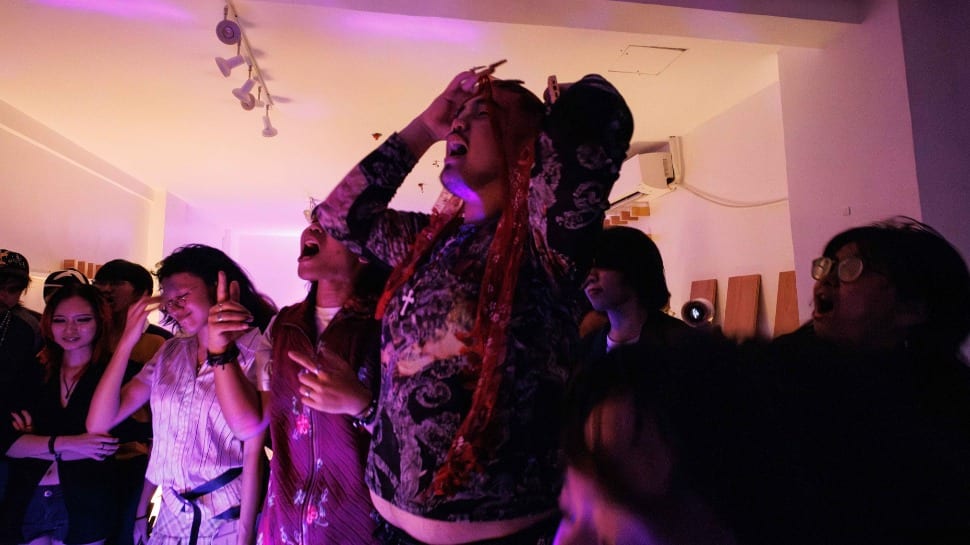
The physical component of the exhibit is viewable through either a pisonet terminal boasting the original League of Legends logo, or a CRT TV toggled the old-fashioned way. (With the kind of remote you need to slap against your hand a few times for it to function, mind you.) To add to the sheer Filipino-ness of it all, the exhibit is structured like a never-ending karaoke party. A little easter egg coded into the machine allows viewers to sing along to any crowd favorite of their choice with a readily available microphone.
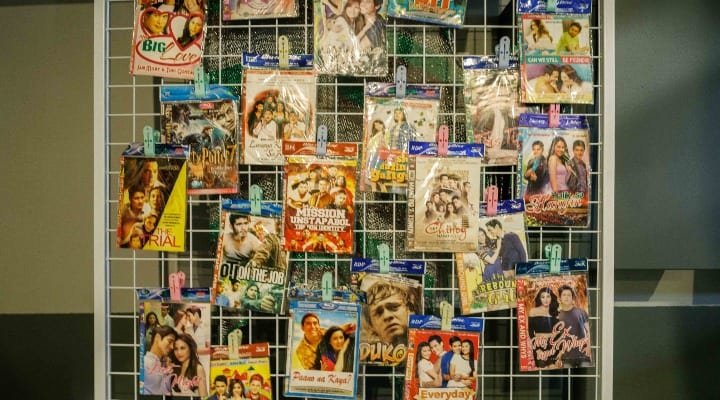
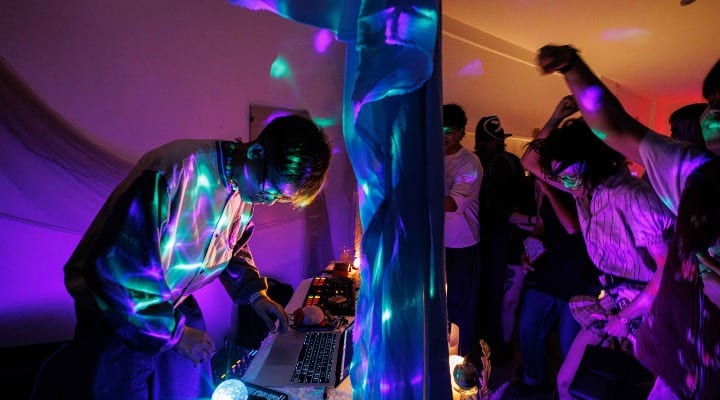
During KMY’s launch last August, visitors were greeted by a table of mixed drinks on a long plastic table flanked beside an actual fishball stand. A display of pirated DVDs was tacked to the wall Divisoria-style; on the floor above, another videoke setup, because some people just can’t wait for their turn to belt out Beer by Itchyworms. If you stayed around for long enough, you’d be treated to a ‘budots’-themed DJ set from the likes of Chain Messages. Once you take in the overwhelming stream of sights and sounds, it’ll start feeling like you never left your own neighborhood.
This intricately planned experience was a year in the making, with Amisola self-funding, coding, and sometimes even reformatting and adapting the artists’ work. Beatris Cabana’s To Induce a Period, for instance, started out as her hardbound undergraduate thesis. For KMY, both Amisola and Cabana restructured the collection of poems to resemble an online abortion forum, in the hopes of articulating the struggle of any Filipina seeking to terminate her pregnancy.
The 24-year-old product designer and internet artist is the perfect steward for this undertaking, with an illustrious track record of documenting the online history of the Filipino in the age of revisionism, disinformation, and repression. “I think to preserve my nation as it has lived and died on the internet might be my life’s work,” Amisola said in their Art & Code Talk at DEMO2024 in New York.
ALSO READ:
This Artist Is Helping Preserve the Dying Art of Repoussé in the Philippines
The Power of Presence and Interconnectedness in Jana Benitez's 'Wild Silence'
In 2016, they founded Developh, a high school organization that has since evolved into an institute that reclaims technology as a tool for liberation rather than oppression. Together with a team of volunteers and members, Developh has hosted 200+ programs and offerings: from events, workshops, and accelerators to libraries and archives. One of their most notable projects is the Martial Law Index, a curation of resources and artifacts concerning the Dictator Ferdinand Marcos’ rule – an era that thrives on the collective amnesia of the Filipino people.
Unfortunately, the current iteration of the internet has only exacerbated these conditions. Everything is not only transient, but also made for profit. We barely have time to process what the algorithm serves us before our attention spans surrender. “Websites are templated, heavy, constrained, seen as a place for performance rather than sincerity,” Amisola told Escape the Algorithm in an earlier interview. “People don’t have as much say about what they make and how it’s distributed.”
But in a country like the Philippines, where leisure is a privilege and public spaces are limited, our relationship with the online world is sometimes all we have. As a result, we’re forced to contend with the limitations of Western platforms. “When Filipinos make net art, we erase this impossible boundary between ourselves and technology that we’ve been enclosed around our whole lives. We’re simply living,” Amisola lamented in their DEMO2024 talk.
Growing up, the internet was first a place for self-exploration and expression, an extension of the self. I developed my writing practice on a neon pink Blogspot site at the age of six, and passed the time in online forums and fanfiction to teach myself what I couldn’t learn in my conservative all-girls Catholic school. It was where a community could flourish and grow, regardless of arbitrary barriers – and this is exactly what Amisola wants to bring back through KMY, among other avenues.
Unlike the usual experience of going online, which involves fishing a phone out of a pocket and making a few quick swipes, accessing the KMY library on a normal day involves falling in line or even congregating around the machine, reminiscent of how young boys would peer over someone’s shoulder in a neighborhood internet cafe.
Aside from the intentional slowness and close proximity the physical space permits, Chia’s team has also organized presentations and readings on cyberfeminism, and an artist-led workshop where participants weave pusô (hanging rice) and keep the disappearing traditional craft alive. Some future plans include providing access to KMY across the Philippines through repurposed pisonet machines and USBs, and hopefully expanding to the broader global south to incorporate more third-world perspectives.
In 2020, a BBC correspondent tracked the elusive Onel de Guzman down, two decades after he unintentionally infected the world. When asked why he used I LOVE YOU as the title of his email attachment, he said, “I figured out that many people want a boyfriend, they want each other, they want love, so I called it that.” Much like Onel, but through less controversial means, Amisola seeks to appeal to the same human desire to reclaim the internet as we know it today and reshape it into something that’s our own: “I look at the internet as a place where I can gather all the people I love and want to build an internet that’s just like it.”
Kakakompyuter Mo Yan! is available for viewing at Space63, Comuna (238 Pablo Ocampo Sr. Ext) until September 21st, and can be found online here. Donate to the team to fund more KMY exhibits in the future.
