

Pop Goes the Fable: Catching Up With Sean Go in Paris


In Paris, a Filipino artist explodes sacred icons of pop culture. Sean Go and his brand of vibrant anarchy are back, this time with the exhibition Pop Goes the Fable, hosted by Hoang Beli Gallery.
Around 200 people made quite the ruckus at serene Rue Chapon during the opening day. Known for championing the Asian diaspora, the gallery and its owner, John Hoang, have carved out an interesting space around Le Marais, one that values diversity, identity, and universal connection. Go becomes the freshest voice to be amplified amidst the busy Parisian art scene. The pop art showcase is the latest in a string of successful shows in Paris for Go, who has now had interesting exhibits over the past years in Manila, Osaka, and New York.
"Moon Rabbit"; 2025; acrylic paint
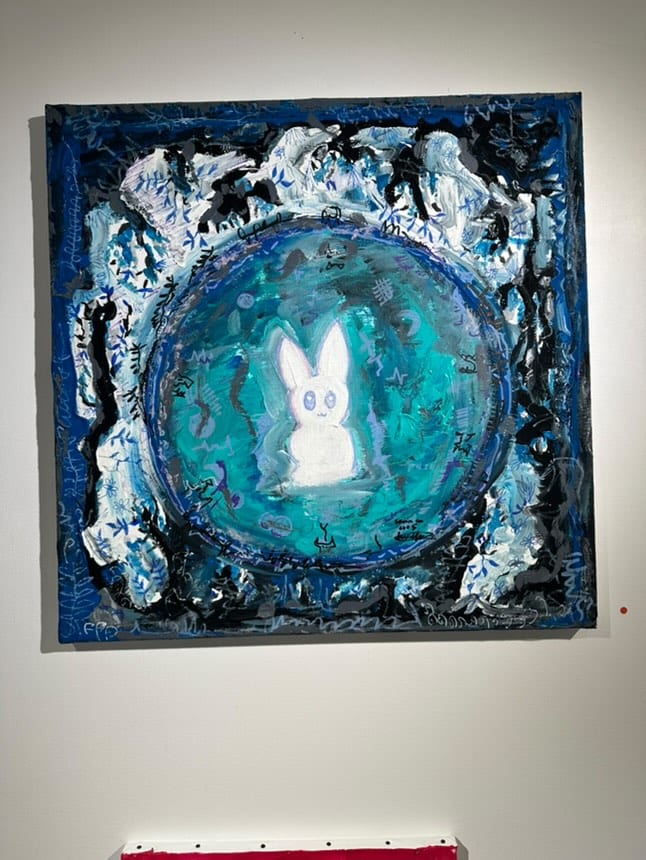
In Pop Goes the Fable, the artist delves into the fascinating world of fables, rethinking their cultural origins and their prescribed meanings. Go credits his time spent at Parsons School of Design for shaping the conceptual weight behind the exhibition. Particularly, he was struck by the theorist Roland Barthes' ideas about myth-making. "Myths come as a result of repetition of stories out in the world, and largely that discourses are contested and fought to bring new meaning,” says Go.
The artist reexamines the various heroes and heroines of some of the most retold legends and fables across Asia, Europe, and America, infusing them with his signature cartoonish irony. Myth, as the theorist once said, is neither a lie nor a confession: it is an inflexion. It is within and from that that the artist operates. In Go’s hands, myth becomes a contested site, something we negotiate over time and across ideologies.
“The exhibit likely aims to deconstruct these 'myths’ created around fables,” he explains, “revealing the layers of meaning that have accumulated over time and exploring the power dynamics involved in shaping these narratives.”
"Captain America," 2023; acrylic paint
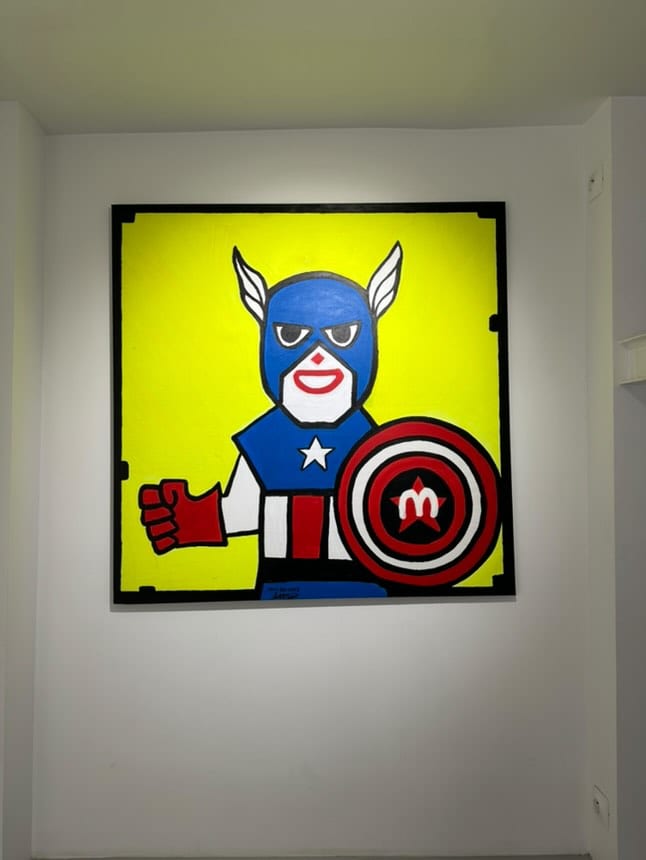
Pop Goes the Fable erupts like a Technicolor dream—a bright, absurd, and deadly serious indictment of myth-making. What Barthes might’ve called second-order semiological systems, Go reimagines such myths as crayon riots tripping on themselves, stumbling away from their original meanings and contexts.
We see a tender, quiet violence to Go’s palette here: the usual acidic yellows, screaming fuchsias, and thick strokes, evoking both innocence and brutality. The aesthetic feels deliberately accessible and “unfinished,” as if to leave space for the viewer to reckon with what’s missing, what’s been distorted.
ALSO READ
Manuel Ocampo and the Carnival of Monsters
Benedicto Cabrera, Filipino Artist in Flux
The fables become linguistic battlegrounds. Consider Go’s reworking of the “Wolf in Pig’s Clothing.” He has two simultaneous stories fold in on themselves and become less about good versus evil and more about who gets to write the ending—and what language they’re allowed to use.
But Go doesn’t stop at Barthes. Michel Foucault lurks in the walls of the exhibit. “Foucault emphasized that the specific words and language used within a discourse are never neutral,” Go points out. “They carry historical baggage, reflect power relations, and actively contribute to the construction of meaning.”
"The Legend of the Pineapple (Filipino Fable)"; 2025; acrylic paint
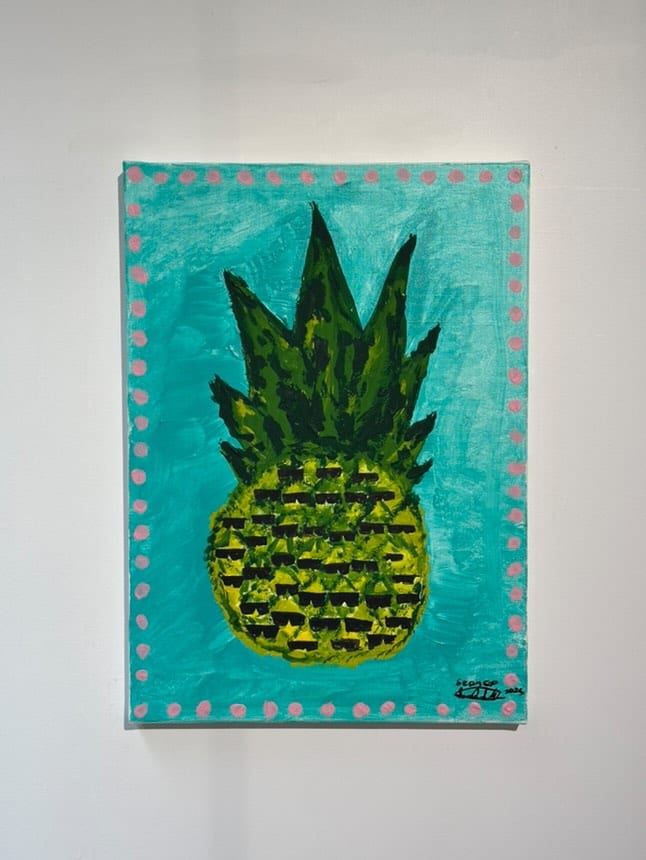
One of the central pieces of the exhibit reimagines the old Filipino folktale, “The Legend of the Pineapple.” But instead of a gentle cautionary tale on obedience and respect, Go’s interpretation is aglow with satire: we see the girl’s thousand eyes resemble surveillance tech (the artist, after all, mentioned Foucault being a key contributor to the concept; so it’s hard not to think of the panopticon), her fruit body rendered with militaristic chrome. This multilingual, multicultural echo chamber of allegory retells and interrogates the sacred icons of childhood.
By juxtaposing such stories with contemporary iterations in popular culture and commerce, he traces Barthes' ideas about how meaning is constructed and contested and ultimately how it becomes "naturalized" within a society.
The scene outside Hoang Beli.
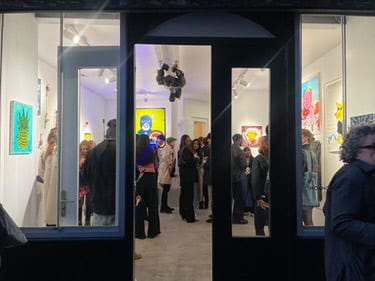
Such appropriations transform these familiar images. With it, Go creates a dialogue between past and present, East and West, the sacred and the lowbrow, and high art and popular culture. It’s a testament to how art can transcend cultural barriers, as well as to the enduring relevance of fables in understanding our contemporary world.
Go’s ability to fuse theory and visual excess is what makes Pop Goes the Fable feel urgent. It’s a postcolonial fever dream, an annotated children’s book, a thesis on capitalist mythologizing disguised as a cartoon universe. His work is equal parts remix and resistance. And in a world drunk on simplification, Go, we may argue, insists on complexity.
Pop Goes the Fable is on display with Hoang Beli Gallery at 30 Rue Chapon, 75003, La Marais, Paris until May 18, 2024. For more information, visit the gallery’s website here.
