

To Make Better Pasta, A Mano Turns to the 'King of Carbonara'

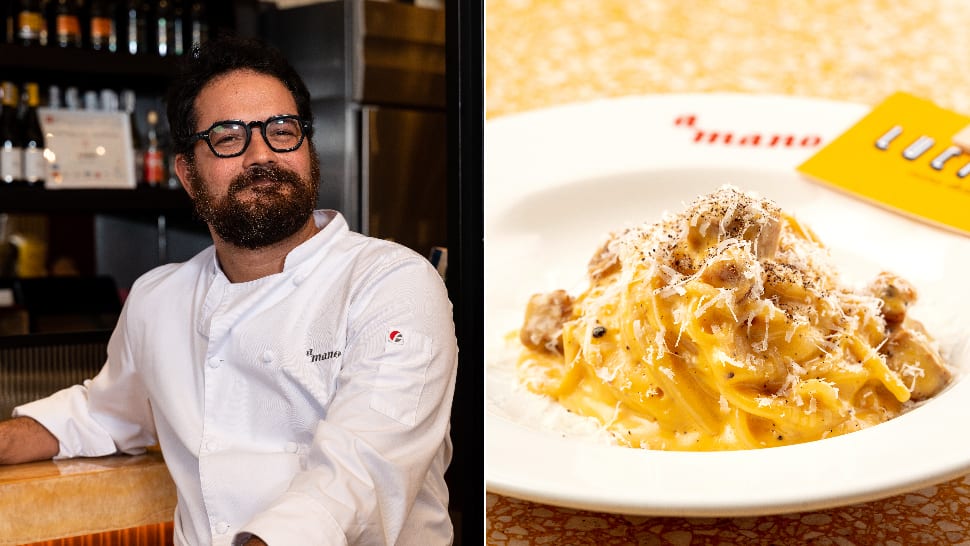
Luciano Monosilio was 26 years old when he won his first Michelin star. At that restaurant, Pipero al Rex, which is located in Rome, he married the traditional flavors of Italian cuisine with more modern techniques. One of his most famous dishes was his take on carbonara, which has been so acclaimed the world over that it has earned for him the rather impressive honorific “King of Carbonara.”
Margarita Fores, Luciano Monosilio, and Amado Fores
.jpg)
“The New York Times came (to visit) and then they gave me the name King of Carbonara because it was something strange for fine dining restaurant to serve (a) traditional plate,” he tells Esquire Philippines during a brief visit in early August. “That time was completely different than now, because now it's much easier to find traditional plates in fine dining restaurants.”
ALSO READ
Margarita Forés on Her Son Amado: 'He Reminds Me of Me When I Was Younger'
These Chef and Restaurant Collabs Showcase the Best of Singapore and the Philippines on a Plate
One would think anyone would be pleased to be known as the “King” of anything, but Monosilio admits he was initially upset at the title. He had worked to present a full menu of Italian classics with a modern twist at the restaurant, but all anybody would ask for was his famed carbonara.
Chef Luciano working with A Mano's chefs
.jpg)
“That was a big challenge,” he says. “But after many years, I understood what should be the opportunity about the carbonara.”
That’s when Monosilio decided to open his own restaurant, Luciano Cucina Italiana, which would become the home of his carbonara. He was careful to brand it not as a traditional Italian trattoria, but a more modern restaurant.
“That's important to know, because sometimes people get confused because they think it's a trattoria,” he says. “Yes, we make carbonara, but no, it's not a trattoria.”
So how does he make this carbonara that has achieved near-legendary status. Monosilio explains that, contrary to what people might expect, he doesn’t make it the original way, but that he puts his own spin to the process. He uses the same ingredients—guanciale or cured pork jowl, egg yolk, cheese and pasta (no cream)—but makes sure to keep the temperature of the egg below 65 degrees Celsius, which prevents it from overcooking it and turning it into scrambled eggs.
Chef Luciano's famed carbonara
.jpg)
He also doesn’t heat the sauce over the fire or in a pan but mixes the cheese and eggs in a bowl over a water bath.
Monosilio explains that, while people are free to attempt to make his version of the carbonara at home, there is something different when professional chefs like him make it.
In 2015, Monosilio crossed paths with one-time Asia’s Best Female Chef Margarita Fores and her son Amado, who invited the Italian chef to come to Manila to help improve the processes of their own Italian Restaurant, a mano. The restaurant is doing fine and had actually won notices for its pizza (even placing in the 50 Best Pizzas in Asia Pacific list at number 15 this year), but clearly Amado believes there’s always room for improvement.
This isn’t the first time A Mano has worked with international chefs to help make what’s already good become even better. Last year, the restaurant invited the folks behind Thailand’s Pizza Massilia, which had earned the title of “the best pizza in Bangkok,” to come to Manila. In July, the restaurant group hosted micro pizzeria Small’s from Singapore, led by Chef Bjorn Shen.
Plating the carbonara
.jpg)
For a few days, Monosilio and his team worked with the chefs of A Mano to perfect their food, particularly their pasta. The Italian chef said he was impressed with what he saw.
“They’re good,” he said. “They already have knowledge. You know Margherita, she’s very knowledgeable with Italian cuisine. She and Amado are traveling a lot in Italy. So there is great Italian flavor (in their food).”
