

Yes, These Churches in the Philippines Were Built With Eggs

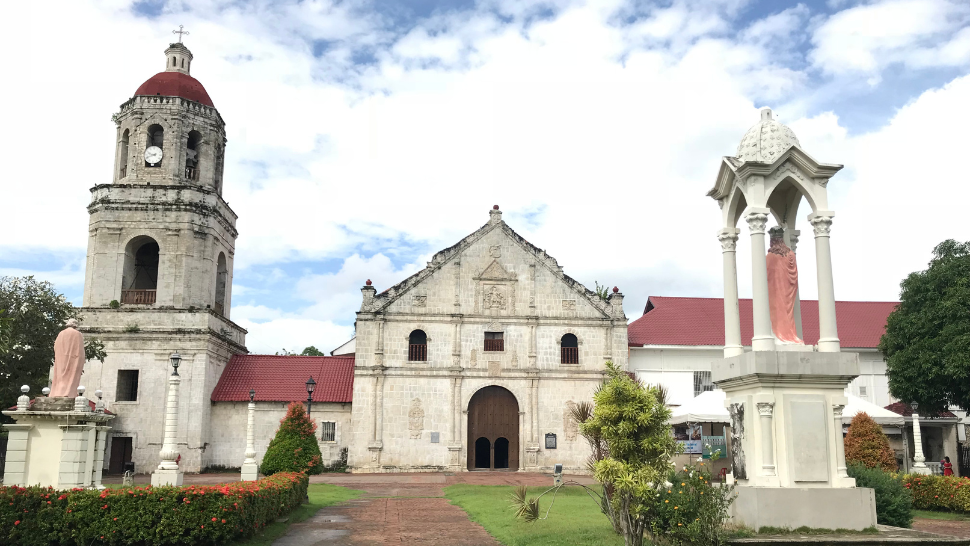
It can be hard to fathom how some of the oldest, most impenetrable stone churches in the Philippines can be built with eggs. But during the Spanish Colonial period, egg whites were commonly used to reinforce these structures.
It was a common practice for Spaniards to use egg whites to make a mortar mix called argamasa. The whites would make the buildings' reinforcement more durable, based on historical records.
Millions of eggs were used to build churches throughout the Spanish colonies, including ours. During the Spanish occupation in the Philippines, egg whites were emulsifiers for concrete by various religious orders, from the Augustinians and Franciscans to Jesuits and more.
We can attribute the use of stone and masonry construction in the country to Jesuit missionary Antonio Sedeño. Spanish Dominican historian Fr. Pablo Fernandez OP, who had authored History of the Church in the Philippines, said that Sedeño had “knowledge of quarrying [and] finishing stone, erecting arches, and measuring distances. [His] work was copied by others and carried throughout the archipelago.”
Dr. Michelle Sotaridona Eusebio, who majored in Archaeology, at the Department of Anthropology, University of Florida for her doctorate work, claimed that eggs were combined with lime, sand, water, and various ingredients to make the mix.
Priests were said to have paid townsfolk for the materials and labor. Men took care of the lifting of the logs while women and children were the ones who brought the eggs and sand to the construction site.
ALSO READ:
These Are the Oldest Churches in the Philippines
24 Historic Philippine Churches
The mortar mix, however, would differ from region to region based on natural materials native to the locality. In Vigan, for instance, natural lime mixed with egg white was popular. It was also customary to use sticky extracts from plants like maguey.
Pampanga churches such as the Holy Rosary Parish Church in Angeles City, San Guillermo Church in Bacolor, St. Augustine Church in Lubao, and St. James the Apostle Church in Guagua, are good examples of churches with eggs as their foundation. Manila Cathedral in Intramuros, Manila, on the other hand, used a different kind of eggs for its structure—duck eggs to be exact.
In the paper Eggs in Philippines Church Architecture and its Cuisine, culinary historian Pia Lim-Castillo said that "records show that the dome of the Manila Cathedral was sealed in 1780 with a layer of lime, powdered brick, duck eggs, and bamboo sap.” Friar Mariano Gomes of Cavite, had even listed duck eggs for the mortar in his expense list from the year 1824. His predecessor had used duck eggs for a church in Bacoor, as well.
After being destroyed in 1945, the Manila Cathedral's current architectural reconstruction is characterized by Romanesque Revival elements.

The San Guillermo Church Parish was founded by the Augustinians in 1576.
The Daraga Church in Albay was erected by the Franciscans in the 1770s.

Egg whites were used to build the Archdiocesan Shrine and Parish of Saint Michael the Archangel in Argao, Cebu, too. This church is famously made out of white and coral stone. Some townsfolk also credit the structure's history for the legend behind a local delicacy called La Torta de Argao, which is made of flour, sugar, tuba, lard, and, you guessed it, egg yolks.
Seeing all the extra yolks thrown away during the construction, Filipino women at the time saw this as an opportunity to make something out of them. What came about were some of our most iconic desserts. If we trace our culinary history, the likes of pan de San Nicolas, yema, tocino del cielo, leche flan, and tortas came about during the Spanish occupation, as well. These, however, are the stuff of myths that have yet to be proven. It sill makes for interesting historical rumor, though.
Nevertheless, what we can take away from these stories is that the aforementioned colonial churches have stood the test of time, from earthquakes and eruptions to modernization and more. These places of worship were a byproduct of the time's best technologies, methodologies, and techniques, and they should be appreciated as such. Moving forward, if we restore these churches, we should at least explore the idea of reconstructing them in a similar manner. It's the only way we can truly honor our past, one broken egg at a time.
Sources:
- Eggs in Philippines Church Architecture and its Cuisine
- History of the Church in the Philippines
- Did Our Church Builders Use Egg Whites as Mortar Ingredients?: The Biomolecular Reason behind Collecting Mortars from Historical Sites
- How Building Churches Out of Egg Whites Transformed Filipino Desserts
- Do Spanish colonial structures need steel reinforcement?
