
Saturn's Inner Moon Looks Like a Space Empanada

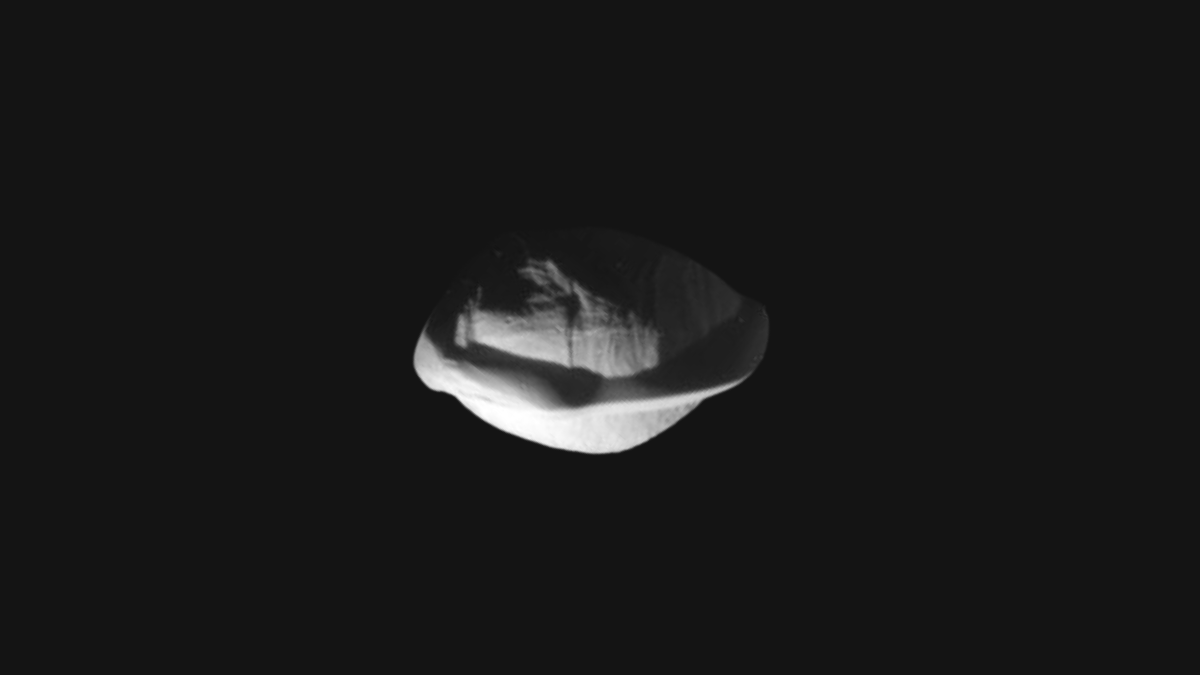
For centuries, something peculiar lay hidden between Saturn’s rings. The tiny moon—35 kilometers wide—looks like a space empanada. Although others could argue it looks like a piece of ravioli, a dumpling, or an uncracked walnut. The moon, Pan, is the innermost of Saturn’s 83 moons. It was discovered by M.R. Showalter in 1990 while analyzing images taken by the Voyager 2 spacecraft in 1981.
Why does it look like an empanada?
The most prominent feature of Pan is the ridge surrounding the moon, making it look like an oversized empanada. Like Saturn's moon Atlas, Pan has an equatorial ridge that gives it a distinct shape. The ridge is composed of accumulated frozen particles from Saturn’s rings. As Pan revolves around Saturn, it clears up a path in the rings, creating an area called the Encke Gap, a 325-kilometer opening equivalent to the distance from Manila to Vigan or the distance between Cebu City and Legazpi City.
The Encke Gap with Pan Seen as a Tiny Dot

Where did the name Pan come from?
Traditionally, Moons of Saturn were named after Greek and Roman gods and goddesses. But That was during a time when astronomers did not realize Saturn would have as many as 83 moons. When they ran out of Greek and Roman gods, they went for characters from Norse, Inuit, and Gallic mythologies.
The Moon Pan, as much as it looks like pastry, is not actually named after a bread.
“Pan, a satyr, a creature resembling a man with the hind legs and hooves of a goat, is a Greek god of nature and the forest,” says NASA.
Check out Pan’s images below, taken by NASA’s Cassini spacecraft during a flyby in 2017.

