

The Story of 'Homeless Jesus'

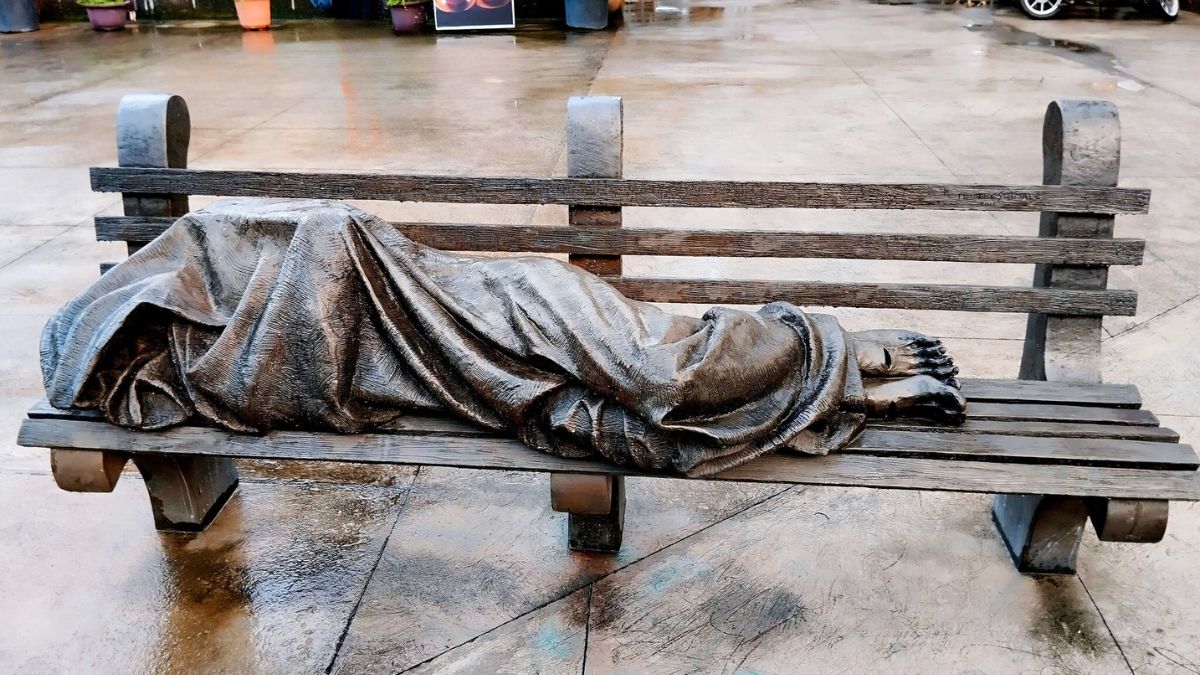
If you've been to the Manila Cathedral in recent times, you might have come across a curious bronze statue in front of the church. It depicts a man, his identity shrouded by a blanket, as he sleeps on a park bench—seemingly indistinguishable from those without a home to return to at night. The figure reveals its identity as Jesus solely by the signs of crucifixion on its feet. The life-sized sculpture, crafted by Canadian sculptor Timothy P. Schmalz, is titled "Homeless Jesus."
Manila Archbishop Jose F. Cardinal Advincula unveiled the statue On April 10, 2022, Palm Sunday. The Manila Cathedral hopes that the sculpture not only becomes "a place for visits or pictures, but a space to deepen our prayer and to convert and change our hearts.”
ALSO READ:
Quiapo Church Has Now Been Officially Recognized as a National Shrine
Yes, These Churches in the Philippines Were Built With Eggs
“Ang imahen ng ‘Homeless Jesus’ ay nangungusap sa atin, sumisigaw sa atin na marinig ang tinig ni Hesus at makita siya sa mga kapatid nating walang lugar sa ating lipunan at walang lugar sa ating puso,” Cardinal Advincula said in his homily that year.
Schmalz's statues of the "Homeless Jesus" are also installed in various prominent locations worldwide, including the Papal Charities Building in Vatican City; Christ Church Cathedral in Dublin, Ireland; Cathedral of the Good Shepherd in Singapore; St. John the Divine Cathedral in New York, New York; Holy Magdalena Church in Bruges, Belgium; St. George’s Tron Church in Glasgow, Scotland; Sant’Egidio in Antwerp, Belgium; St. Anne’s Square in Manchester, England; the Sant’Egidio Headquarters in Trastevere, Rome; Capernaum, Israel; Almundena Cathedral in Madrid, Spain; and many others.
The Manila Cathedral hopes that the sculpture not only becomes "a place for visits or pictures, but a space to deepen our prayer and to convert and change our hearts.”

Schmalz said the “Homeless Jesus” is a visual representation of Matthew 25:35–45, where Jesus teaches about the importance of being compassionate to those in need. He illustrates that caring for the hungry, thirsty, strangers, unclothed, sick, and imprisoned equates to caring for Him. The renowned figurative artist said seeing a homeless person sleeping on a bench during the Christmas holidays moved him to create this sculpture.
For more than 25 years, Schmalz has dedicated himself to creating large-scale sculptures. Timothy views his most significant creations as visual translations of the Bible. "I describe my sculptures as being visual prayers. When I create a three-dimensional sculpture in bronze, I am quite aware that it will last longer than myself. I realize I am between two things that are much more durable than myself: Christianity and bronze metal," he wrote on his official website.
The figure reveals its identity as Jesus solely by the signs of crucifixion on its feet.

Schmalz sees his outdoor sculptures as effective advertisements for Christian churches. "The best compliment these sculptures receive is to amaze and fascinate the most cynical youths of today," he said. By placing a compelling sculpture outside a church, he aims to spark curiosity and encourage them to go to church.
"My purpose is to give Christianity as much visual dignity as possible. Christian sculptures are like visual sermons twenty-four hours a day," he added.
The sculptor highlighted an insightful quote from Saint Gregory the Great, who noted that “art is for the illiterate,” emphasizing the power of imagery in educating the masses.
"Our contemporary culture is in the same state today, not because of illiteracy, but because people are too busy to read. In this world of fast-paced schedules and sound bites, Christian art creates 'visual bites' that introduce needed spiritual truths in a universal language," Schmalz said.
