

Today I Learned: ‘Kung Hei Fat Choi’ Doesn’t Mean ‘Happy New Year’

Also known as the Lunar New Year or Spring Festival, Chinese New Year is one of the most significant and widely celebrated holidays in the world—celebrated by around a quarter of the world’s population. It is based on the lunar calendar, typically falling between January 21 and February 20. This year, it starts from January 29 to February 8, 2025.
Its origins date back over 3,000 years, a celebration rooted in ancient myths and agricultural traditions. Legend says that a mythical beast called Nian would terrorize villages at the start of the new year—devouring humans, crops, and livestock. Villagers then discovered that the monster feared loud noises, fire, and the color red, thus giving birth to age-old traditions such as setting off firecrackers, wearing red, and hosting grand celebrations.
Chinese New Year is a time of family reunions, feasting, and honoring ancestors. Each year is associated with one of the twelve Chinese zodiac animals and 2025 marks the Year of the Snake, symbolizing intelligence, wisdom, and transformation.
ALSO READ
Where are Filipinos Spending the Chinese New Year Holiday?
New Ways to Rock Red: Celebrate Chinese New Year in Style
Kung Hei Fat Choi: What It Really Means
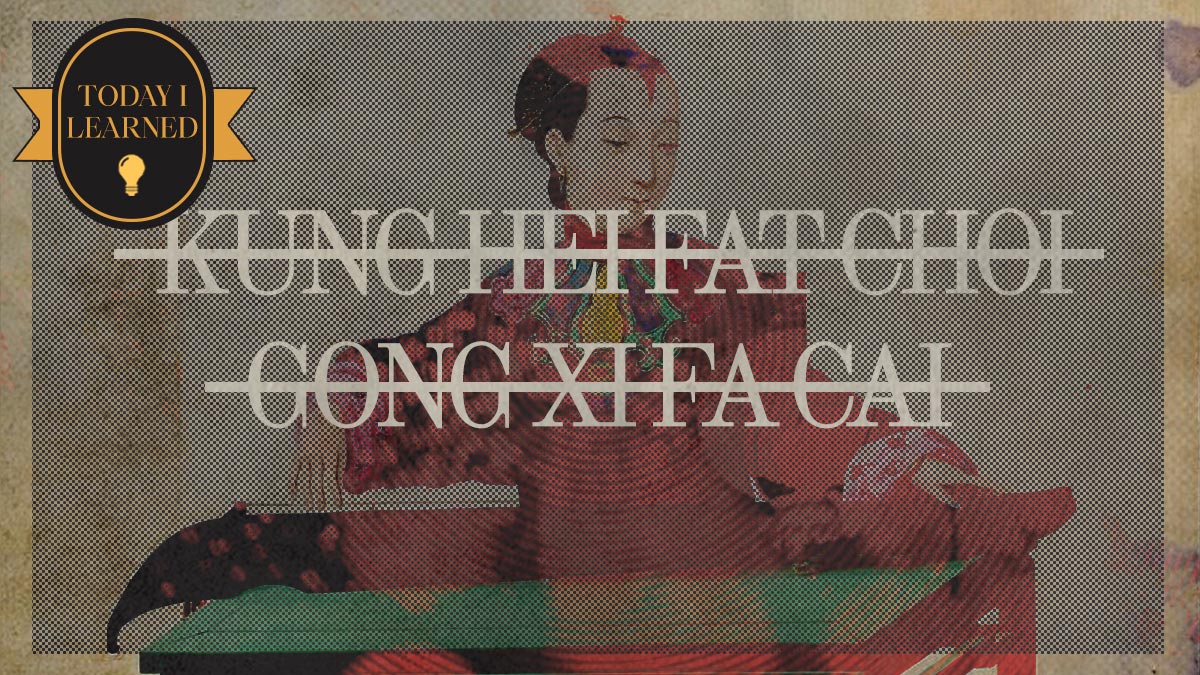
For years, many people—especially in non-Chinese-speaking countries—have assumed that “Kung Hei Fat Choi” directly translates to “Happy New Year.” However, the phrase actually means “Wishing you prosperity and wealth.” While this is an auspicious and widely-used greeting during Chinese New Year, it does not express the general well wishes that “Happy New Year” conveys in English.
Interestingly, “Kung Hei Fat Choi” was also the title of a 2003 Hong Kong film, further popularizing the phrase beyond Chinese-speaking communities. While it’s not a bad greeting per se, the Mandarin way of saying “Happy New Year” is actually “Xin Nian Kuai Le” and in Cantonese, it’s “Sun Nin Fai Lok.”
In the Philippines, “Kiong Hee Huat Chai” is a popular saying among the Filipino-Chinese communities. While there’s no direct translation, former Chair of Chiang Kai Shek (CKS) Language Center Thunderson Tan shares what it means in his TikTok video: “Ito ‘yung paboritong greeting ng mga Chinoy tuwing Chinese New Year…Ang ibig sabihin ng ‘Kiong Hee’ ay ‘Sa loob ng puso ko ay may dala-dala akong ligaya at selebrasyon at ibinabahagi ko ito sa’yo.’ Ang ‘Huat’ ay lumago at ang ‘Chai’ ay kayamanan o pera."
In other words, it’s a mix of saying Happy New Year and wishing someone more prosperity and wealth. Known as Filchi Thunder (@thunder.filchi) on TikTok, he also revealed that “Kung Hei Fat Choi” is the Cantonese version, while “Gong Xi Fa Cai” is the Mandarin version—but they all hold the same meaning.
He further shares in another video that “Xin Nian Kuai Le” is barely spoken here in the Philippines: “Ginagamit lang namin [ang ‘Xin Nian Kuai Le’] ‘pag kausap naming ‘di marunong mag-Hokkien na Chinese or sa formal setting dahil ang ‘Xin Nian Kuai Le’ ay Mandarin. ‘Pag pumunta ka sa Taiwan or China, ‘yan ang madalis gamitin. Sa Hokkien ito ay ‘Sin Ni Khuai Lok’…pero ang nakasanayan pa rin ng mga Chinoy ay ‘Kiong Hee Huat Chai’ ‘pag formal, ‘Kiong Hee’ kapag informal."
Why Are ‘Kung Hei Fat Choi’ and ‘Gong Xi Fa Cai’ Popular in the Philippines?
Due to centuries of trade and migration, the Filipino-Chinese community (also known as Chinoys) in the country has grown and shared various traditions to the rest of the country, including the celebration of the Lunar New Year.
“Kung Hei Fat Choi” became widely popular because of the strong influence of Cantonese-speaking communities in the country, particularly in Binondo, Manila—recognized as the world’s oldest Chinatown. Businesses, media outlets, and local festivities have reinforced the use of this phrase over the years. To this day, you will find plenty of posters with this greeting.
Meanwhile, “Gong Xi Fa Cai” is more commonly used among Mandarin speakers and has gained traction in recent years due to its prevalence in global media and online content. Regardless of dialect, both phrases symbolize the same wish for success and prosperity.
How to Attract Prosperity This CNY
Speaking of wealth and prosperity, there are plenty of well-known customs to follow this Lunar New Year for good fortune:
- Wear red: Aside from warding off Nian (or evil spirits), red symbolizes luck.
- Give and receive ang pao (red envelopes): Traditionally filled with money, ang pao are given to children and children-at-heart—as a way to pass on good luck.
- Eat auspicious food: Dumplings represent wealth, fish symbolizes prosperity, and long noodles for longevity.
- Decorate with lucky symbols: Chinese lanterns, red couplets, and images of the zodiac animal of the year.
There are certain things, however, that you must avoid or not do to prevent bad luck:
- Sweeping on the day of Chinese New Year: It is said to “sweep away” good fortune.
- Avoid saying negative words: Those related to death, sickness, and misfortune should not be spoken.
- Washing or cutting your hair: As with sweeping, washing or cutting your hair means getting rid of fortune and luck.
- Using sharp objects: Knives and scissors are also believed to “cut” your fortune.
Whichever the greeting you use, the essence of Chinese New Year remains the same—a time for joy, celebration, and wishing everyone well and good fortune. These traditions, superstitions, and greetings reflect a rich cultural heritage that has endured for centuries and continues to be celebrated all over the world. So, this Chinese New Year, why not impress your Filipino-Chinese and Chinese friends by knowing exactly what your greetings represent?
