
This Doctor Is One of the First to Get the Sinovac Vaccine. Here's What He Wants You To Know

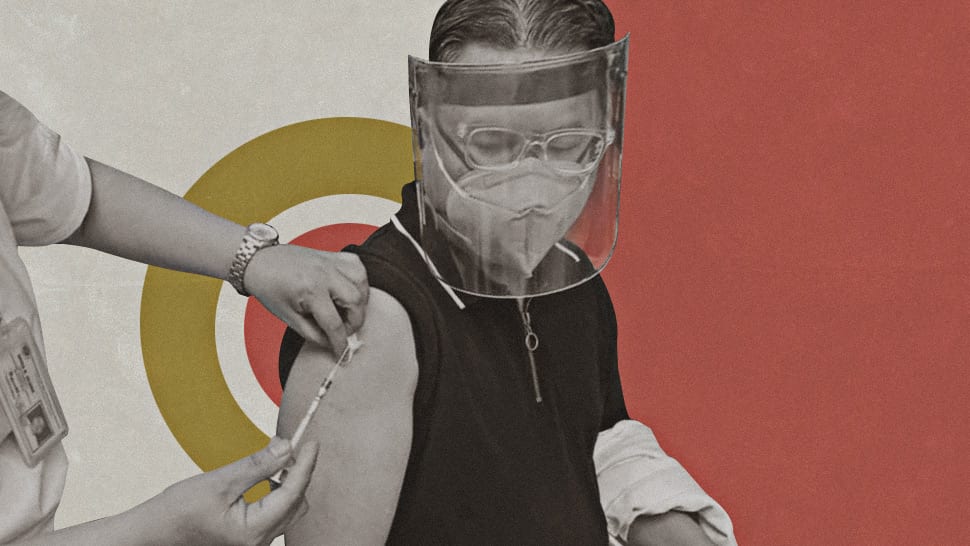
ILLUSTRATION: WARREN ESPEJO
Doctor Joseph Adrian Buensalido is an infectious disease specialist affiliated with the University of the Philippines – Philippine General Hospital, Asian Hospital, and Makati Medical Center. On Monday, March 1, he was one of the first medical professionals who received the vaccine against the coronavirus during a ceremonial inoculation held at the UP-PGH.
Around 100 frontliners who signed up received the Sinovac vaccine through a donation from China that arrived in the country on Sunday. The rollout of the vaccine is ongoing in several hospitals with high admission rates of COVID-19 cases.
“I’m happy to get it,” Dr. Buensalido told Esquire Philippines while taking a quick break from doing his rounds. “We’ve all been waiting for it for around one year, so it was a relief to finally get vaccinated.”

Slight side effects
Dr. Buensalido, who is also the infection control chair of the Asian Hospital and deputy training officer of the Division of Infectious Diseases at UP-PGH, said there were slight side effects after getting inoculated, but nothing too serious.
“As you might have heard in the news, you may experience side effects but they’re all local, meaning slight pain, swelling, and redness on the arm,” he said. “For me, I only felt a slight heaviness for around 15 to 30 minutes after getting the vaccine. But no pain. My right deltoid is still not normal, but it doesn’t affect my work.”
Dr. Buensalido talked about reactogenicity, which is defined as “the property of a vaccine of being able to produce common, ‘expected’ adverse reactions, especially excessive immunological responses and associated signs and symptoms, including fever and sore arm at the injection site.”
“The vaccine’s main goal is to train our immune system, to try to give it a ‘heads-up’ to watch out for this virus, he explained. “The vaccine is showing [the body] what [the virus] looks like and what you should watch out for in the future.”
“The vaccine helps the soldiers of our body, mobilizing, training, learning, and reacting,” he added. “So the side effects are nothing out of the ordinary. I mean, we were vaccinated as kids and even as adults. So it’s no different.”
Getting Sinovac
Buensalido is aware of the controversy surrounding the deployment of the China-made Sinovac vaccine, about 600,000 of which were donated by the Chinese government. Last week, the Food and Drug Administration (FDA) said that the vaccine’s efficacy rate on healthcare workers was at 50.4 percent and cautioned that it was not the best vaccine to administer to medical frontliners.
“My personal feeling is that we are in a Titanic-type of situation,” he said. “We’ve been able to hold down two surges, one in March and another in July and August. The numbers were going down, but now they’re going up slightly again. So we’re in a ship that’s slowly sinking. I feel that we’ve been waiting a long time for our life vests. And finally, the life vests have arrived.

“So when a life vest is offered to you, you take it,” he added. “Your reaction shouldn’t be, ‘I’ll wait for another life vest.’ [The one we have now] might not be as good and as shiny, but it works to save us. Pangit naman yung nasa Titanic, tapos mag-aaway pa kayo sa life vest (It’s not good that you’re like in the Titanic and you fight over life vests).”
Buensalido said that the Sinovac vaccine has been deemed safe by FDAs in many other countries. It has also been examined by National Immunization Technical Advisory Groups (NITAGs), which, according to the World Health Organization, are multidisciplinary groups of national experts responsible for providing independent, evidence-informed advice to policymakers and program managers on policy issues related to immunization and vaccines.
“Does [Sinovac] work? It does,” he said. “So my recommendation is, if it’s offered to you, you should take it.”
Finally, Buensalido stressed the importance of getting as many people vaccinated as soon as possible in order to achieve herd immunity.
“Vaccine offers individual protection, but the truth is that we need it to achieve herd immunity. At least 67 to 70 percent of the population needs to get it so we will achieve herd immunity, which means we will protect not just ourselves but those who can’t get the vaccine. There will be a percentage who cannot get it, like those who have an allergic reaction, but through herd immunity, we can protect them as well.”
Don't let your guard down
But getting the vaccine doesn’t mean letting our guard down against the virus. Buensalido pointed out that, for over a year, we’ve been defending ourselves with masks and face shields, and through proper health and safety precautions like better ventilation and hand hygiene.
“Those are all time-tested,” he said. “For a year, we’ve been doing it, and it’s been working. So we won’t turn our backs on our PPEs (personal protective equipment). We finally got this last piece of defense against the virus. But I think we still need to maintain a healthy dose of precaution and fear.”
