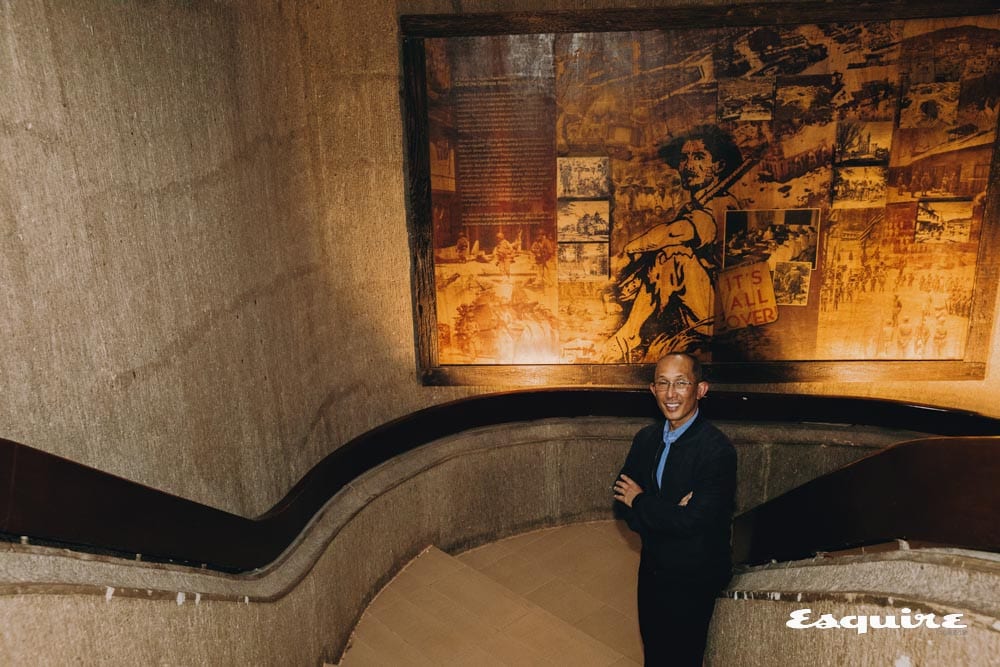
Every year, Esquire Philippines presents Man at His Best, the local iteration of a global signature event where we celebrate extraordinary Filipino men and women reshaping society as we know it. These are the dreamers and doers who have made a profound impact on the Filipino's way of life, who are using their talents and skills to make something of themselves and inspire the rest of us to do better with our lives.
This year, we're honoring nine mavericks and legends in film, music, business, politics, and entertainment. Despite coming from disparate fields and industries, they all have one thing in common: all of them exemplify what it means to be a Man at His Best.
Meet Esquire Philippines' Maverick of the Year, Benjamin Magalong
Joseph Pascual
ADVERTISEMENT - CONTINUE READING BELOW
Thirty-eight years, eight months, and 20 days. That's how long Baguio City Mayor Benjamin Magalong served in the Philippine National Police (PNP). If there was someone who's seen how this nation's police force has fluctuated and transformed, it's him.
His credentials speak for themselves: 166 military and PNP achievement and merit medal, including the PNP Gold Cross and Distinguished Service Star. Men like him are bound-and ultimately defined and undone-by this sense of monotheistic duty to law and order, bolstered only by what should be a greater sense of virtue and integrity. Operative word: should. But maybe that's just the distrust talking.
Magalong has heard the criticism of the organization loud and clear. "Believe me, maraming police tayong mababait, magaling, at matalino. Ang kanilang mindset ay public service," he says. "Kaya lang, nakakalungkot lang that there are probably less than even one percent na sumisira. You cannot prevent and avoid it. There will always be bad eggs in a tray. Unfortunately, ang laki ng influence ng bad eggs."
CONTINUE READING BELOW
watch now
These bad eggs don't act alone, of course. It always depends on the leadership in place. The lifelong policeman-turned-politician is a witness to this. He's been on the right and wrong side of commanders throughout his years of service.
Graduating magna cum laude from the Philippine Military Academy (the Sandigan class of '82), Magalong first made his name in the Philippine Constabulary, working in Abra and Agusan del Norte.
"People will follow you not because of your position, but because of your disposition."
When he was lieutenant in the command of the constabulary in Benguet, he was part of a crew who played a key role in the 1986 People Power Revolution in the Cordilleras. He was the first officer to defect from the administration, leaving the force in Northern Benguet to go to the Baguio City Police station to disarm the station personnel.
He's been on the good side of presidents, as well. The merger of the constabulary and the Integrated National Police opened new doors for Magalong, eventually going from Gen. (later President) Fidel V. Ramos' Special Action Forces (SAF) to heading the counterterrorism group Special Operations Battalion under the Ramos and Estrada administrations.
ADVERTISEMENT - CONTINUE READING BELOW
PHOTO: Joseph Pascual
And then there was the time when he was falsely accused of plotting to assassinate President Gloria Macapagal-Arroyo in 2001. His troubles with GMA didn't end there. Five years later, when the President declared a state of emergency because of a foiled coup d'etat attempt, then-Supt. Magalong admitted to his role in the destabilization plot, and would later be imprisoned for three months.
Magalong also famously led the Board of Inquiry on the Mamasapano case. In 2015, he held President Benigno Aquino III, Gen. Alan Purisima, and SAF Chief Getulio Napenas liable for the deaths of the 44 troops. "Sabi nga nila, the leader dictates the behavior of its men," he tells Esquire Philippines.
"I'm not the perfect leader, you know. I have my faults and mistakes. But I know how to determine what is right from what is wrong."
He further argues: "The leader defines the behavior of the organization. People will follow you not because of your position, but because of your disposition. People will follow you because they believe in you, and how do you make them believe in you? Character and competence."
During the pandemic, we might also recall Magalong resigning as the Duterte regime's contact tracing czar (even if it was rejected by the National Task Force) because of a certain celebrity birthday party in the Cordilleras during a period when quarantine restrictions were at their sternest.
"As leaders, you are there to inspire and motivate people. People are willing to do everything if the leadership is strong and ethical," he states. "I'm not the perfect leader, you know. I have my faults and mistakes. But I know how to determine what is right from what is wrong."
PHOTO: Joseph Pascual
The Culture Shift
Is the police today less disciplined than the police of Magalong's early days in the force? Not necessarily. "I've been there and I can tell you, mas disiplinado ang pulis ngayon. Kaya lang, during that time, there were only about 48,000. Ngayon, umaabot na sa 220,000 ang personnel."
ADVERTISEMENT - CONTINUE READING BELOW
Police offers now, he points out, are much more organized and well-equipped as opposed to the days of the constabulary. "A lot of things have already changed in the PNP," he says, reflecting on close to four decades' worth of shifts in the nation's law enforcement.
"Character is something you build, and it starts way before you occupy a position."
"When I was in the Philippine Constabulary, I remember the group being a ragtag army. In a company of 120 men, halos wala kang makitang isang tao dyan na parehong uniform. Ang hahaba ng bigote. Walang maayos na admit," he recalls.
"Sometimes, we even wore pajamas or among kasama ng load-bearing vest. 'Yung paglalagyan nga namin ng mga bala, iba-iba din." The merger of the constabulary and the Integrated National Police also gave the organization a much-needed structural redirection.
The former chief of the Criminal Investigation and Detection Group (CIDG) also helped oversee the transformation program of the PNP. Under the auspices of the Institute for Solidarity in Asia, the PNP strengthened its Performance Governance System. "I was one of the core group. We started it in 2010. We saw to it na gawing mas community-based ang PNP.
"Bilang national program, mahirap talaga ang reforms. Before kasi, other transformation programs failed. During that time, ako mismo, wala akong buy-in," Magalong admits. "Kasi sabi ko, ang dami na nangyaring transformation. It never prospered." This time around, Magalong made sure to restore the PNP's reputation. "Katakot-takot ang mga sessions noon. The PNP then was probably one of the biggest institutions to have that great shift."
"Isa lang naman ang programa ng traditional politicians, diba? Control-Alt-Delete."
The backbone of Magalong's brand of no-nonsense governance and hardline stance against corruption stems from his days in the PNP. According to the veteran police officer, leaders used to only have two central obligations.
"One was to accomplish the mission, and second was to look after the welfare of the men." These days, leaders have a third: to make sure your men work as a team, although the equation isn't as easy as he makes it sound. "There are instances as a leader that you have to sacrifice the mission and look after the welfare of your men. But after looking at the welfare of your men, balikan mo 'yung mission," he says.
So as someone who's been involved in the deliberation of generals and colonels, Magalong knows a good chief when he sees one. He's equally unafraid to call out the bad ones, too. In 2019, the Baguio City mayor testified in the Senate, accusing PNP chief Oscar Albayalde of protecting officers who were part of the drug trade.
"Leadership should always be based on merit, reputation, and track record. Character is something you build, and it starts way before you occupy a position," he notes.
Joseph Pascual
A Native Son of Baguio
Most people don't know that, before Magalong even considered a national post or the Baguio mayoral race, he worked in the private sector for a while, serving as senior vice president for operations at Steel Asia, one of the biggest steel manufacturers in the region. "Being exposed to corporate dynamics, it gave me a lot of insights on managing from a different perspective. Going from uniformed service to the corporate sector and then politics, hindi na ako nahirapan."
Here lies the parallels and entanglements between business and politics: The constant maneuvering and scheming. The targets. The balancing of favors and relationships. The criticism and pivots. Traditional politics, especially, is something Magalong abhors. "Isa lang naman ang programa ng traditional politicians, diba? Control-Alt-Delete. Ayokong mangyari 'yan sa Baguio," he says.
Magalong's anti-corruption crusade and good governance campaigns have helped him gain a steady influx of followers and supporters, both among regular citizens and some peers in the government. He takes this campaign seriously. A little too seriously, if we ask his rivals.
"I don't want to end up apologizing for not doing enough. Regret is one of the most painful human emotions."
"I've been portrayed as a very corrupt officer. Sisirain nila 'yung background mo. Ang ginagawa pa nila ay they come up with all these reports about me being one of the most corrupt officials, portraying me as a gambling lord, or that I'm involved in drugs. Pati na rin 'yung daughters ko are portrayed as prostitutes, even though they're a lawyer and a nurse," he stresses. Tapos 'yung two grandsons ko naman ay accused as drug addicts, even as boys? Nakakalungkot din."
Cases have been filed against him, he says. Earlier this year, for instance, he faced a graft charge before the Office of the Ombudsman for his alleged role in the anomalous rehabilitation of a P50-million multipurpose building in Barangay Irisan. Magalong is offended by the accusations.
"You'll be creating a lot of enemies, especially those who are part of groups targeted by your anti-corruption crusade," he adds. "So I've been receiving a lot of messages and calls telling me to keep the fire burning, to stay on course. But at the same time, nakakatanggap din ako ng mga messages and calls din from some people discouraging me to pursue [these reforms]. It's just a matter of being focused."
"Ang pinakaayaw namin is makabalik ang traditional politicians."
Since swapping in his blue uniform, badge, and gun for a polo barong, trousers, and a cozier seat at the Baguio City Hall, Magalong has ensured that Baguio stays relevant with the times. It was under his watch that Baguio leaned more into becoming a more advanced "smart city," after all.
The city has since incorporated digital technologies, data-backed solutions, and sustainable urban planning to improve quality of life. Baguio has been cited for its strong digital infrastructure, allowing better government accessibility, urban management, and notably, more efficient health services. Areas like water management and distribution, as well as its smart traffic and transportation decongestation program are also better optimized based on data Magalong's team collects.
Joseph Pascual
"All this is related to our urban carrying capacity study. Our efforts are meant to address urban decay. If your decisions are based on science and clear evidence, you can be more strategic," he says. "In politics, doing the right thing will always be unpopular. But kung titignan mo naman, what is the impact? What is right, most of the time, is also the most sustainable."
As someone who was born and raised here, he knows the community like the back of his hand. "I know basically the behavior of the people of Baguio. There are 43 tribes in Baguio, and probably more than 50 percent of residents here are indigenous to Baguio. The rest are lowlanders. So, kakaiba ang cultural tradition dito." He's observed this hierarchical decision-making process among them, and he hopes to change that by vetting young people who have leadership potential.
"From a personal perspective, I believe that right is something absolute."
Magalong meets regularly with leaders of indigenous communities, and he says that more of them are becoming more receptive to the idea of young leaders. "In fact, some of the biggest groups, the Ibaloi, Kalinga, and Kankanaey communities, they've taken the lead on allowing more youth engagement in local politics. I finally realized na you can change the mindset of people as long as you build that trust.
"If there's anyone among the young people who will emerge as a leader in the next elections, hindi na ako tatakbo ng third term. Ang pinakaayaw namin is makabalik ang traditional politicians," Magalong further explains. "My ultimate motivation is to create a better future for our younger generation."
"I want to create a better future for our young leaders. In five, 10, 20 years from now, I don't want to end up apologizing for not doing enough. Regret is one of the most painful human emotions."
PHOTO: Joseph Pascual
It almost always goes back to making the right choice at the right time. In time, he dreams of all these decisions adding up, eventually concluding in what would be a great deviation from our current politics: a government that is clean and true (or at the very least, as clean and true as it can possibly be).
"From a personal perspective, I believe that right is something absolute," he declares. "Kasi may well-defined parameters ka naman: laws, ordinances, rules, regulations, policies, code of ethics.
"You always ask yourself, is this for the common good? Will it benefit the majority? And finally, if doubtful ka pa rin, you can always drill down on your spiritual foundation and ask yourself, is this aligned with the teaching of God?" All is well in Benjie's Baguio, it seems.
Story & Production: Bryle B. Suralta Editor-in-Chief:Paul John Caña Creative Direction:Igi Talao Photography:Joseph Pascual
We use cookies to ensure you get the best experience on Esquiremag.ph. By continued use, you agree to our privacy policy and accept our use of such cookies. Find out more here.