
The Lost Story of the Old Headless Christopher Columbus Monument in Cavite

There are more than 200 Christopher Columbus statues around the world. Cartographers, like a researcher named Peter van der Krog, for instance, have made it their life's work to track them down in their travels. Most of these monuments still stand today, even after many critical studies on race and colonialism attached to the problematic legacy of the Italian explorer. His contributions, of course, have since been reexamined in light of recent racial tensions in the West, with protesters and anti-fascists tearing down and beheading some statues in the United States and other places.
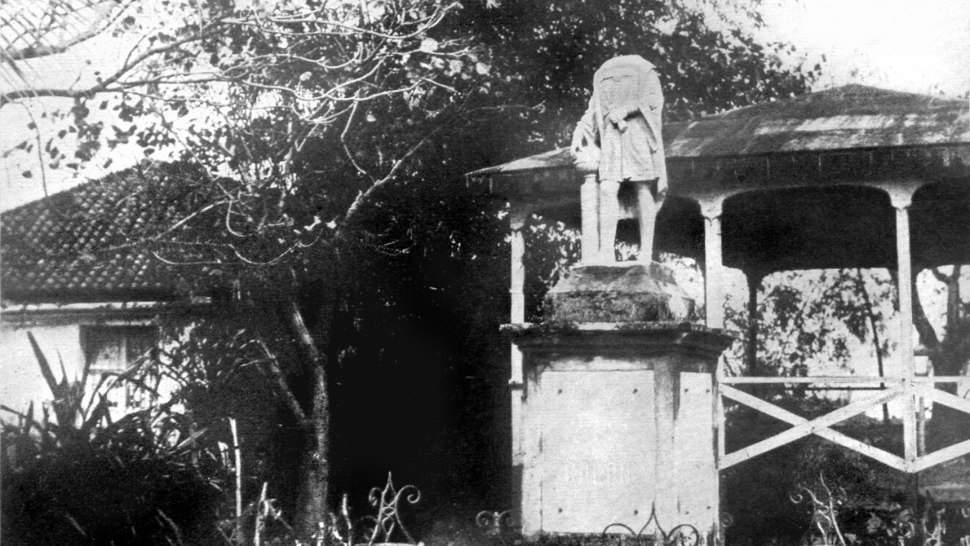
The Philippines is no stranger to decapitating Columbus statues, too. As a matter of fact, there was even one that stood in Cavite sometime around the late 19th to early 20th century. Standing inside what used to be Cavite Puerto, the statue's head was said to have been decapitated by Filipino revolutionaries in the aftermath of our declaration of sovereignty from the U.S. in 1899. It happened during a time of social upheaval, following the events that created the Spanish-American War of 1898.
Artwork of the statue from the 23rd volume (first period of 1899) of the French popular science weekly La Science Illustree.

ALSO READ:
How the Americans Double-Crossed the Last Sultan of Sulu
The History of 'Mabilis Pa sa Alas Kwatro'
So What Happened to the Headless Columbus Statue?
A colored photo of the infamous monument.

While Columbus never had any real direct connection to the Philippines, he was quite the figure in Spain and America, as we know. The explorer is credited for Europe's early knowledge of American continents and, of course, for "discovering" the United States. He had completed four voyages across the Atlantic Ocean under the auspices of the Catholic Monarchs of the country. In Spanish colonies, statues of him were built to honor his contributions. That included the Philippines, too.
Certainly, Filipinos' views on Columbus evolved, or rather devolved, over Spain's rule. During the Philippine Revolution, accounts of Filipinos vandalizing monuments and the like were few and far between. One of them, as author Ian Alfonso points out in a post, was the case of the Simon de Anda monument in Bacolor, Pampanga, which was dismantled in June 1898. The materials from the said structure were supposed to be repurposed for the construction of a Rizal monument that never materialized.
"When historian and educator Luther Parker came to Pampanga in 1902, he discovered the slabs of the Anda Monument at the Escuela de Artes y Oficios de Bacolor (now the Don Honorio Ventura Technological State University," Alfonso wrote.
Meanwhile, in Cavite, amidst growing tensions that would lead to the Philippine Revolution and later the Philippine-American war, Cavite Puerto became a target of revolutionaries during that period. The arsenal, which is now Samonte Park and the navy base, used to be the official residence of Commodore. This was where the Columbus monument was erected, together with Sebastián Elcano, the circumnavigator of the world.
Rebels were said to have shot Columbus' head clean off as a show of might during the liberation of the Philippines.
In this photo of the Cavite Puerto, we can see a statue on the left that appears to either be the Columbus or Elcano monument.

Unfortunately, there hasn't been much information on the statue's origins or its eventual disappearance, apart from confirmation from those who lived in Cavite City in the past. The Spanish-American war ended with the signing of the Treaty of Paris on December 10, 1898 while the Philippines gained full independence from the U.S. on July 4, 1946.
It is said that, even without its head, the monument reportedly lasted until World War II. It was a victim of the carpet-bombing on the Cavite Puerto done by the United States, as part of the battle at the time.
Interestingly, as the Knights of Columbus website notes, the memory of the explorer would be resurrected in Cavite around 1955 with the chartering of the Knights of Columbus Porta Vaga Council. It would become the mother council of the Order in the province.
Van der Krog, who was once a teacher at Utrecht University in the Netherlands, previously thought the Cavite Puerto Columbus monument was in Caloocan. He had even assumed in the early 2000s that it was still there.
In the original 1899 annotation for the photo, it simply reads: "The hero of Spain and America is not so beloved by the Tagals. Before deserting this town they shot off the head of the statue of Columbus."
Today, Columbus' standing in history continued to be reexamined as we further look into the colonial and imperialistic roots of various nations' patrimony. Decapitated Columbus statues can be found elsewhere. In the U.S., for example, a few Columbus monuments in different cities have been taken down, like the one in Columbus, Ohio (which was named in his honor, mind you).
"For many people in our community, the statue represents patriarchy, oppression and divisiveness," Columbus Mayor Andrew Ginther said back in 2020, in light of the decision to place their local statue in storage. "That does not represent our great city, and we will no longer live in the shadow of our ugly past."
Chances are, we are going to uncover a whole lot more about Columbus and the dark side of his memory. Much like the Filipinos who desecrated the old Columbus statue in Cavite, we are left questioning these old dangerous ideas of whitewashed heroism—ones that were built on bloodshed, enslavement, and other vile and despicable acts on the premises of outdated dogma.
