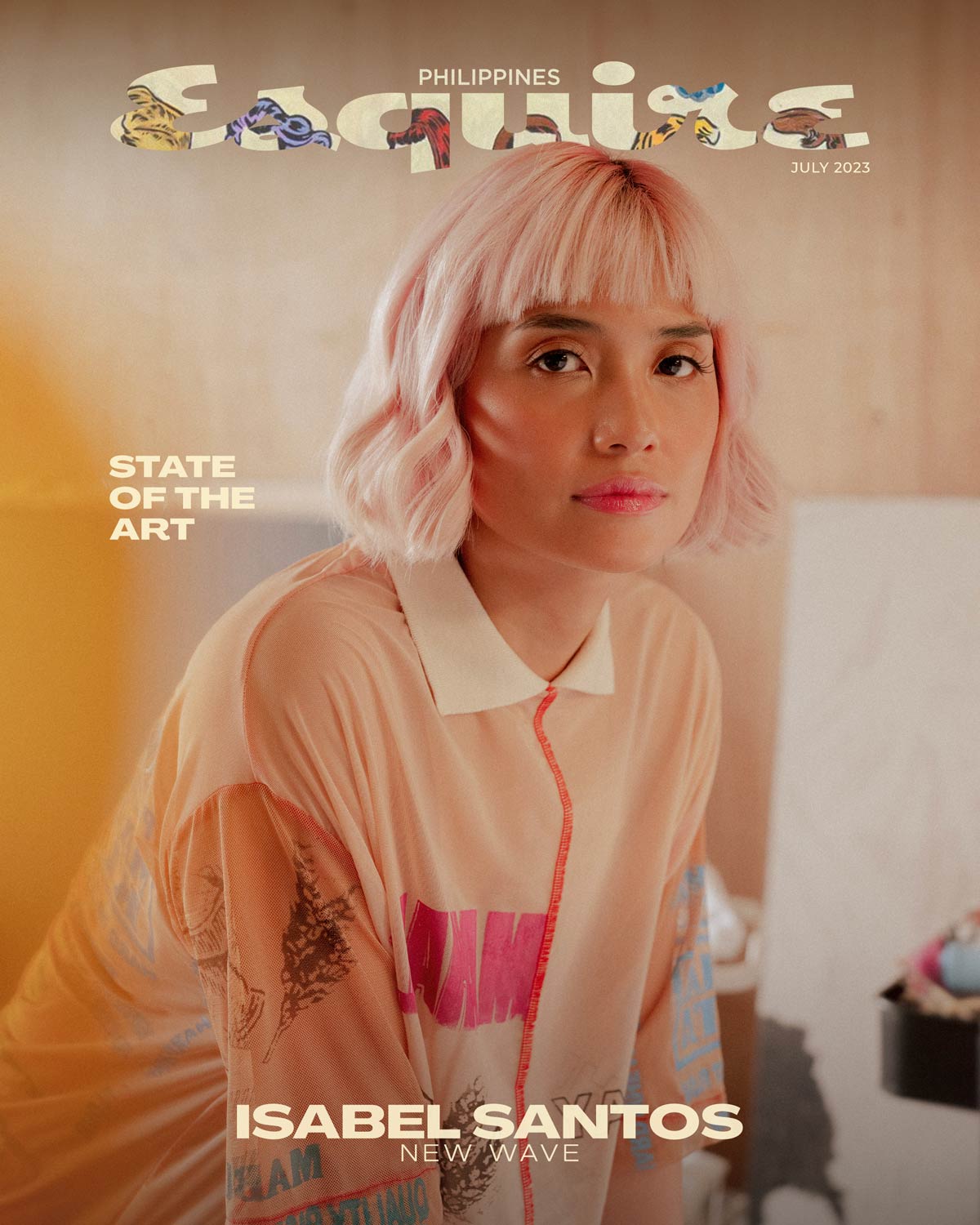
We're catching Isabel Santos in the middle of a down year. Down, not because it's one of those lost years; the kind when you're down on your luck or when you're down in an ineffable rut. Down, because it's a period of meditation, a self-imposed hiatus, if you will. A space to breathe perhaps with all this texture around us.
ADVERTISEMENT - CONTINUE READING BELOW
"There's no teasing," she says, when asked about any painting she's working on right now. "Wala. Kasi wala pa." Ah yes, the importance of being idle. But that doesn't mean she's not thinking about it.
This is something every artist has to go through every now and then. Reflect, confront, and, if they're fortunate enough, conquer. "Feeling ko, it's my break year," she states, after having a flurry of exhibitions over the past couple of years. "'Yun 'yung magiging way ko to look at things differently. Hindi ako nape-pressure to produce something [right now] with the things I'm thinking about." The wandering mind is always in a state of flux, after all. "Pero 'di rin naman ako, like, break, break. Iniisip ko pa rin naman siya. Meditate ulit on the ideas." There's no such thing as a wasted moment, of course, if you know how to really look.
"'Yung nga yung panglait sa lolo ko before. 'Cartoonist lang 'yan,' He's an artist. I've never had the feeling that a sculpture is better than video art or something like that. Feeling ko it's how a person consumes it. Minsan kasi, I think people put a premium on paintings."
CONTINUE READING BELOW
watch now
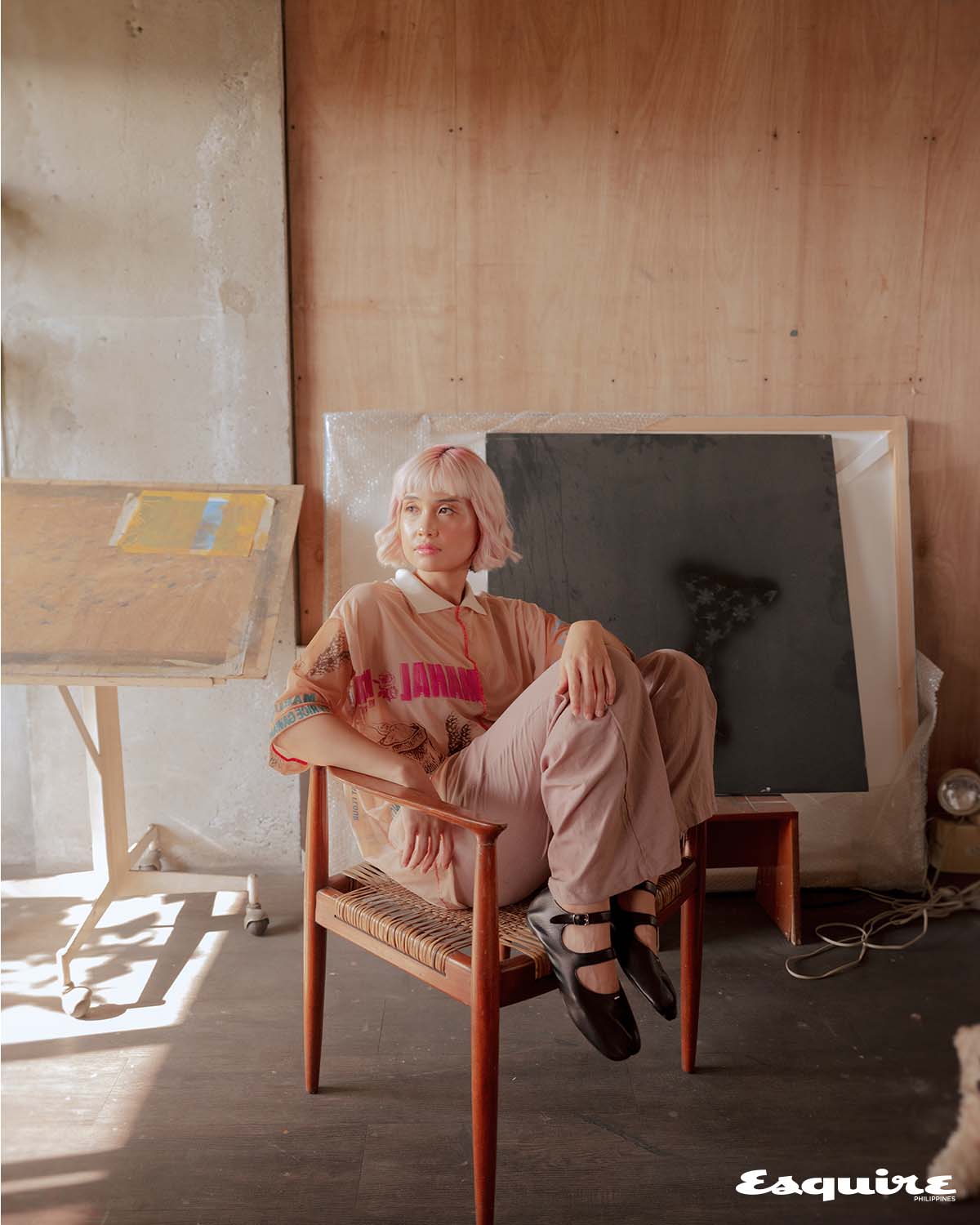
Inside the Santos family compound, in the house that Mauro "Malang" Santos built (not literally, I want to note), we are surrounded by three generations' worth of the artist's natural successors. We see a robust art collection curated by Isabel's parents, Soler and Mona of the West Gallery.
Just exquisite taste. Paintings by Elmer Borlongan, Manuel Ocampo, Jigger Cruz, and Pow Martinez, to name a few, adorn the confines of the place. The Malangs are tucked away elsewhere. There's a wall of Mona Lisas (dozens of commissioned reimaginings of the fabled painting that Isabel's father did for her mother), too, that seems to tie up the aura of the four-story complex nicely. Up on the fourth floor is where the magic happens. It's the workspace, where we see much of the family's works in progress: some pieces from Luis, one from Mona. Carina has to have some sketches here somewhere, I assume. This is a home of prolific artists. Isabel's dogs, Benny, Noah, and Charlie, have quite the playground here.
ADVERTISEMENT - CONTINUE READING BELOW
It's not a stretch to say that the shadow, or rather the glow, of Malang's legacy is imprinted all over his progeny. This is something even they would acknowledge. "Weird to say but yeah, my grandfather was pretty famous," she quips. A cheeky understatement.
PHOTO: SHAIRA LUNA
Post a Comment
Critic Cid Reyes once said that Malang's paintings were the "most color-irradiated" pieces ever done in the history of Philippine art. There wasn't one color that he couldn't conjure. This radiance has breathed quite a life into the Santos family. Funny enough, there was a time when he was criticized somewhat for this, him being an illustrator and all. Malang wasn't a product of the Amorsolo school, but he did possess the same gravitas and prowess, illustrating the spectacle of Filipino folk culture through magnitudes of vibrance that only he could imagine.
Santos has heard the murmurs herself a little bit. "'Yung nga yung panglait sa lolo ko before. 'Cartoonist lang 'yan,'" she explains. "He's an artist. I've never had the feeling that a sculpture is better than video art or something like that. Feeling ko it's how a person consumes it. Minsan kasi, I think people put a premium on paintings. I don't know why. I mean, di ko pa rin gets kung bakit. I mean, I love painting. I love doing it. Pero, it's not higher than other things."
Pomposity is best left to those who don't have an eye for finding beauty, I suppose. Like her grandfather, Santos didn't exactly have the kind of formal training in the fine arts. She studied European and German studies in college at the Ateneo, with a minor in Marketing (which she says is underrated as a creative course). It took her a lot of trial and error before she could find her visual language and the mediums she wanted to take on.
ADVERTISEMENT - CONTINUE READING BELOW
PHOTO: SHAIRA LUNA
Post a Comment
"Madami ring 'sana gumana' [moments]," she quips. "Alam mo 'yun? I think if I took those courses, a lot of my work would have been finished earlier. But then again, it's okay naman to discover it on your own." The artist would turn to her family, too, in times of crisis. "Syempre, I ask papa, mama, and kuya kung ano yung mga materials best for certain things na gusto ko ma-achieve sa work. Hindi naman kailangan academically."
"Eventually, may year off ako after college. Doon 'yung awakening na sinasabi nila. Soul-searching kumbaga."
She was never weighed down by the burden of talent in the family. Her parents and siblings are revered artists in their own right. But she's more than held her own. From her grade school days, just around the time that the 1998 Malang-laden Bear Brand commercial came out, to the present time, she thought of herself as an "artsy" person. Go figure. But it wasn't exactly a thing she thought of pursuing professionally. She wanted to explore other aspects of her being and sate her curiosity. Isabel was not to be just another artist. We all have that time in our lives when we're trying to figure out not who we are, but who we ought to become, after all.
"In high school, I thought I had other things to offer in life. So, it was like an 'I'm not just an artist' phase. So, in college, I chose a random course. And then, I had a thing na I wanted to be a diplomat for some reason." She even entertained the idea of entering architecture, but opted not to because she didn't feel like wasting another year.
"Eventually, may year off ako after college. Doon 'yung awakening na sinasabi nila. Soul-searching kumbaga," she notes.
PHOTO: SHAIRA LUNA
Post a Comment
When she held her first exhibition with West Gallery, she burst into the art scene with her illustrative work, as well. She got her feet wet with group exhibitions like 12 x 9 and Works on Paper.
"My first show was a group show with West Gallery with a lot of illustrative work. So, medyo malayo siya from what I'm doing now. Pero, I looked back recently. And, okay naman. I used to like them. Pero, syempre, 'yung technique." She would dissect and hone that more in recent years, showcasing her work in Manila and as far as New York, Berlin, and France.
By 2014, exhibitions like Vader Boy with Secret Fresh or Gathered Narratives with Silverlens Gallery, or Rebel With a Cause with Univers cemented her space in the scene. In the next year, it was In the Year 2000 with Silverlens. She's had her works on display at Art Fair Philippines six times by this point. But it was in 2021 when Santos became more sure of herself, casting away some of those anxious leftover jitters.
Of course, it's not like they go away that easily. Sometimes, anxiety takes newer, more complicated shapes, bred by newer, more complicated monsters. In her most recent exhibition, But may we mourn? last year, Santos took us into the new-age fears brought about by the pandemic and the cultural upheaval that came with the elections. It invited viewers to reflect, asking us: "What do we do with all the flailing of this hope? The flickering of this light?"
"I think aesthetically, yun din yung gusto ko. In terms of the colors I choose, yung medyo mas muted or yellowish. Frank Sinatra and Joan Crawford. The drama that the time had."
A piece like "Are the People Rejoicing?" for instance, spoke of the torment of our shared despondency, a common trait of man in the quest for legitimate change. It is as much a reflection of social poignancy as it is a political one. The piece is a testament to the fallacies of hope and crippling perception in a vacuum, reconfiguring the subjects and images in a state of transition and muffled unrest. Of all things, the piece gives us a venue to exercise our own grievances, as we ponder the uncertain.
Santos drew this in what was quite an anxious time for her and the rest of the nation. At the very least, she finds refuge in her art practice. "When I'm anxious, malikot 'yung kamay ko kasi I can get very tense. So, naging meditation ko 'yun, the drawings."
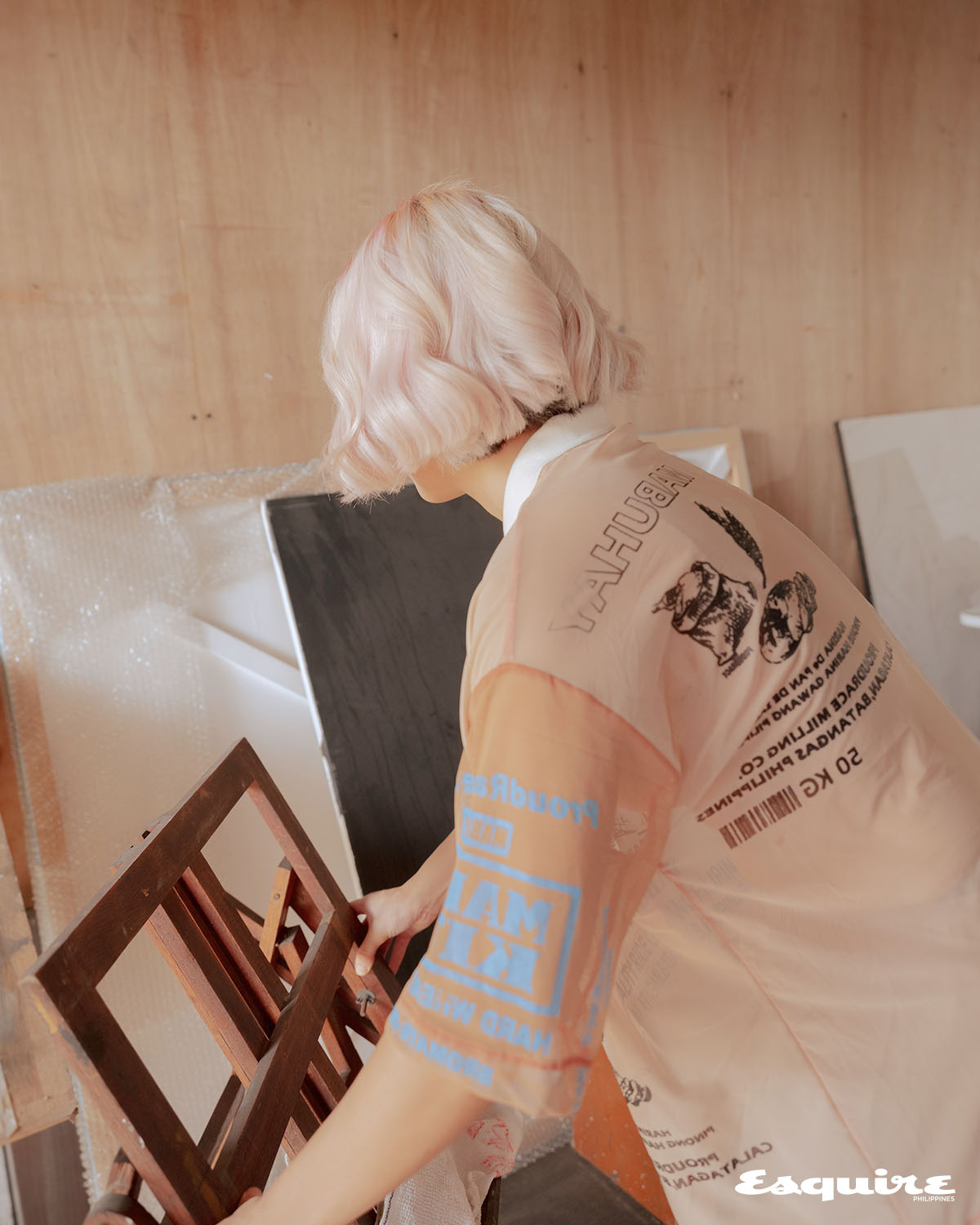
In the Uniqlo UT Grand Prix T-shirt design competition back in 2021, which was a partnership with New York's Museum of Modern Art, she bested 10,000 entries with her work. There, we see Santos' brand of deconstruction, melding pop culture motifs and old-world iconography. What made things a little sweeter for her was the fact that one of her heroes, conceptual artist Lawrence Weiner, whose radical theories have long captivated the movement, was one of the judges. "He picked me, and he doesn't know any history around my work." It was a big boost to her creative self-esteem.
Santos says she's always had a keen fascination with the '40s and '50s, particularly the music and movies in the West at the time. We think of these decades as sort of lost years, a period of war and disarray for most of the globe. But it was nevertheless a period that built the foundations of the modern world and contemporary art. This was around the same time as the Golden Age of Hollywood, one of the great epochs in American cinema, as well as the Mad Men generation of (at times, sleazy) outdated ads. Line, color, bold patterns, and composition were used to dictate moods. From these came the emergence of a certain mid-century aesthetic entirely its own.
"I think aesthetically, yun din yung gusto ko. In terms of the colors I choose, yung medyo mas muted or yellowish. Frank Sinatra and Joan Crawford. The drama that the time had," she points out. "Even in the advertisements I like. Siguro i'ts with the limitations noong time na 'yun, and then the colors na lumabas. Ngayon kasi, di ba, parang, in terms of printing things, we can do anything. Dati, medyo old style 'yung printing process. So, limited yung mga colors, pero 'yun 'yung attractive sa akin."
"Sometimes, deconstructing an image, nakaka-satisfy siya, e. Nililito mo 'yung eyes mo kasi sanay ka with this or that. You add another element and then it becomes, for me, more interesting."
If we circle back to the '40s and '50s in the Philippines with Malang, we'd catch him just around the start of his would-be brilliant career. We'd find him drawing comic strips for the Roces chain and the Manila Chronicle perhaps, reckoning with our own mid-century aesthetic. It was when he really started experimenting with gouache, cultivating that beautiful palette of his. This was when he slowly framed and honed his visions of the Manila that once was. Interestingly, it was an era whose color was limited by the monotony of post-war ennui. Out came the avoirdupois of neorealists. Out came the lushness of Malang's imagery.
As Malang grew older, he'd venture deeper into ideas of abstraction. As his granddaughter, Isabel, matures, on the other hand, she's plunging deeper into ideas of deconstruction, she claims. "I think, lumabas 'yun (deconstruction) noong COVID health crisis, and then the question of kung arts is a necessity, parang ganoon," Santos underlines. "Art is a necessity. But there was a panic kasi, di ba? Doon ako napunta sa mga taking away, mga ganoon, kung ano 'yung essential." Malang had Chagall. Isabel has Broodthaers and Frankenthaler.
PHOTO: SHAIRA LUNA
Post a Comment
The genius of deconstruction in art lies in its attempts to subvert and challenge any established meaning. Deconstruction picks apart binary pairs in our thought processes, refuting any preconceived images or text rooted in history--or truth-making. Here, the tangibility of the human experience matters more than abstract ones in a sense. These are the things Santos' works explore.
"Even in a picture, maganda pa rin ba ito without these certain elements? Or gumaganda ba siya without these other elements? 'Yun 'yung pinaglalaruan ko with that. Sometimes, deconstructing an image, nakaka-satisfy siya, e. Nililito mo 'yung eyes mo kasi sanay ka with this or that. You add another element and then it becomes, for me, more interesting."
It sort of transcends social statements, we may argue. The more Santos has leaned into these concepts, the more she's found her art becoming more personal. "Dati kasi parang, should there be a higher purpose? May ganoon, like socially, should I be...tungkol sa current events? Pero it's not natural to me. So, why would I do that, diba? So, may mga works is how I deal with my brain, my thoughts—cino-confront 'yung sarili."
Yes, even in a "break year," this confrontation echoes. The ideal process for Santos is like that of her father, who is constantly working. "'Yun yung gusto ko sana. Kung may space ako. 'Yung pwede ka lang magkalat anywhere." More often than not, she starts with one work and allows it to take her somewhere she least expected it to. There's this obsession with creating nuance in her practice. It's a way for her mind to have a break and find new angles to exploit in her desired topography.
Too much obsessing, however, does have its pitfalls. For example, she reminisces about the images that hovered around her head during the Uniqlo contest, and how they ended up haunting her. "[Noon kasi], may mga ulo, ganyan. May one time, I was dreaming about headless women.'Yung mga hair lang nila, or yung ulo lang nila. Kasi paulit-ulit ko silang nakikita throughout the day. So, kailangan ko rin ng break from it." Art is an expression and a release, Santos emphasizes. "Minsan kasi sobrang clouded na yung brain ko para ma-eject na rin siya. So, minsan, it's in the process talaga." Beauty, of course, is always in the search, the honest attempt.
This time around, Santos has found a new way to meditate, to reconcile the clutter. She's indulging in this sabbatical as much as she can. "Ngayon, I'm excited to work. Ready na akong mag-work, parang ganoon," she concludes.
By next year, she has four exhibits lined up. Santos is going to have three solo shows with three premier contemporary galleries, namely Gravity Art Space, West Gallery, and Blanc Gallery. After that, the artist is closing the year with a group show with her family at Silverlens. It's going to be a busy year. Until then, however, she's right here biding her time, taking it all in, carrying the family name as much as she carries her own, ruminating, ticking away... basking in the afterglow.
Story: Bryle B. Suralta Photos: Shaira Luna Styling: Paolo Chua Grooming: Muriel Vega Perez Editor-in-Chief: Paul John Caña Production: Paolo Chua Creative Direction: Igi Talao Design Direction: Bacs Arcebal
We use cookies to ensure you get the best experience on Esquiremag.ph. By continued use, you agree to our privacy policy and accept our use of such cookies. Find out more here.




.jpg)
