Every year, Esquire Philippines presents Man at His Best, the local iteration of a global signature event where we celebrate extraordinary Filipino men and women reshaping society as we know it. These are the dreamers and doers who have made a profound impact on the Filipino's way of life, who are using their talents and skills to make something of themselves and inspire the rest of us to do better with our lives.
This year, we're honoring nine mavericks and legends in film, music, business, politics, and entertainment. Despite coming from disparate fields and industries, they all have one thing in common: all of them exemplify what it means to be a Man at His Best.
ALSO READ: Esquire Philippines Honors 9 Heroes and Mavericks at the 2024 Man at His Best Awards
Meet Esquire Philippines' Creative of the Year, Jose "Joey" Javier Reyes

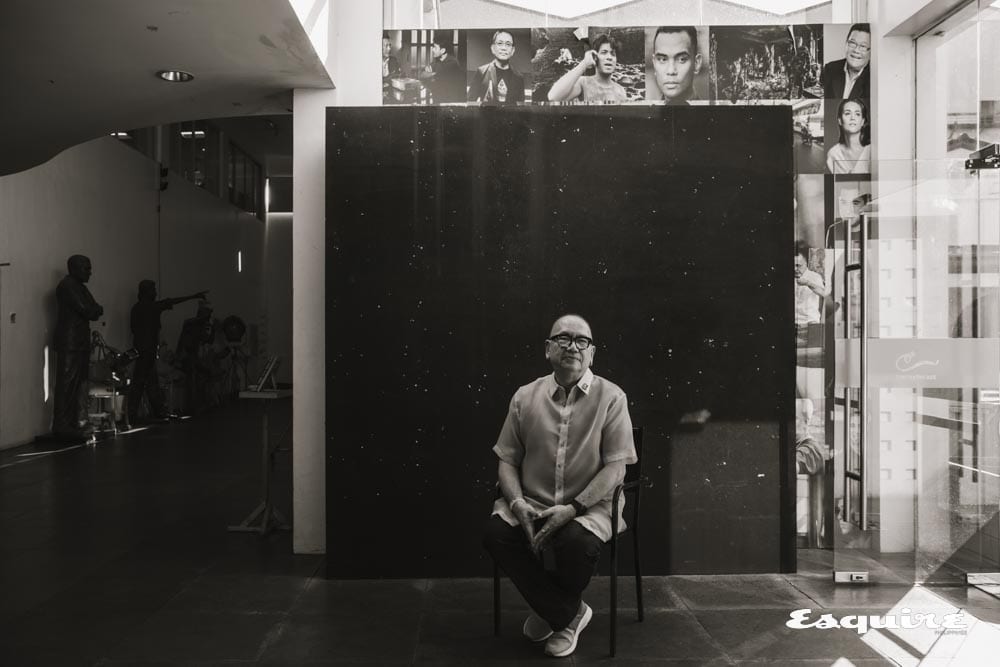
"I'm a filmmaker, I'm a producer, I'm also a writer, I'm a teacher. In other words, I'm like the Hydra with so many heads. But more than anything else, I'd like to see myself as an educator. Because a filmmaker is an educator, a writer is an educator," Jose "Joey" Javier Reyes introduced himself in front of the camera during an interview with Esquire Philippines at the Cinematheque Centre Manila.
While being multi-hyphenated is almost the norm among artists these days, it is undeniably true and unique for Direk Joey, who started serving as CEO and chairman of the Film Development Council of the Philippines on April 11, 2024. And rightfully so, as the 70-year-old spent most of his life writing, directing, and teaching films.
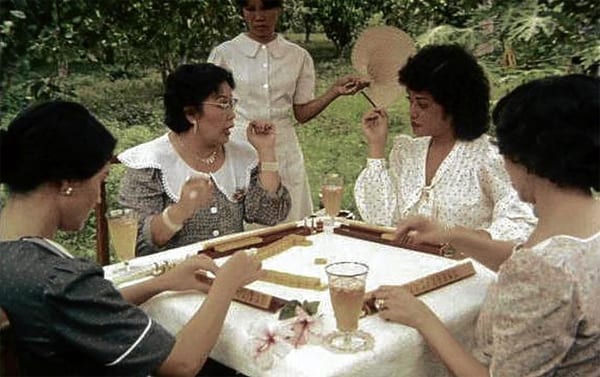
While we know Direk Joey as the screenwriter of Oro, Plata, Mata (1982), and director-writer of Regal Shocker: The Movie (1989), May Minamahal (1993), Pare Ko (1995), and several others, his academic foundation was really in literature. A Lasallian through and through (from grade school to high school, then to college), he graduated with a Bachelor's Degree in Literature in 1977, then a Master's Degree in English Education a year after.
"That was because Brother Andrew Gonzalez, whose building is now there in La Salle, wanted to take care of me and wanted me to be a dean. And perhaps eventually have a bathroom in La Salle named after me," he tells us. While Direk Joey was at university, Gonzalez served as Academic Vice President.
Upon further prodding of the Lasallian brother, who was a language scholar himself, Reyes started his PhD in Comparative Literature at the University of Santo Tomas. He was also a recipient of the Fulbright-Hays (non-degree) Program in 1979 in English Literature (Doctoral Enrichment) at Indiana University.
"It has nothing to do with film; it's about folklore and anthropology. It's my dissertation that I never finished. Alam mo, magtatapos na ako ng PhD ko nung sinakop ako ng pelikula, hindi ko na nagawa. I had a PhD [dissertation] on the Virgin Mary and Philippine literature and the folk roots of Marian devotion and all that. Hindi ko natapos, and that's in my bucket list. I want to finish my PhD. Because I don't want to leave things incomplete in my life," he explains.

Throughout this academic journey, the call to filmmaking was always there, as he combined these disciplines for his art. But how did he become interested in movies? For that, we go back to the start of the story.
Esquire Philippines: What sparked your passion for filmmaking? What was that moment you decided to become a screenwriter or director?
Joey Reyes: At a time when it was not fashionable, much less acceptable, for the children of the middle class to be watching Filipino movies, I was into Filipino movies mainly because of my yaya. My yaya and I would make puslit because my yaya then was a movie fan. And we lived in Pasay. So what she would do during her day off is she would go to Rica Theater on Taft Avenue or Martan Theater or Joy Theater in Libertad, and she'd watch a movie. And then I would ask my mom and dad if I'd be allowed to join her and watch these movies. And they had nothing against it. Sabi nila, "Okay, go ahead." So at a very young age, I was watching Filipino movies.
And this was the time when, you know, when you are studying in La Salle, you don't watch Filipino movies because it's something that is for the bakya crowd. But I never felt it to be bakya because I really enjoyed it. So I was watching Sampaguita Pictures. I was watching the Darna movies. and I was very interested in it. And I remember when I was a kid, I would do movie posters of movies I'd like to do. So bata pa lang ako, I was into movies. I was not only enjoying movies but I was into the whole magical world of making movies, although I did not know the technical aspect involved.
It was not proper for kids in La Salle to be reading Movie Confidential-all these interviews of Rosemarie Sonora and of Ricky Belmonte or of Pepito Rodriguez. But I was into it...quietly. So, at a very early age, I loved making movies.
I think the turning point was in college. Because in high school, I was writing plays. And when I got into college, there was a time when Lino Brocka went to De La Salle College pa noon. He was promoting a movie called Tinimbang Ka Ngunit Kulang (1974), together with Christopher De Leon. I was a co-features editor of The LaSallian, the newspaper of La Salle. We were assigned to interview Lino Brocka. So when I was interviewing Lino, I was just so fascinated-not only by his filmmaking but also his passion for Filipino filmmaking, the importance of Filipino films, and why there should be a greater degree of participation on the part of social classes beyond the D & E market for a new kind of Filipino filmmaking. And Tinimbang Ka Ngunit Kulang was a turning point because that was the movie that brought the middle class to the movie house to watch a Filipino movie. Because of that, I said I would be a screenwriter. I was a playwright at that time, but I wanted to write movie scripts.
Nagkataon [in 1975], La Salle opened a Communication Arts program, but I was already about to graduate. I'm a Literature major, just like you. I was into creative writing. But I had all these electives remaining because I took up all the courses except the electives. So, I used all my electives. I cheated my mom and said I needed more units, and I took CommArts major subjects. That's under Clodualdo del Mundo. And I had teachers like Gil Cortez and Bernardo Bernardo. And because of that, I became a screenwriter. I started writing for the screen.
And then one thing happened after another. It's as if you make plans for the future, but then, somehow, the future makes plans for you. Somehow, one opportunity opened, and one opportunity led to another. And before I knew it, I was not only writing plays; I was writing a movie. I was writing a screenplay. Did I have any formal training in screenwriting? None. I learned my screenwriting by reading the scripts of Orlando Nadres. I would find ways and means of getting the scripts of Orlando Nadres and learn the structure of how it is done, etc. I was writing for television. From then on, it was one thing after another.
In 1978, I got an offer to write a movie for Elwood Perez. And we were in Coco Banana-it's a club-because he wanted to do a movie called Coco Banana. And that's where I met Lily Monteverde. But then, it did not materialize.
When I was about to leave for the U.S.-because I got a scholarship in the U.S.-Elwood again offered me another movie, and this was Problem Child (1980). So I wrote that script, and I left for the U.S. Even to this day, I've never seen Problem Child, which is my very first script. I've never seen it. Then, when I got back from the U.S., Mother Lily reconnected with me and said, "Do you want to write more scripts?" I said okay. But this time, it was with Lino Brocka. So how could you refuse? This was the guy I interviewed a number of years ago. My second movie was called Caught in the Act (1981) with Lino Brocka. And that was a lot of fun. I asked him, "Do you remember me? I interviewed you." And he said no. He didn't remember this fat kid who interviewed him in college. But I had a working relationship with Lino.
And then the third movie I did was with Marilou Diaz-Abaya. So, the first two movies that I did when I got back from the U.S. were with national artists. So that's how I got my training. When people ask me, how did you learn how to write scripts? I said it's on the job. It's really on-the-job training. How did you learn how to direct? It's by being on the set. It's not in the classroom but by being on the set. And I had the best teachers-Lino, Marilou, Ishmael Bernal, Peque Gallaga, Maryo J. de los Reyes. That's how it all started. And that's how it continued.