

Underwater Pantabangan Town in Nueva Ecija Reemerges Amid El Niño

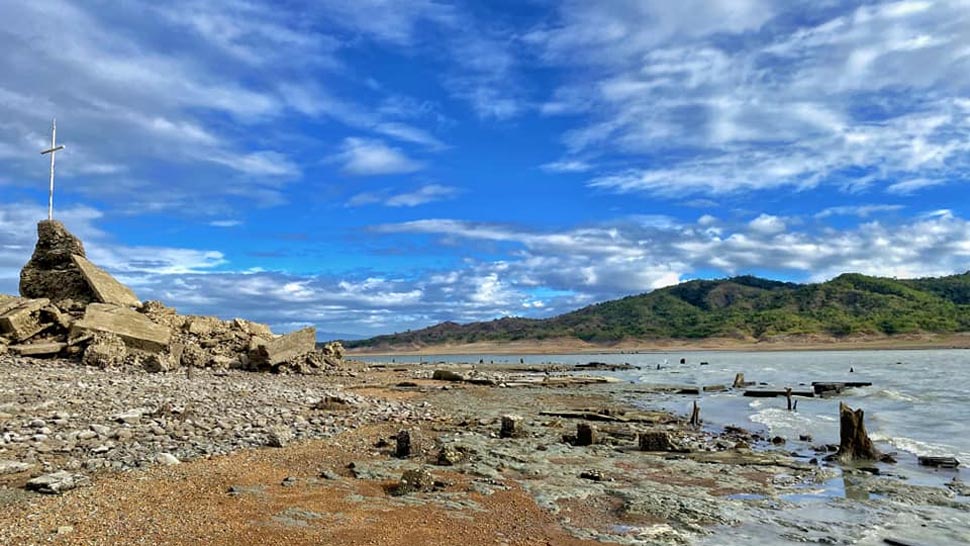
Lost cities all over the world have inspired myths and legends, plenty of modern artistic interpretations, and even conspiracy theories. In the Philippines, it's the town of Pantabangan in Nueva Ecija that has an interesting story to tell, and it has recently reemerged from underwater amid the drought brought about by El Niño.
This is only the fourth time that the ruins of the lost town reappeared from the depths as the dam has seen a drop in water level. The other times were in 1983, 2014, 2020, and now, during the first weekend of April 2024. Interestingly, all four incidents coincided with the El Niño phenomenon.

The 1982–83 El Niño event was one of the strongest recorded worldwide as droughts occurred in Indonesia and Australia, and widespread flooding was witnessed across the southern United States. Likewise, the 2014–2016 El Niño resulted in unusually warm waters in the Pacific Ocean with widespread drought. The year 2020 was the start of a rare three-year, triple-dip La Niña event, but it was also one of the warmest years around the world. Finally, the Philippines is now at the peak of the 2023–24 El Niño event, declared in July 2023 by the World Meteorological Organization.
According to Nueva Ecija resident Renren Gala, whose photos of the lost town have gone viral, the ruins have reemerged on April 1. You can now see the old cross of St. Andrew Parish, constructed in 1825; foundations of the old municipal hall, the town plaza, and town marker; and old tree trunks that have been submerged for 50 years.


History of Pantabangan, Nueva Ecija
Pantabangan, a first-class municipality in Nueva Ecija, is the site of the Pantabangan Dam and Lake. It is located in the northern part of the province, specifically at the foot of Mt. Mabilog below Mt. Dalimanok, between the Sierra Madre and Caraballo Mountain ranges.
Its original inhabitants were the Aetas and Bugkalot (or Ilongots). According to the records of the local government unit as well as the writings of local folk painter Elito V. Circa, Pantabangan was originally called Pantabanganan in the early 18th century, likely from the root Bugkalot word "Sabangan" or "Sabanganan," loosely translated as the junction of water streams.
Pantabangan was occupied during the Japanese regime and was recaptured at the end of World War II.
ALSO READ
The Creepy Legend of Biringan, the Phantom City of Lost People
An Underwater Town in the Philippines Reemerged and It's an Eerie Sight


Why is Pantabangan, Nueva Ecija, underwater?
In May 1966, the Upper Pampanga River Project Act (Republic Act 5499) was passed, and the construction of the Pantabangan Dam was authorized. A groundbreaking ceremony took place on June 11, 1971, and the project was completed in August 1974. This also meant effectively wiping out all the towns within the Pantabangan Dam.
About 8,100 hectares of farmlands in Nueva Ecija, the town proper (East and West Poblacion), and nearby barangays (Malbang, Villarica, Liberty, Cadaclan, San Juan, Napon-Napon, Marikit, and Conversion) were all submerged under the new lake during the construction of the Pantabangan Dam. Residents were transferred to higher ground overlooking the reservoir, which eventually became the new town center.


According to Mayor Roberto Aglipa in an interview with community radio station DWNE Teleradyo, there were five reasons why the massive dam was constructed, essentially uprooting the lives of the residents in the area. The first was to irrigate the farmlands in the province, to put up a power plant and generate electricity, as a means of flood control, to create livelihood programs for the community, and for tourism purposes.
"Sa bawat paglitaw niyan, sinisimbolo lang na tayong mga tao, anumang problema ang dumating sa atin, hindi tayo dapat mawalan ng pag-asa. Sa bawat paglitaw niyan, nando'n 'yung pag-asa at inspirasyon," Aglipa said in the interview.
In addition, locals are putting in the effort to have Pantabangan Dam declared a heritage zone. It's currently a tourist destination with visitors coming in through outrigger boats. Tourists are reminded to keep the place clean and avoid stepping on the ruins. Excavation in the area is also prohibited.
All photos used with permission.
