
What Conan O’Brien Means to Me

It was thanks to cable and local UHF channels, which carried his old Late Night show, that I got introduced to Conan O’Brien. In the days before YouTube and streaming, I’d stay up to watch David Letterman first and then switch over to Conan right after (I skipped Leno, whom I never, ever thought was funny). It was only much, much later—well into his tenure as host of Late Night on NBC—that I discovered that he previously wrote for Saturday Night Live and The Simpsons.
Sometimes I’d even catch the afternoon replays at work (yes, we had TVs in the office) just so I could rewatch everything from his monologues (it was a particularly good one when he did the string dance) to the absurd sketches (like the ones with Triumph the Insult Comic Dog, the Audiencey Awards, and his remotes that were the precursor to what’s now an entire Emmy-winning show on HBO). The celebrity guest interviews were just secondary to watching Conan himself perform night after night.
I can’t forget when audiences started noticing a resemblance between him and former Finnish president Tarja Halonen, which the show mined for endless bits of comedy throughout several episodes. The whole schtick eventually culminated in a remote special in Finland where Conan got to actually meet his supposed doppelganger in person. I got so invested in the whole saga that I almost got reprimanded at work because I snuck off to watch that whole hourlong episode in one of the conference rooms with a TV because I missed catching it at home when it first aired.
When he was named successor to Leno on the revered Tonight Show, I was ecstatic for him because I knew it was his dream to inherit the show that was once hosted by one of his idols, Johnny Carson. But everybody knows what happened—he gave up the job after a few months because network execs wanted to bring Leno back from his supposed retirement and they wanted Conan’s show pushed back to a later timeslot. Rather than capitulate to the network’s whims, he chose to let go with his honor and dignity intact.
At the time, there were so many other things going on here closer to home, but I found myself fixated on the travails of a late-night TV show host half a world away. Hashtags and memes had not yet taken over the internet (at least, not as pervasively as it has today), but the campaign to support Conan in what most people believed was a blatant and very public screwing over by network execs flooded my timeline on social media. I posted an “I’m With Coco” meme to show solidarity.
When the dust had settled, Conan, of course, landed on his feet. He filmed a comedy special based on a marathon, multi-city “Legally Prohibited from Being Funny on TV” tour and eventually resurfaced back on late-night TV on the basic cable network TBS, simply titled Conan. He’d host the show for years until he finally called it quits on late-night and focused his energies on other endeavors—a highly successful podcast called Conan O’Brien Needs a Friend (which Is the only podcast I really listen to on the regular), and an HBO series based on his remotes called Conan O’Brien Must Go. He even found time to host the Oscars this year and he’s been invited to do it again next year.
I know Conan grew up in Brookline, Massachusetts, which is a suburb of Boston, and comes from a big Irish Catholic family. His father was a doctor and his mother was a lawyer and he himself went on to study at Harvard, where he graduated with a degree in history. Afterwards he drove out to Hollywood and set his sights on a career as a writer and comedian, eventually teaming up with his writing partner Greg Daniels (who would go on to be successful himself as writer and co-creator of shows like The Office and Parks and Rec).
That might just be a summation of Conan’s own career, but you might be interested to know that I wrote all of that from memory—no ChatGPT or even Google. I think that just goes to show how much Conan has been a steady fixture in my life since I was a pimply faced teenager. He’s made me laugh so many times I’m thinking he singlehandedly saved me from years of therapy. I still find myself coming back to clips from his old TV show every time I need a guaranteed pick-me-up—that time when he played old-timey baseball, the one that started his years-long running gag with Paul Rudd, his Clueless Gamer series with one of his producers Aaron Bleyart, and the one when he went on a road trip in Italy with his friend/colleague/nemesis Jordan Schlansky. I’ve watched these and many other clips many, many times, but still find myself guffawing at the exact same bits every single time.
Conan to me is the definition of the smart comedian. His material always punches up, skewering the rich and the powerful, and never down. His references run the gamut, from the obscure and cerebral to the inane and the downright stupid, and somehow, they always work. To say he has a quick wit is a severe understatement (try listening to his podcast and his regular banter with Sona and Matt). And when all else fails (not that it ever does), he goes to his favorite punching bag—himself. His self-deprecating style is endearing, and because Conan is always the first to make fun of Conan, that guarantees that we’re always on his side.
But more than just providing entertainment, what I like about Conan is the earnestness tucked into his humor. There’s always a smidgen of truth in his jokes and a touch of affection in his insults. And when he really turns on his brain and starts dropping idiosyncratic references—things like random trivia about American presidents, the Civil War, 1970s TV—forget about it. You can’t help but be transfixed.
And speaking of being transfixed, I know Conan has delivered the commencement speech in both Dartmouth and his alma mater Harvard (the latter of which he did online because it was during the pandemic). Both times, it was laugh-out-loud funny and incredibly moving. You can immediately tell that, while he peppers the speech with jokes, he doesn’t pander to his audience and treats them with admiration and respect. This is perhaps the reason Conan first developed a wide fandom among college students—successfully balancing wit and charm with an unvarnished view of the real world.
Earlier this year, Conan received the prestigious Mark Twain Prize for comedy in Washington D.C. While not a few people wondered why it’s taken this long for the award to make its way into his hands, there was near universal agreement that there was no one more deserving of the honor. I sat at home watching the festivities on Netflix, feeling elated that someone I idolized so deeply was being celebrated by his colleagues and friends.
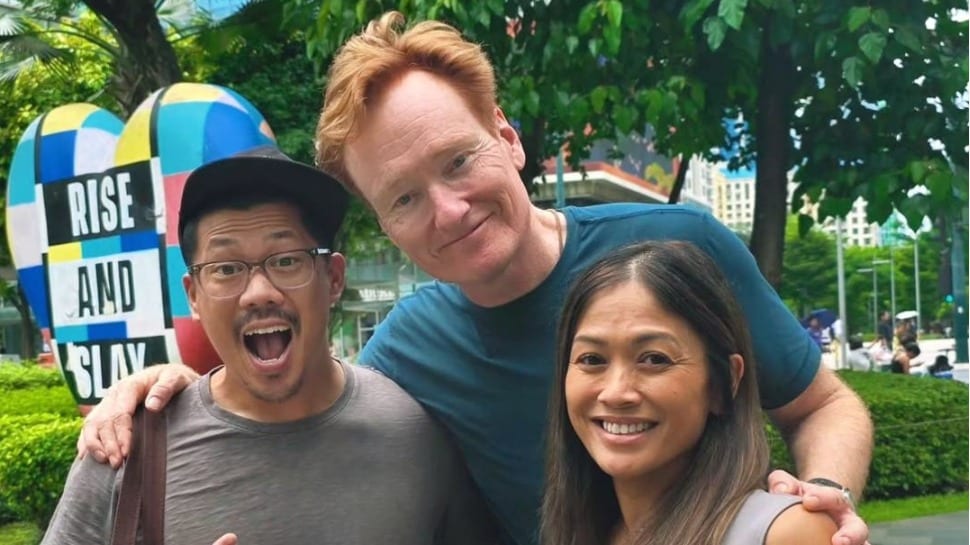
And I guess that’s really what this whole thing is about. As Filipino fans keep an eye out for Conan while he’s traveling here in the Philippines to film his latest special for Conan O’Brien Must Go, I can’t help but feel particularly proud to call myself a fan of Conan O’Brien. Throughout his decades in the entertainment business, he has amassed millions of fans who like him for different reasons—his brand of offbeat comedy, his outsize personality, his giant intellect, his humble nature, his rapport with the people in his immediate circle, and his genuine connection with his devoted followers. I like him because of all of these things, and the fact that, over the years, he’s demonstrated time and time again that he’s just an objectively smart, upstanding, cool guy.
(And if we’re being honest, there aren’t a whole lot of those out there these days).
