
Biden Just Approved a Nuclear Strategy Amid Tensions With China

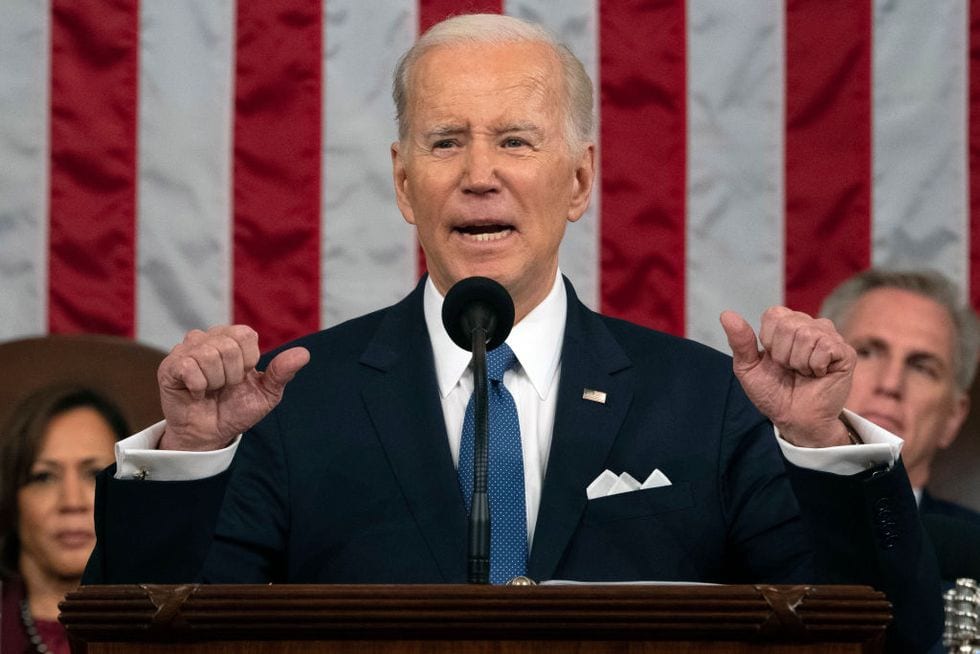
Incumbent United States President Joe Biden reportedly approved a secretive nuclear strategy amid ongoing tensions with Russia, China, and North Korea.
As written in a report by the New York Times, the revised guidelines were said to have been approved by the president in 2023. Spokesperson Sean Savett clarified that while “the specific text of the guidance is classified, its existence is in no way secret. The guidance issued earlier this year is not a response to any single entity, country, nor threat."
Its "deterrent" policy considered China's increasing nuclear power. China is on pace to exceed the capacity and diversity of the United States and Russia over the course of the next decade.
The nation added more than 34 GW of nuclear power capacity over the last 10 years and should easily triple that in the near future. Its operating nuclear reactors, for instance, have increased up to 55 at a total net capacity of 53.2 GW. In fact, Russian President Vladimir Putin had also once even brought up the possibility of using nuclear weapons during its conflict with Ukraine.
As it stands, China has a total of 500 nuclear warheads while Russia has 5,580. The United States has 5,044, based on the latest numbers from Statista.
It should also be noted that global nuclear weapons spending increased to a record 13 percent last year, setting a record $91.4 billion in sales, according to data from the International Campaign to Abolish Nuclear Weapons (Ican) pressure group.
Nine of the world's nuclear-armed countries contributed to the spending total, with China being the second largest at $11.9 billion. Russia is third at $8.3 billion, followed by the United Kingdom at $8.1 billion and France at $6.1 billion. In just five years, nuclear weapons spending has climbed by as much as 34 percent. The United States reportedly spent 45 percent more during this period.
All these updates to the United States nuclear guidance report are made as China and Russia become more aligned. The two countries now enjoy a great relationship and alliance, moving to do more diplomatic and economic agreements. In July, for example, Chinese and Russian long-range bombers reportedly patrolled in unison around Alaska. On the subject of the disputes in the South China Sea, Russia has pledged support for China.
ALSO READ:
Is It Time to Power Up the Bataan Nuclear Power Plant?
Why Did Australia Notify the Philippines of Its Nuclear Submarine Purchase?
What Is the Nuclear Employment Guidance?
The revised plan was said to have been approved by President Joe Biden in March 2024. Nevertheless, the policy changes have yet to come to Congress for deliberation.
The Nuclear Employment Guidance does not have any electronic copies and has only been distributed to national security and Pentagon officials. These changes to the policy reflected growing concern among the administration's officials, as the threat of nuclear war by China, Russia, and North Korea continues.
In early August, former acting assistant secretary of defense for space policy Vipin Narang claimed in a speech that the sitting president "recently issued updated nuclear weapons employment guidance to account for multiple nuclear-armed adversaries, and, in particular, the significant increase in the size and diversity of the PRC's nuclear arsenal." Narang is a Massachusetts Institute of Technology nuclear strategist affiliated with the Pentagon.
“It is our responsibility to see the world as it is, not as we hoped or wished it would be,” Narang told the New York Times. “It is possible that we will one day look back and see the quarter-century after the Cold War as nuclear intermission.”
More on China and Russia's Nuclear Policies
While reports in the West suggest that China and Russia have taken increasingly aggressive stances on the use of Nuclear arms, the two countries have reiterated that they would only use such weapons in the face of a deterrent retaliatory force.
In China, the policy of the republic is that it will never be the first to deploy nuclear weapons in times of crisis or conflict. China is also recognized by the Nuclear Non-Proliferation Treaty, something that the country helped ratify in 1992.
Back in 2021, Joe Biden and Chinese President Xi Jinping even discussed nuclear issues that face their two countries in a virtual summit. Unfortunately, the talks have yet to yield any significant progress or strategic dialogue. Pundits suggest that China's position hinges on the political relationship between the two global powers.
Russia, on the other hand, has taken a less-than-subtle approach in its nuclear direction. In 2020, Putin would sign the Basic Principles of the Russian Federation’s State Policy in the Domain of Nuclear Deterrence. Here, Russia made it clear that it retains the right to use nuclear weapons and that, even in the case of any aggression made with conventional weaponry, nuclear arms may still be deployed.
Putting into context the invasion of Ukraine, Putin exercised quite hostility against the U.S. in a February speech. “For the United States and its allies, it is a policy of containing Russia, with obvious geopolitical dividends,” he explained. For our country, it is a matter of life and death, a matter of our historical future as a nation. This is not an exaggeration; this is a fact. Putin has gone on and define the predicament between Ukraine, Russia, and the U.S. as one that constitutes such use.
