
What the Philippines and Canada's New Visiting Forces Pact Means for Security in the Region

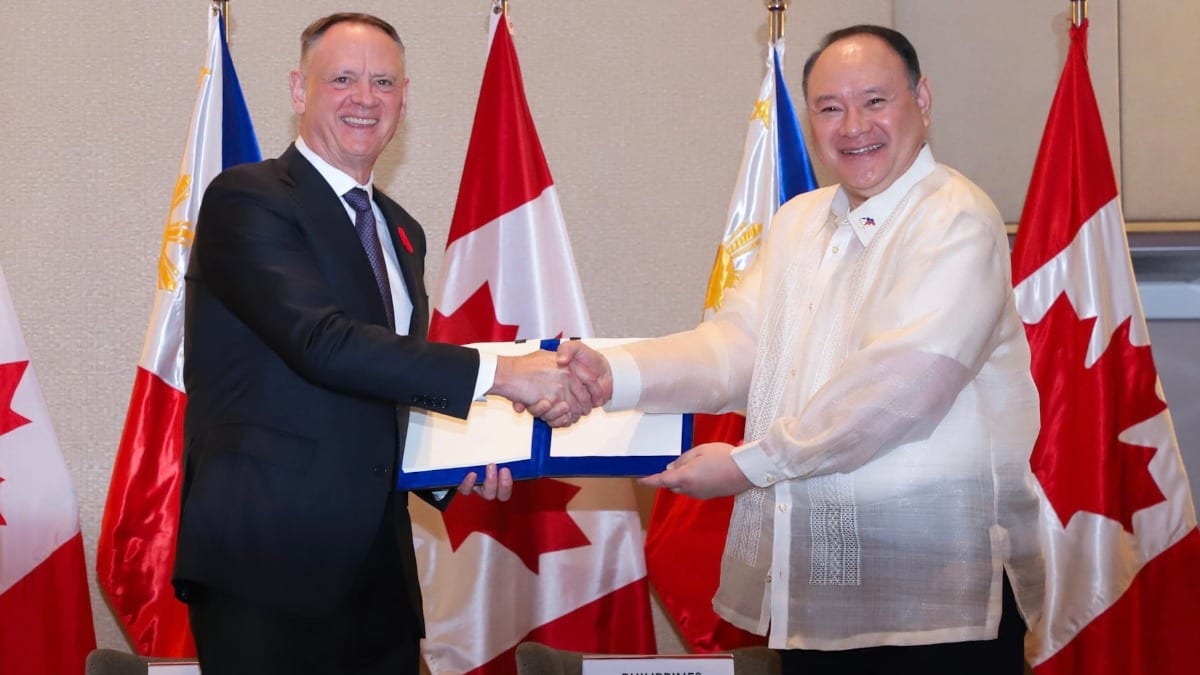
The Philippines and Canada have just inked a deal that would boost Ottawa’s participation in Manila’s military operations. This is a visiting forces agreement that is now being seen as a development that could shake up the security landscape in the South China Sea, with belligerent China still looming over the waterway.
So what will this deal mean, if anything at all, for the Philippines' quest to deter China’s aggression in the strategic waterway? We asked political and security experts on what this development does for the Southeast Asian nation’s defense capabilities and dealings with China.
ALSO READ:
What The Japan-Philippines RAA Means For Our Ties With China
The DFA is Downplaying China’s Latest Travel Advisory Vs. the Philippines
Both the Philippines and Canada signed on the dotted line on the military pact on Sunday (November 2), paving the way for each other’s troops to set foot on their respective territories amid lingering tensions in the South China Sea.
Philippine Defense Secretary Gilbert "Gibo" Teodoro and his Canadian counterpart Minister David Joseph McGuinty signed the Status of the Visiting Forces Agreement (SOVFA) in Manila. Canada is the fifth country to form a troop access pact with the Southeast Asian nation.
The only thing left to truly finalize the deal is for the Philippine Senate to ratify the agreement to take effect in Manila, while Canada doesn’t really need to do so since treaties become binding in that country without formal parliamentary approval.
“Canada’s SOVFA is an add-on deterrence to multiple defense partnerships that Manila has welcomed and it signifies credibility to the defense posture of the Philippines as more like-minded nations wanted to partner with us,” Chester Cabalza, founding president of the security think tank International Development and Security Cooperation, told Esquire Philippines in an interview. "It signifies credibility to the defense posture of the Philippines as more like-minded nations wanted to partner with us."
Cabalza noted that Ottawa has helped the Philippines detect Chinese vessels in the waterway via their dark vessel detection system and state-of-the-art cybersecurity tech and humanitarian assistance.
The Philippines is trying to beef up its defense industry and capabilities to counter China’s aggression in the South China Sea. The Southeast Asian nation has hiked its defense budget this year with about P35 billion set aside to enhance its military in the next decade.
“China will frame this using the idea of ASEAN (Association of Southeast Asian Nations) centrality that despite the influx of western powers in the region to stretch their Indo-Pacific plans, ASEAN nations should become the main driver of defense and diplomacy in the region. And that is a must for ASEAN countries,” Cabalza added, speculating on China’s possible response to the development.
The pact is Canada’s first defense deal in the Indo-Pacific region, which has become a hotbed for simmering regional tensions between global superpowers and a flashpoint for clashes between Philippine and Chinese vessels situated near disputed features in the South China Sea.
All the way back in 2016, the Hague-based and United Nations-backed Permanent Court of Arbitration struck down China’s almost 80 percent claim over the South China Sea for lacking legal basis. Other Southeast Asian nations such as Malaysia, Indonesia, and Vietnam also have competing claims over the West Philippine Sea.
Beijing’s claims are based on what it claims are 1940s maps that it sees as a historical basis. The waterway is seen as a crucial trade route as more than $3 trillion worth of global trade flows through it.
The Philippines can’t seem to enforce its tribunal victory because of China’s superior fishing and coast guard fleets seemingly swarming the waterway.
The treaty allies are unlikely to discard the fact that they still heavily rely on China-based value chains and products, says Hansley Juliano, who teaches political science at the Ateneo de Manila University..
“Whether it does, of course, is whether it can afford to,” he adds. “The Chinese economy is precisely pushing on a charm offensive and greater content production in its favor because its manufacturing is beginning to suffer contractions. They are as much beholden to globalization as we are, and they're not yet as hegemonic as they would wish.”
China’s Defense Ministry earlier claimed that the Philippines was “blackmailing” the Chinese government over the dispute in the South China Sea with its spokesperson saying Beijing “would never allow any provocation and trouble-making to work, nor would we leave any room for blackmailing the big by the small.”
China was commenting on the Philippine Coast Guard’s various maritime domain awareness operations in the disputed Scarborough shoal, which the Filipinos call Bajo de Masinloc.
“Would you talk to or would you offer to talk to somebody who slammed your country that way? Of course not,” Teodoro responded to China’s claim. “If China makes that statement that you invite an outsider in the open sea area, then it is indicative of how it views international law.
To put it into context, the Philippines recently also ratified its Reciprocal Access Agreement with Japan, a military pact that eases the entry of defense, military equipment, troops, and disaster response tools on each other’s soil.
During her visit to Manila last year, Japanese Foreign Minister Yoko Kamikawa said her country’s military pact with the Philippines is not targeted against any country and only aims to bolster efforts towards peace and stability in the region.
This all unfolded as China continues to double down on its growing assertiveness backed by sweeping claims over the heavily disputed South China Sea and accompanying features.
Manila currently has visiting forces agreements with the US, Australia, and is in talks with France for another military pact.
“SOVFA always runs the risk of being cast as Western hegemony/imperialism, it is the cornerstone of Chinese propaganda,” Juliano, the political analyst, said referring to Canada’s pact with Manila. “However, SOVFA's best deterrence to that would be a constant push to involve and retain the commitment of key and relevant Asia Pacific actors."
The recent pact also comes on the heels of American Defense Chief Peter Hegseth expressing that the Trump administration plans on setting up a task force to help the Philippines bolster its defense capabilities in the waterway that sees $3 trillion in global trade pass through it.
The Philippines and the US are strategic partners rooted in a 1950s Mutual Defense Treaty that compels both nations to defend each other in case of an armed attack. Defense ties between them have flourished under the Marcos administration and China’s growing assertiveness in the region.
“While maritime Southeast Asia should be easier to commit/participate in, gaining mainland SEA allies (like Vietnam and Thailand, the countries which can best hedge against full alliance with China) would be to SOVFA's advantage,” said Juliano.
