
What The Japan-Philippines RAA Means For Our Ties With China

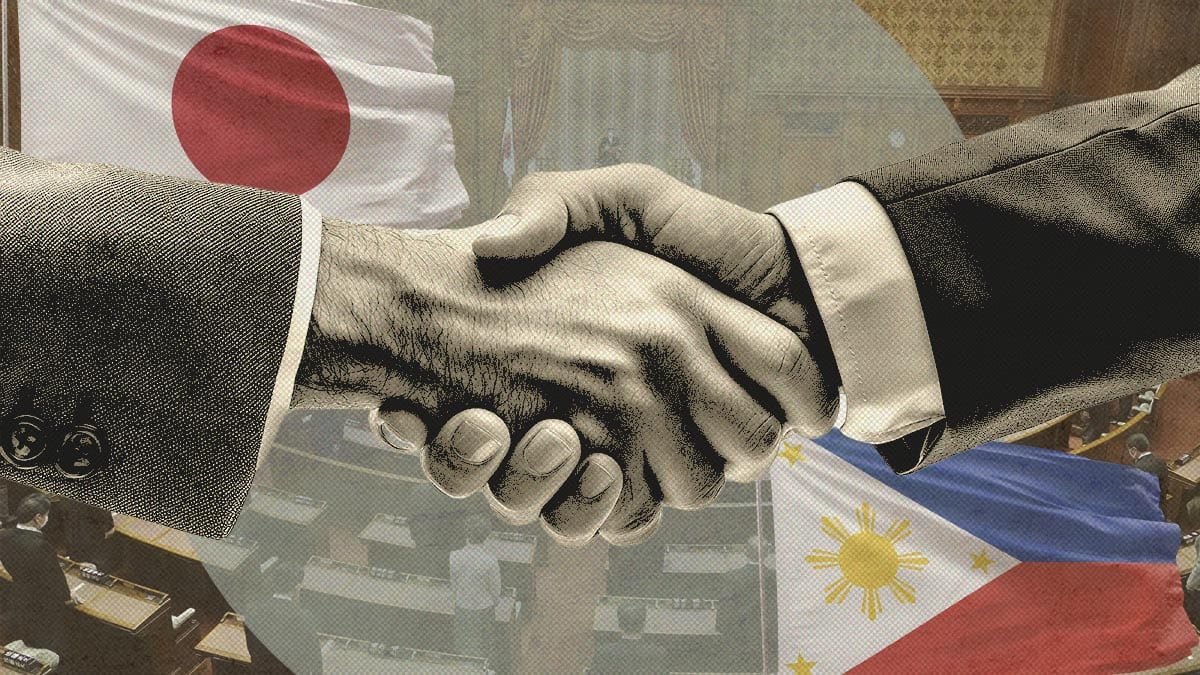
On June 7, Tokyo’s House of Councilors ratified the Japan and Philippines Reciprocal Access Agreement (RAA) , a military pact seen to bolster Manila’s defense capacity amid tensions with Beijing over the West Philippine Sea.
The pact is seen to complement the Philippine government’s recently passed Republic Act No. 12024, or the Self-Reliant Defense Posture Revitalization Act, which requires the government to boost local production of defense equipment to deter threats.
Both countries inked the military deal in July last year, paving the way for easier entry of defense and military equipment for military drills and disaster risk response on each other’s soil.
“The anticipated closeness of Manila and Tokyo will irk Beijing leaving a pinch of insecurity for China in its ascribed ambition to widen the metes and bounds of its undefined maritime territory,” Chester Cabalza, the president of the Manila-based security think tank International Development and Security Cooperation (IDCS), told Esquire Philippines in an interview.
“To reverse the tide, China will rehearse a potential military scenario to split the binded union of Japan and the Philippines through RAA.”
Also Read
Why Marcos Wants a Code of Conduct on the South China Sea
Why the Philippine Coast Guard is Worried About Chinese Research Vessels
The Japanese military pact, which is the first of its kind in Asia, coincides with Beijing’s increasing assertiveness in the waterway backed by its sweeping claims over the sea.
Philippine President Ferdinand Marcos, Jr. signed the RAA in October prior to Manila’s concurrence in the pact.
“At the same time, through joint exercises and collaborations in other vital sectors, the two countries can ascertain that their shared commitment to promote freedom of navigation in the Indo-Pacific will thrive,” said Josue Raphael Cortez, who teaches diplomacy and international relations at the De La Salle College of Saint Benilde School of Diplomacy and Governance.
“This forging of agreement between the Philippines and Japan will certainly be alarming to China.”
The RAA and Manila's Quest To Beef Up Defenses This Year
The Philippines is trying to beef up its defense industry and capabilities to counter China’s aggression in the South China Sea. The Southeast Asian nation has hiked its defense budget this year with about P35 billion set aside to enhance its military in the next decade.
Beijing is claiming nearly the entire waterway or more than 80 percent based on what it claims are 1940s maps that it sees as a historical basis. The waterway is seen as a crucial trade route as more than $3 trillion worth of global trade flows through it.
In 2016, the Hague-based and United Nations-backed Permanent Court of Arbitration voided China’s claim over the South China Sea for being illegal. Other Southeast Asian nations such as Malaysia, Indonesia, and Vietnam also have competing claims over the West Philippine Sea.
The Philippines has failed to enforce the ruling due to the Chinese Coast Guard’s vast fishing fleet and aggression at sea.
“The Marcos administration needs first to work on the institutional foundations of this defense industrial sector. And so far, it appears it is not doing enough towards this end,” Michael Henry Yusingco, a resident fellow at the Ateneo de Manila University Policy Center, told Esquire Philippines via an online exchange.
The Philippines has visiting forces agreements (VFAs) with the US and Australia, while Tokyo hosts the biggest concentration of American forces abroad and similar military setups with Australia and Britain. Tokyo is also in talks with another military pact with France.
During her visit to Manila last year, Japanese Foreign Minister Yoko Kamikawa said her country’s agreement with the Philippines is not targeted against any country and only aims to bolster efforts towards peace and stability in the region.
Japan has committed to provide the Philippines with more patrol vessels and surveillance radar systems amid the Chinese Coast Guard’s persistent presence in the disputed waters.
Meanwhile on Monday, June 9, the Philippines and China marked 50 years of diplomatic ties, which started in 1975.
That year, President Ferdinand E. Marcos, Sr., the incumbent Philippine leader’s father, signed a joint communiqué with Chinese Premier Zhou Enlai in Beijing, making it the first country from the region to form ties with Beijing during the Cold War.
“This partnership can be interpreted by Beijing as a way for the two countries to jointly stand against China and work hand in hand in promoting their rights over their respective maritime jurisdictions,” Cortez said, referring to Tokyo and Manila’s closer ties after finalizing the military pact.
The Philippines' Department of National Defense welcomed the Japanese Diet’s ratification of the deal, saying it would allow both countries to build reliable defense ties. In a statement, Defense spokesman Arsenio said the RAA is in line with President Marcos’ directive to boost partnerships with “like-minded countries."
At the 46th Association of Southeast Asian Nations Summit in Kuala Lumpur, Malaysia in May, President Marcos called on his neighbors to fast-track negotiations and an adoption of a code of conduct on the South China Sea to deter volatile clashes.
The regional bloc and China have been in talks to craft the code as far back as 2002, but have led to limited progress in forming an enforceable document.
The Chinese Foreign Ministry has said China was open to dialogue on the maritime dispute but called on the Philippines to stop its “provocations."
“We cannot afford a major military conflict happening in the region,” Edwin Estrada, who also teaches international relations and specializes in national security studies at the De La Salle College of Saint Benilde School of Diplomacy and Governance, said in an interview. “Looking through a realist lens, China naturally wants to control the game.”
Estrada added that forging defense alliances and increasing military weaponry may invite “insecurity in security” with China.
In March this year, US Defense Secretary and Trump appointee Peter Hegseth reaffirmed the United States’ ironclad commitment to boosting deterrence efforts with Manila “considering threats from the communist Chinese.”
Beijing’s Foreign Ministry has urged the Philippines to stop “serving as other countries’ mouthpiece and more stunts for personal political agenda.”
“With US Defense Secretary Hegseth's recent strong statements versus China, is it possible to imagine what I call a ‘Fellowship of the Ring of Fire’ materializing?,” Estrada said, citing the strategic geographical tussle between the two economic rivals.
“Only time will tell," he said. "One thing is certain. Diplomacy may still be our best bet in resolving one of the region's biggest maritime conundra.”
