
A Look At What Marcos Has Done So Far In His Washington Trip

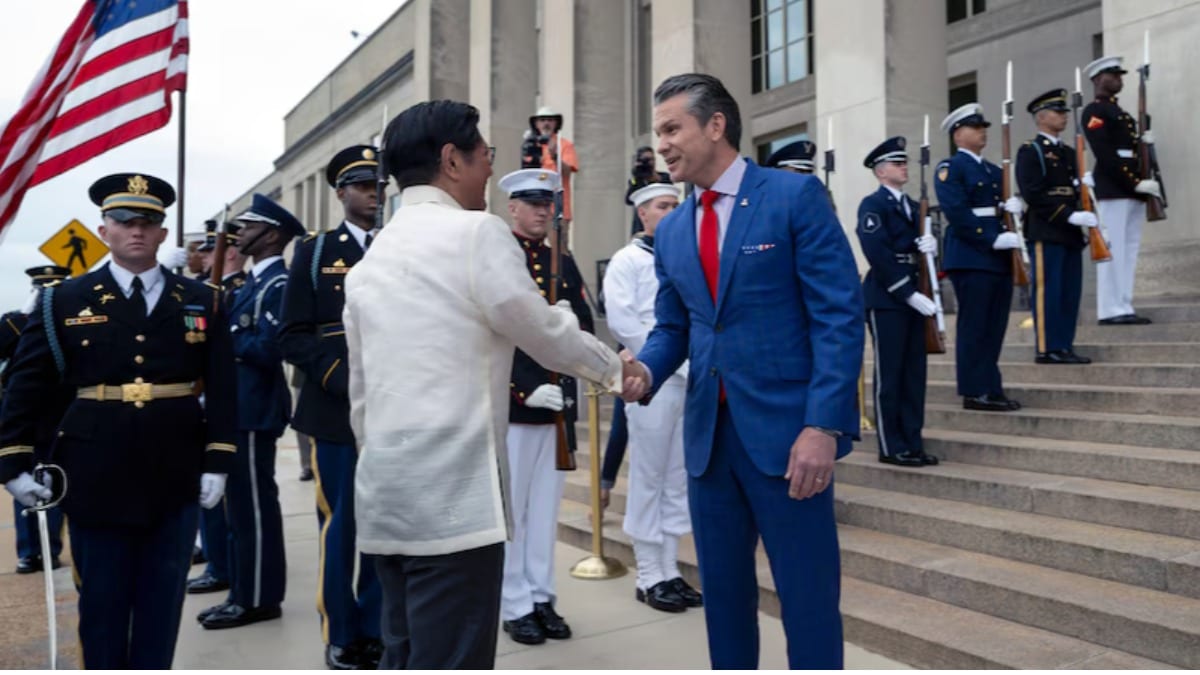
President Ferdinand “Bongbong” Marcos, Jr. is in Washington to meet with US President Donald Trump as both countries are in the middle of concerns over a new round of reciprocal tariffs and burgeoning maritime and security tensions with China. So what has the Philippine leader done so far ahead of his meeting with his American counterpart on July 23, Wednesday (Philippine time)?
Earlier in July, Trump’s government imposed a slightly higher 20 percent duty on Philippine products in a new round of tariffs, which were announced in a series of letters published on social media platform X via the White House’s official account. His government had earlier imposed a 17 percent tariff after eventually pausing the rate following Wall Street panicking that sent the US stock market plummeting.
Manila has an existing tariff rate of 24 percent on US goods, which is based on estimates made by US trade officials.
ALSO READ:
Trump Slaps Higher Tariffs On Philippine Exports: What Does This Mean For Local Businesses?
Here’s What to Expect When Marcos Meets With Trump This Month
In his pre-departure speech, the Philippine President said he is hoping to strike trade and security deals in his trip and to “alleviate the effects of a very severe tariff schedule on the Philippines.”
Last year, the US experienced a deficit of nearly $5 billion with Manila on the trade of goods both ways worth about $23.5 billion.
Finance Secretary Ralph Recto has said the Philippines is open to lowering duties on selected imports from Washington when Marcos negotiates Trump’s tariff scheme when he meets with his American counterpart.
Who has Marcos Met With So Far In Washington?
Since landing in Washington on Monday (July 21), Marcos has met Trump's State Secretary Marco Rubio and Defense Chief Peter Hegseth to discuss security cooperation amid China’s aggressive behavior in the South China Sea.
On Monday, Marcos spoke with Rubio on how to boost supply chains through the Luzon Economic Corridor and to bolster deterrence and to reinforce “freedoms of navigation and overflight in support of a free and open Indo-Pacific.”
The Luzon Corridor is an economic and logistics hub that aims to link Subic, Clark, Manila and Batangas via a 250 kilometer freight line. The collaboration that led to this initiative was approved during the trilateral meeting between the Philippines, Japan and United States in the US last year.
The project design stage for the corridor is set to be completed next year, while construction is expected to start in 2027, Presidential Special Assistant on Investment and Economic Affairs Frederick Go earlier said.
The hub will also entail investments in ports, rail, clean energy, semiconductors, supply chains and four cities set to host military air bases near the West Philippine Sea.
“The Secretary and President Marcos looked forward to maintaining regular high-level engagement between the United States and the Philippines as friends, partners, and allies, particularly ahead of the 80th anniversary of United States-Philippines diplomatic relations in 2026,” US State Department Spokesperson Tammy Bruce said in a statement.
Washington And Manila To Boost Deterrence in The South China Sea
The Philippine leader also met with Defense Chief Hegseth on Monday at the Pentagon, where Washington reaffirmed its "ironclad" defense cooperation commitment with Manila to bolster deterrence in the Indo-Pacific region.
"Our storied alliance has never been stronger or more essential than it is today," Hegseth said during the meeting. "Together, we remain committed to the mutual defense treaty. And this pact extends to armed attacks on our armed forces, aircraft or public vessels, including our Coast Guard, anywhere in the Pacific, including the South China Sea."
In March this year, Hegseth reaffirmed the United States’ commitment to boosting deterrence efforts with Manila “considering threats from the communist Chinese.”
Beijing claims more than 80 percent of the South China Sea, which is a major trade route with more than $3 trillion worth of goods passing through it.
A United Nations-backed tribunal struck down China’s sweeping claim in 2016 as it failed to find legal basis.
Southeast Asian nations such as Malaysia, Indonesia, and Vietnam also have competing claims over the disputed waterway. The Philippines has failed to enforce the UN ruling and has since filed hundreds of protests over "encroachment and harassment" by Beijing's vast fishing fleet and coast guard.
China’s Foreign Ministry has urged the Philippines to stop “serving as other countries’ mouthpiece and more stunts for personal political agenda.”
The US and the Philippines are bound by a Mutual Defense Treaty, which requires both nations to defend each other in the event of armed conflicts and attacks.
“We're proud to support our mutual economic vitality, including your efforts to ... modernize your armed forces and collective defense," Hegseth told Marcos based on a statement by the US Department of Defense. "We've made rapid progress enhancing real deterrence and upholding a free and open Asia-Pacific."
An advanced multipurpose Typhon missile system from the US, which was left in the country in April during last year’s Balikatan drills, has been moved from Laoag airfield to an island in Luzon.
In April, the treaty allies held their yearly Balikatan (shoulder-to-shoulder) combat drills, China’s foreign ministry had once again accused the Philippines of jeopardizing regional peace and economic ties as tensions over the West Philippine Sea continue to heat up.
Malacañang has asked China to respect the Southeast Asian nation’s decision to deepen its military ties with the US and for its neighbor to stop meddling in its diplomatic affairs.
Manila’s Departments on Finance and National Defense have said they are working on financing plans for advanced fighter jets to modernize the Philippines’ military capabilities. The Philippines has been looking at multi-role combat jets to beef up its existing inventory of air force planes as tensions with China continue to worsen.
Philippine Ambassador to the US Jose Manuel Romualdez earlier said the government was working with the United States to finance a $5.6 billion contract for 20 F-16 jets.
“I believe that our alliance ... the United States and the Philippines, [has done a great deal] in terms of preserving the peace [and] in terms of preserving the stability of the South China Sea," Marcos told the US Defense Chief on Monday. "But I would even go as far as to say in the entire Indo-Pacific region. And we are always very, very happy to continue to strengthen that relationship."
