Today I Learned: Why BBM Vetoed a Bill Declaring Pampanga as the PH’s Culinary Capital

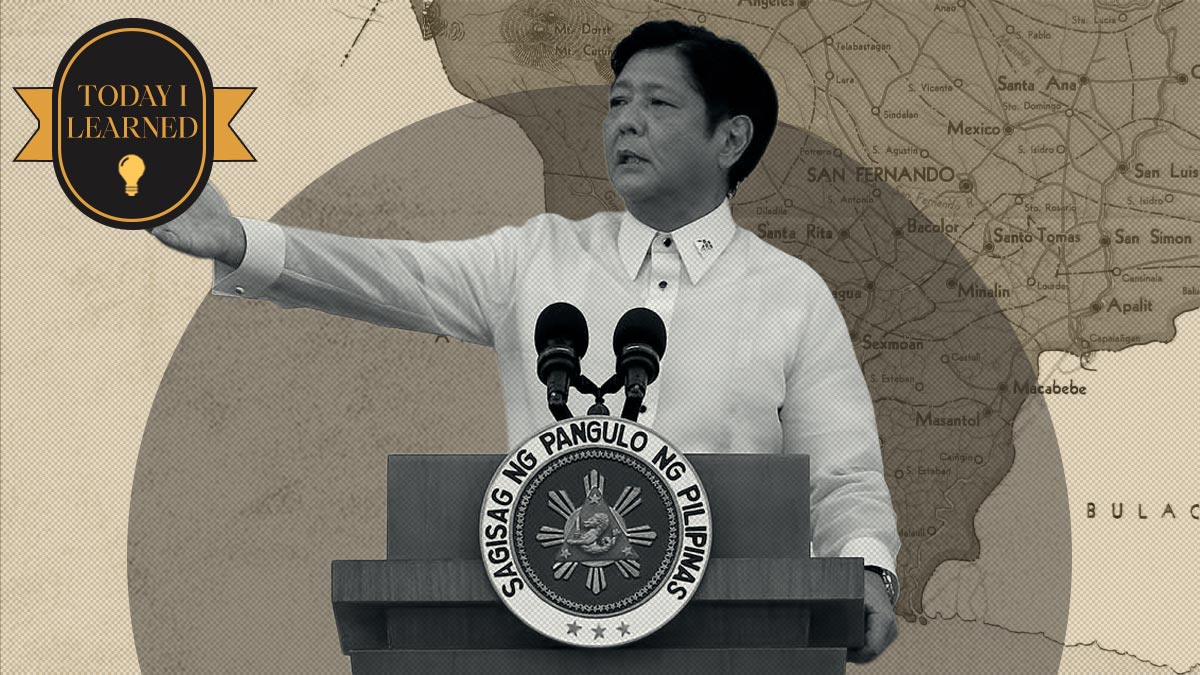
President Bongbong Marcos Jr. has vetoed Senate Bill No. 2797 / House Bill No. 10634 that would have named Pampanga the "Culinary Capital of the Philippines."
The legislation—authored by Pampanga Representatives Anna York Bondoc, Carmelo Lazatin II, Senior Deputy Speaker Aurelio Gonzales Jr., former President Gloria Macapagal Arroyo, and others—aims to formally recognize the rich culinary heritage of Pampanga to boost tourism and, in effect, drive economic growth within local communities.
Pampangueño Senator Lito Lapid, for his part, authored Senate Bill 2797 which “seeks to formally recognize Pampanga's unique contribution to the nation's culinary landscape by declaring it as such."
However, in his veto message, President Marcos raised concerns about the “declaration's lack of historical basis, the absence of a thorough study that shows key performance indicators for such designation, and the possibility that the bill may offend sensibilities in other provinces that are equally proud of their culinary contributions.”
The President also stressed: “Our regional variants and their recognizable nuances are what make the palette that is truly Filipino.” Therefore, to prevent “negative cultural implications, discrimination, regional bias, and loss of diversity,” he decided to veto the bill.
‘We were surprised’
The decision has polarized Filipinos from all over the world and has sparked an endless debate among food critics, food historians, lawmakers, and Kapampangans, who take pride in their province’s deep-rooted gastronomic identity.
Robby Tantingco, director of the Center for Kapampangan Studies at Holy Angel University, echoed the sentiments of many Kapampangans, stating his surprise at President Marcos' decision.
“We were thinking that because the House of Representatives passed the legislation unanimously, [its passage] was going to be a breeze. But we were caught off guard. We didn’t think it would be vetoed,” he admitted.
Regarding the historical basis for the declaration, Tantingco said they prepared several documents detailing Pampanga's role in supplying food to Manila, Kapampangan chefs' cooking for the Malolos Congress, and the visits of Russian and Cambodian royalty, among other evidence.
“Hindi kami nagkulang doon sa historical basis,” he told Esquire Philippines. However, he cannot confirm whether these were included in the documents submitted to Congress and the Senate.
Tantingco believes the recognitions from the New York Times, Condé Nast, and world-renowned chef Anthony Bourdain can be considered key performance indicators, given their positive assessments of Kapampangan cuisine. “The title ‘Culinary capital’ did not come from us. We did not create that title," he insisted. "It was bestowed on us. It's a reputation that was created by the very people who were impressed with our food. So kami naman, we accepted it graciously and gratefully.”
He added that the bill could immensely help the province by leveling the playing field. “Kasi in this very competitive tourism industry, we have no white beaches, we have no perfectly cone-shaped volcano, we have no rice terraces. What we have is our food. So we needed help from government to support our tourism industry—not to create a title, but simply to validate the existing one. The title is already there. It's universally accepted.”
Addressing the President's concerns about offending regional sensitivities, Tantingco said it was never their intention, although he acknowledged the possibility. “Maybe we misread the temperament. Any objections should have been raised during the committee hearings or interpolations. But there was none. There was a groundswell of support. The senators we spoke to expressed that it was truly acceptable, saying, “Okay naman talaga. Sino pa ba?” Those were their words. So we were confident of their approval.”
ALSO READ
Are the Kapampangans Really the Inventors of Kare-Kare?
Unpacking the Myth: Do Kapampangans Really Eat Dogs?
'Our journey is far from over'
Chef Jam Melchor, Founder of Philippine Culinary Heritage Movement, also expressed his disappointment over President Marcos’ decision. “As a Kapampangan, I am deeply disheartened by the recent veto of this Senate bill. Having witnessed firsthand the tireless efforts of our province to champion this measure, I know the positive impact it could have had—not just for Pampanga, but for the recognition and preservation of our rich culinary heritage,” he told Esquire Philippines.
However, he sees the decision as “an opportunity to strengthen our resolve and deepen the discourse on the broader issues affecting our food system.”
He added: “As mentioned in my FB post the other day, Pampanga has long been recognized as the Culinary Capital of the Philippines—not by request, but by the weight of its history, the excellence of its cuisine, and the generations of artisans who have safeguarded its traditions. This distinction was bestowed upon the Kapampangans long before the internet amplified their food stories, and it remains undisputed.”
He continued, highlighting the unique passion of the Kapampangan people: “Only a Kapampangan can truly understand why we are so deeply passionate about our food—why we fight to preserve our traditions and ensure that future generations continue to take pride in our culinary identity. And if only more people knew that it was through the unwavering efforts of a Kapampangan that we now have a national celebration of Filipino Food Month—the only initiative officially recognized by the Philippine government that continues to elevate and honor the richness and diversity of our nation’s gastronomy."
'Celebrate our culinary diversity'
Conversely, there are people like food writers Ruston Banal and Clang Garcia, who oppose the decision to turn the “Culinary Capital” declaration into a law.
Banal said that the proposal submitted to congress by the Culinary Council under the Provincial Board of Pampanga lacked crucial information regarding the provenance of the title "culinary capital," a point he deemed essential to the discussion.
"The earliest known reference [of the term 'culinary capital'] dates back to February 1990, in an article published in Mabuhay Magazine, the in-flight publication of Philippine Airlines. Titled 'Gourmet Highway,' the piece recalled how premier Filipino culinary historian Felice Sta. Maria referenced Pampanga as part of what writer Gilda Cordero Fernando once described as the 'Gourmet Province.' In her writing, Sta. Maria used the phrase 'culinary capitals' to describe her experience of Pampanga’s vibrant food culture during her visit—potentially laying the foundation for the title that remains strongly associated with the province today," said Banal, who's also a visual enthographer. "However, according to Sta. Maria—based on a recent conversation—her statement, much like Fernando’s, was merely an opinion at the time."
Banal, a native of Pampanga, added that the proposal did not offer any explanation about a program on sustainability or key performance indicators. He was hoping to offer more information through his book "Pimamanan, A Taste of Pampanga’s 65 Heirloom Dishes," but it unfortunately did not meet the deadline.
“I did a food mapping in 21 municipalities [in Pampanga], cataloging the food practices per town to analyze our food culture," he said. "My findings suggest that the culinary practices in Pampanga, particularly the values and attitudes of the people toward their food, are not unique. These practices can also be found in Tarlac and the Ilocos region," Banal explained. "I discovered this during my immersive research for these regions' gastronomy book."
His research further indicated that the food produced in Pampanga is not exclusively derived from within the province. "We have bagoong from Pangasinan and Bataan, tinapa from Bataan, carabao meat from Pangasinan and Tarlac, and leghorn chicken and beef from Batangas. It's a complex network of gastronomy and a food ecosystem," he stated.
Banal objects to Senate Bill No. 2797 / House Bill No. 10634, which would name Pampanga the "Culinary Capital of the Philippines" because "billions of taxpayer funds will be spent on a divisive title. Besides, there is no historical basis, and no comparative research has been conducted. Before making such a claim, there should have been a study to see how your culinary culture is different from other communities. No such study was carried out," he stressed.
For him, Pampanga can continue claiming the title. But “creating a law with no clear programs about sustainability and inclusivity may cause divisiveness among communities and would start a new wave of advocates that are purists and might use this as a sword to cut rather than as a torch to light the path for harmony and diversity.”
For Clang Garcia, author of Philippine Food Holidays and Philippine Ambassador of World Food Travel Association (WFTA), there shouldn't be just one culinary capital for the Philippines. “Our cuisine is extremely diverse; having a single capital would misrepresent our culinary heritage. Instead, we should celebrate our culinary diversity,” she said.
Garcia suggested establishing a Culinary Capital for each province, with evaluations conducted every year to determine if they can retain their title. “It is a program that the WFTA implements in various countries they collaborate with. It encourages destinations to maintain their title while inspiring others to seek similar recognition,” she said.
Updated on: March 22, 2025