

Are the Kapampangans Really the Inventors of Kare-Kare?

Filipinos commonly recognize the Kapampangans as the inventors of sisig, with its first recorded mention appearing in a Kapampangan dictionary by Diego Bergaño, a Spanish missionary and parish priest in Mexico, Pampanga, in 1732. This is supported by the popularity of sisig makers in the province like Lucia Cunanan, often referred to as the "Sisig Queen" of Aling Lucing; Benedicto Pamintuan of Bening's Sisig; and Milagros "Aling Mila" Cruz.
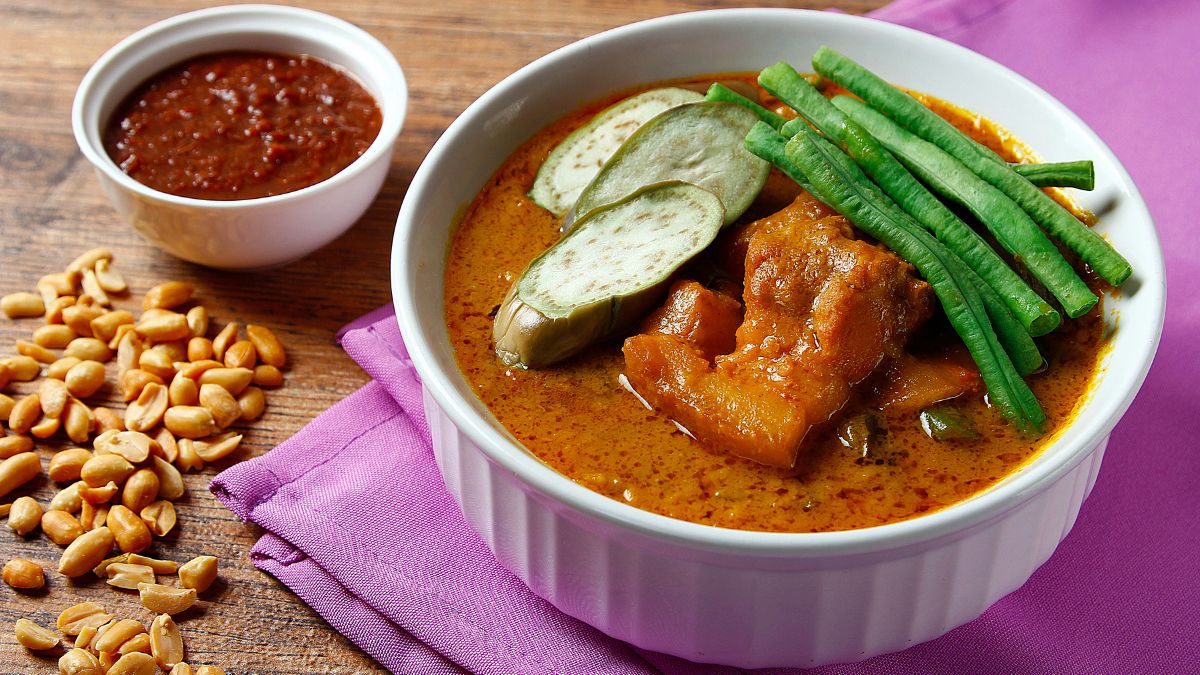
But there's another popular Filipino dish—the kari-kari (kare-kare among the Tagalogs)—whose provenance remains a subject for debate among culinary historians and enthusiasts. Many people believe that, like the sisig, the kari-kari also had its origins in Pampanga, as was published on the website siuala.com.
According to the website, Kapampangan cooks are traditionally called magkakari, and the eateries that cook and serve the dish are called kariyan (written in Spanish as carijan). "The Kapampangans are said to have established the first kariyan in Manila during the Spanish era to cater to homesick Kapampangan colonial bureaucrats, soldiers, sailors, and students working and studying in Intramuros," photographer and cultural advocate Ruston Banal shares at the KainCon 2024.
ALSO READ
Filipino Ice Cream Gets the Spotlight on Netflix Docu 'Somebody Feed Phil'
Toyo Eatery Chef Shares Secrets to Great Pork Barbecue, Siomai, Kinilaw in New Netflix Series
The narrative suggests that Kapampangans brought their own cooks or chefs to Manila to prepare kari-kari. The term "kariyan," eventually evolved into carinderias as it is known today.
There were stories claiming that when Tagalogs began establishing their own kariyan, Kapampangans regarded these as poor copies of the Kapampangan kari, referring to them as "kari-kari."
"I was never comfortable with this narrative because it tends to divide communities—the Tagalogs and Kapampangans," says Banal.
There was no way he could validate the information on the Siuala website because it didn't indicate its sources. This prompted him to start his own investigation about the provenance of kari-kari.
The Indian Connection
Banal began his research by checking out the culinary terms "kari" and "cari" in three dictionaries: the Vocabulario De La Lengua Tagala, published in 1764; the Vade-Mecum Filipino, published in 1875; and the Vocabulario de la Lengua Pampanga, published in 1732.
Upon examination, he found that none of these dictionaries contained entries for "cari" or its culinary processes, including the use of peanuts or annatto oil in sauce-making.
He reached out to culinary historian Felice Sta. Maria, and sought insights from anthropologist Dr. Nestor Castro, who has conducted extensive ethno-ecological and archaeological research on Pasig, particularly on the clay pot referred to as "cari."
This led to Banal discovering the connection between cari and the Sepoys, or the Indian soldiers serving as part of the British Imperial Army that attempted to occupy the Philippines in 1762. Despite the brief British occupation of Manila, many Sepoys stayed in the country, particularly in Cainta and Taytay.
They were called Bumbay because of their distinctive appearance. He discovered that the Sepoys played a significant role in shaping local culinary practices by setting up stalls that sold kari (curry), a dish that eventually became a staple Filipino fare. This assertion is supported by an 1874 painting by Jose Honorato Lozano depicting Filipinos eating curry.
Banal's findings brought him to Cainta, where he engaged in food mapping. He sampled the local versions of kari-kari in the town's major karinderyas.
"I asked the store owners how they learned to cook the kari-kari, and many of them said they inherited the recipe from their ancestors. I asked if they're related to an Indian, and many of them confirmed to either have an uncle or an aunt, who is one," he says.
Dr. Castro's research led to the identification of a specific type of clay pot known as kari, used for cooking kari-kari. "Given that Pasig is near Cainta, it's a logical connection," he notes.
The Spanish Cari
Meanwhile, a document from the Biblioteca Nacional de España (BNE) detailed the origins of cari as recorded by a Spaniard named Angel Muro. "He described cari as a well-known dish in Spain, popular among those who have visited the Philippines. Muro attributed the dish's origins to native Filipinos (Indios) and noted its typical ingredients, including beef tendons, butchered chickens, wild rabbit, and eel, served with steamed white rice Indio style," shares Banal.
Muro also mentioned the use of kari powder or flour, incorporating a spicy pepper unique to the tropics, terra merita from India, black pepper, nutmeg, and ginger, thereby highlighting the Indian influence in the spices used.
Banal also cited an entry from the 1921 book entitled Diccionario de Filipinismos Con La Revision de Lo Que al Respecto Lleva Publicado La Real Academia Espanola by Wenceslao E. Retana. In the book, the author noted a citation by Austrian teacher and author Ferdinand Blumentrit quoting historian Trinidad Pardo de Tavera about the cari.
Pardo de Tavera described cari as "a dish made with shrimp and spicy sauce originally from British India. Highly esteemed by the Indios of the Philippines and Europeans as a tonic and useful in tropical countries, it has come to be included in the most selected menus of French cuisine, and especially in English."
The historian said likewise mentioned the local stalls where cari is made and sold. "On the banks of the Pasig and all the rivers, there are countless carinderias built, half on land, half on river, intended to serve more primarity the boatmen."
But it is the 1916 recipe from Kusinang Tagalog by P. Sayo Balo ni Soriano that resembles the current version of kari-kari. Its method of cooking involves mixing peanuts and rice, boiling them together, and then cooking beef and adding vegetables.
Another significant mention is a 1936 document by Kapampangan historian Mariano Henson. His recipe mirrors the 1916 version but uses oxtail and tripe, highlighting that it is "karing Filipino."
"Kari has a rich history that dates back to the 18th century. Over time, the ingredients and cooking techniques have evolved and spread to various regions of the country, including Pampanga. The Kari-Karing Pampanga is simply one of the many results of culinary innovation, much like how other communities have adapted and created their own unique dishes using the resources available to them. But it is a food by the Filipino people, pagkain nating lahat," says Banal.
