
From Buenos Aires to the Vatican: The Unexpected Papacy of Pope Francis

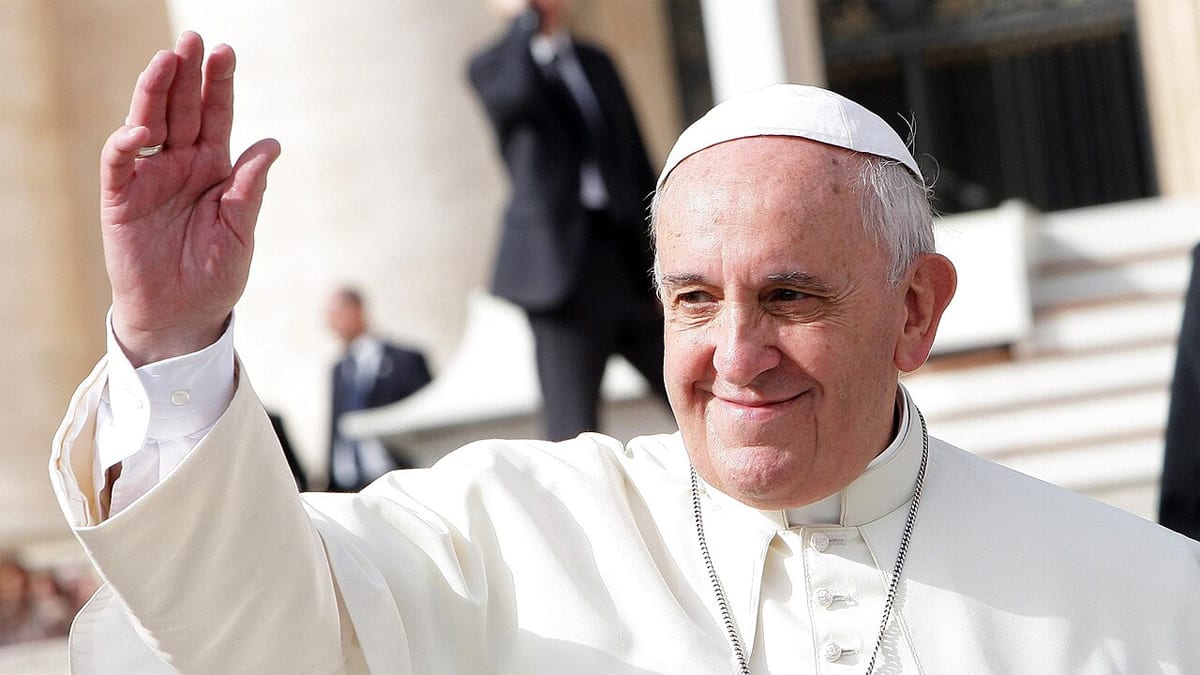
The Vatican confirmed on April 21 that Pope Francis, the first Latin American leader of the Roman Catholic Church, died on Monday morning. He was 88 years old and served as the Papal Father for 12 years (March 13, 2013 - April 21, 2025).
The Pope suffered from a bout of bronchitis for several days and was hospitalized from February 14 to March 23 at Agostino Gemelli Polyclinic Hospital. He returned to his Vatican residence at Casa Santa Marta, and appeared in public for the first time since the hospitalization on April 6.
On Easter Sunday, April 20, from the loggia of St Peter’s Basilica, he greeted the crowd gathered at St. Peter's Square. Italian Cardinal Angelo Comastri presided over the Easter Sunday Mass and read the homily on behalf of the Pope, while Archbishop Diego Ravelli, the Master of Pontifical Liturgical Celebrations, read the Pope's message and blessing Urbi et Orbi from the loggia. Pope Francis was also able to get closer to churchgoers while aboard the open-air popemobile, which made brief stops around the square.
The Pope had a brief private meeting with the Vice President of the United States of America, JD (James David) Vance, shortly after 11:30 a.m. at Casa Santa Marta.
At 9:45 a.m. (Vatican time) on April 21, Cardinal Kevin Farrell, Camerlengo of the Apostolic Chamber, announced the death of Pope Francis from the Casa Santa Marta in a video message:
"Dearest brothers and sisters, with deep sorrow, I must announce the death of our Holy Father Francis. At 7:35 this morning, the Bishop of Rome, Francis, returned to the house of the Father. His entire life was dedicated to the service of the Lord and of His Church. He taught us to live the values of the Gospel with fidelity, courage, and universal love, especially in favor of the poorest and most marginalized. With immense gratitude for his example as a true disciple of the Lord Jesus, we commend the soul of Pope Francis to the infinite merciful love of the One and Triune God."
ALSO READ:
3 Ways Pope Francis Set Himself Apart From Previous Popes
A Brush with the Divine: Remembering Pope Francis’ Visit to Manila
Who was Pope Francis?
Pope Francis was the 266th pontiff of the Roman Catholic Church. He was born Jorge Mario Bergoglio in Buenos Aires, Argentina, on December 17, 1936, to Italian immigrant parents. He grew up in a working-class family: his father, Mario, an accountant employed by the railways, and his mother, Regina Sivori, a homemaker who raised five children.
His early life was a blend of practical skills and a burgeoning spiritual calling. Initially graduating as a chemical technician, Bergoglio's path took a decisive turn towards the priesthood when he entered the Diocesan Seminary of Villa Devoto. In 1958, he joined the novitiate of the Society of Jesus, a move that would profoundly shape his worldview and approach to ministry.
Pope Francis as a student (fourth from left, middle row), studied chemistry before joining the priesthood
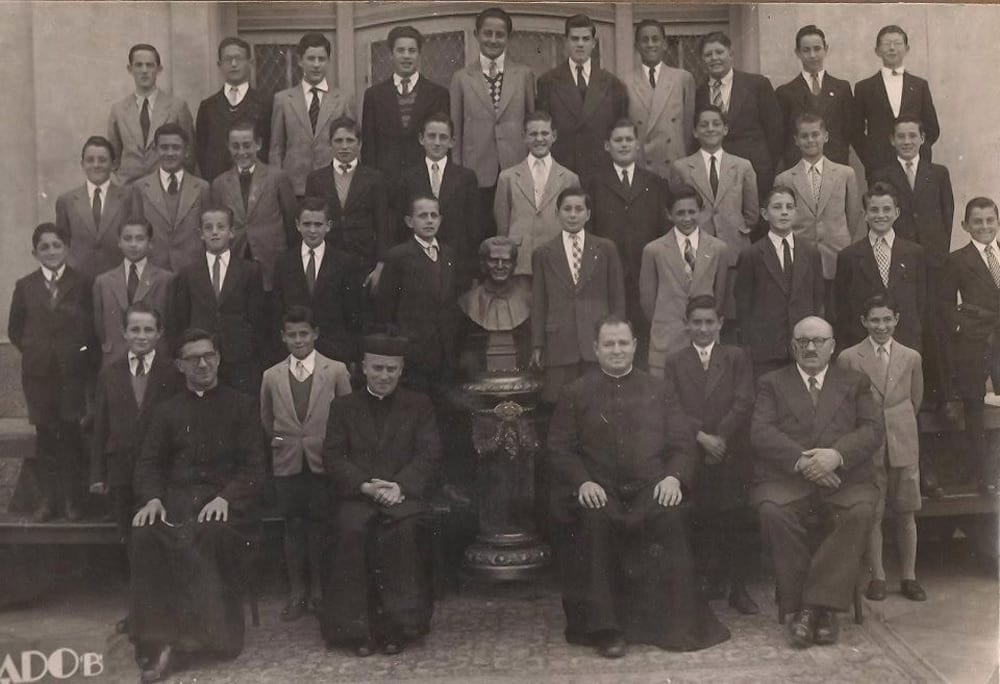
The Jesuit order's emphasis on intellectual rigor led him to pursue extensive studies. He completed his humanities studies in Chile before returning to Argentina, where he earned a degree in philosophy from the Colegio de San José in San Miguel in 1963. His academic pursuits extended beyond philosophy, as he also taught literature and psychology at Immaculate Conception College in Santa Fé (1964-1965) and Colegio del Salvatore in Buenos Aires (1966). From 1967 to 1970, he delved into theological studies, culminating in a degree from the Colegio of San José.
Ordained a priest on December 13, 1969, by Archbishop Ramón José Castellano, Bergoglio continued his advanced training at the University of Alcalá de Henares, Spain, from 1970 to 1971. He made his final profession with the Jesuits on April 22, 1973, solidifying his commitment to the order.
Upon his return to Argentina, his ministry took on diverse roles: novice master at Villa Barilari, San Miguel; professor at the Faculty of Theology of San Miguel; consultor to the Province of the Society of Jesus; and Rector of the Colegio Máximo of the Faculty of Philosophy and Theology.
A significant chapter in his early career began on July 31, 1973, when he was appointed Provincial of the Jesuits in Argentina, a position he held for six years. He then returned to the academic sphere, serving once again as Rector of the Colegio de San José (1980-1986) and as a parish priest in San Miguel.
His pursuit of knowledge continued in 1986 when he traveled to Germany to work on his doctoral thesis. However, his superiors soon redirected him, sending him to the Colegio del Salvador in Buenos Aires and then to the Jesuit Church in Córdoba, where he served as a spiritual director and confessor.
Cardinal Antonio Quarracino, Archbishop of Buenos Aires, recognized the exceptional qualities of Bergoglio and sought his close collaboration. On May 20, 1992, Pope John Paul II appointed him titular Bishop of Auca and Auxiliary of Buenos Aires, formally ordaining him on May 27, 1992, in the cathedral. Choosing "miserando atque eligendo" as his episcopal motto, and incorporating the IHS symbol of the Society of Jesus into his coat of arms, he signaled his deep commitment to both compassion and his Jesuit roots.
He was quickly appointed Episcopal Vicar of the Flores District and, on December 21, 1993, became Vicar General of the Archdiocese. His rapid advancement culminated in his appointment as Coadjutor Archbishop of Buenos Aires on June 3, 1997. Following Cardinal Quarracino’s death, Bergoglio succeeded him on February 28, 1998, as Archbishop, Primate of Argentina, and Ordinary for Eastern-rite faithful in Argentina without their own Ordinary.
Three years later, at the Consistory of February 21, 2001, John Paul II elevated him to Cardinal, assigning him the title of San Roberto Bellarmino. His popularity grew throughout Latin America, yet he maintained his austere lifestyle, often described as “ascetic.” In 2002, he declined the presidency of the Argentine Bishops’ Conference, but in 2005, he was elected and re-elected in 2008. In April 2005, he participated in the conclave that elected Pope Benedict XVI.
On March 13, 2013, Jorge Mario Bergoglio was elected Supreme Pontiff, following the resignation of Pope Benedict XVI on February 28, 2013.
Pope Francis signs the Palace Guestbook at the Reception Hall of the Malacañan Palace during the State Visit and Apostolic Journey to the Republic of the Philippines on January 16, 2015
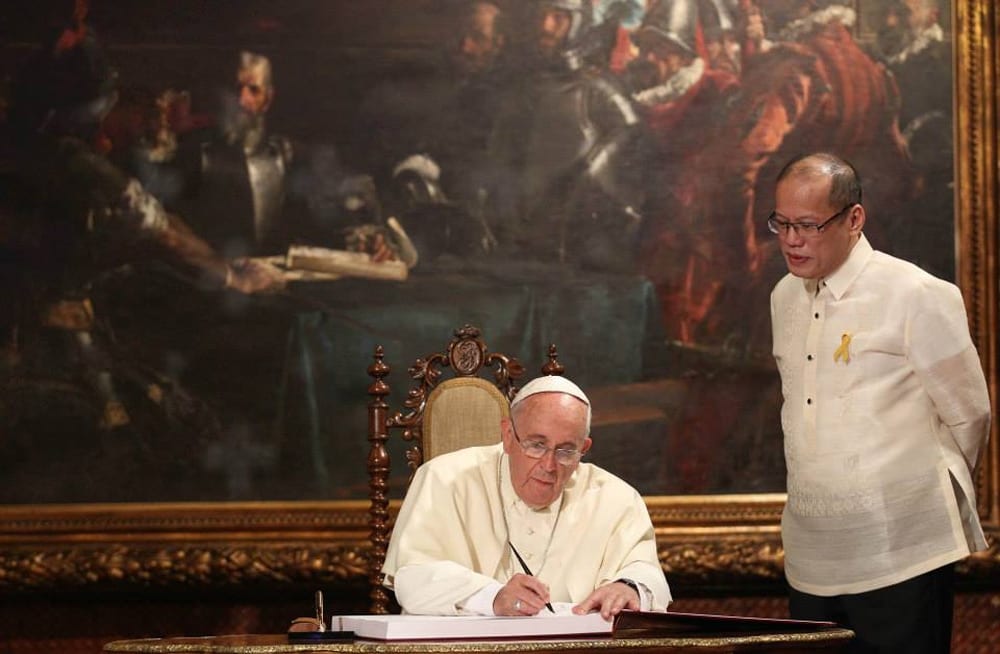
Two Popes at the Vatican
Pope Francis' succession to Pope Benedict XVI was rather unusual. For one, it was the first ever papal resignation since 1415 (Pope Gregory XII, who was forced to relinquish the office), and the first voluntary resignation since 1924 (Celestine V).
Second, it was also the first time that two popes were alive simultaneously: the sitting Pope and the retired Pope, both residing in the Vatican.
Third, it was also the first time that a pope presided over the funeral of his predecessor, as it typically takes a pope's death for a new pope to be chosen. Pope Benedict XVI died in 2022.
