

From Jakarta to Rome: How Global Conflicts Shaped Martial Law

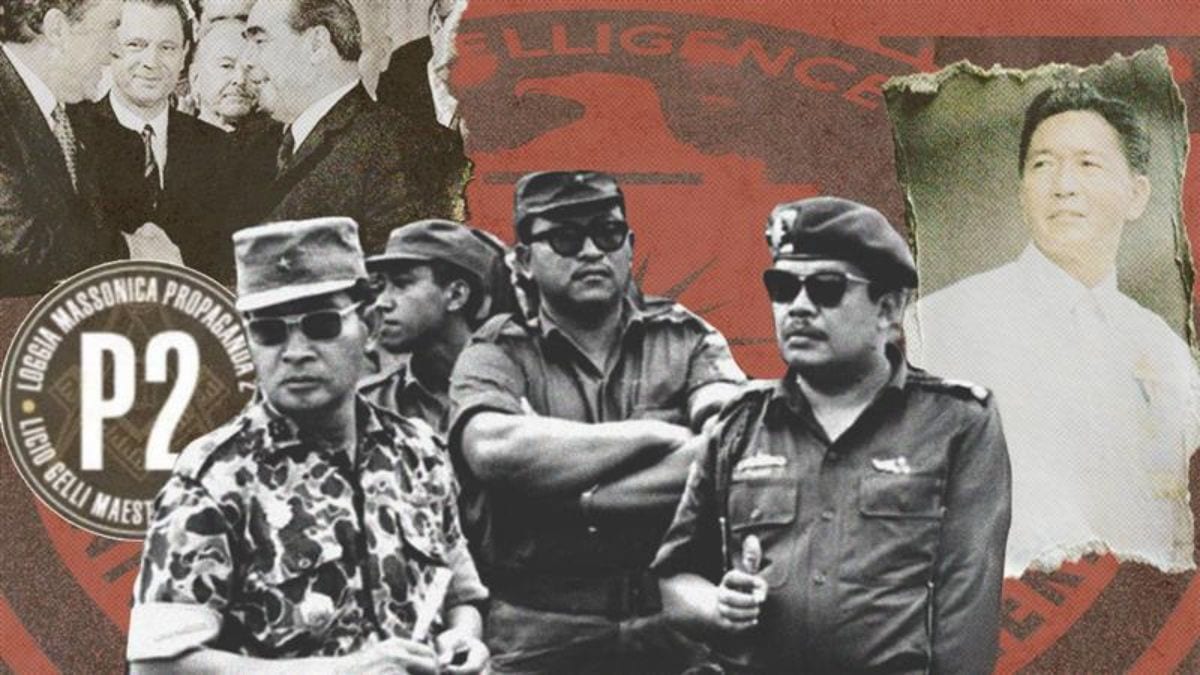
It is always easy to fall prey to either a rehash of conventional history or the re-litigation of past infractions when September 21 arrives. It has become almost a cliché, even a rote function of editorials, to publish think pieces with the same old refrain, one that half the population has already heard a thousand times or grown desensitized to after seeing its images for another thousand times. And no matter how loudly the sirens blare, the effect is always the same: disillusionment, apathy, and exhaustion—for obvious reasons. Rhetoric, no matter how passionately delivered, will never put food on the table.
Instead of recycling old tropes, it would be more beneficial for public inquiry to examine the Martial Law period from a different angle. This approach goes beyond conventional retellings, which often place heavy emphasis on structure over agency and prioritize the calculus of geopolitics above all else. For this reason, the scope must inevitably be international in its claims and unsparing in its analysis.
We begin this journey by retracing the tumultuous years from the mid-1950s to the late 1960s, from Cairo to Bangkok, and from Washington to Moscow.
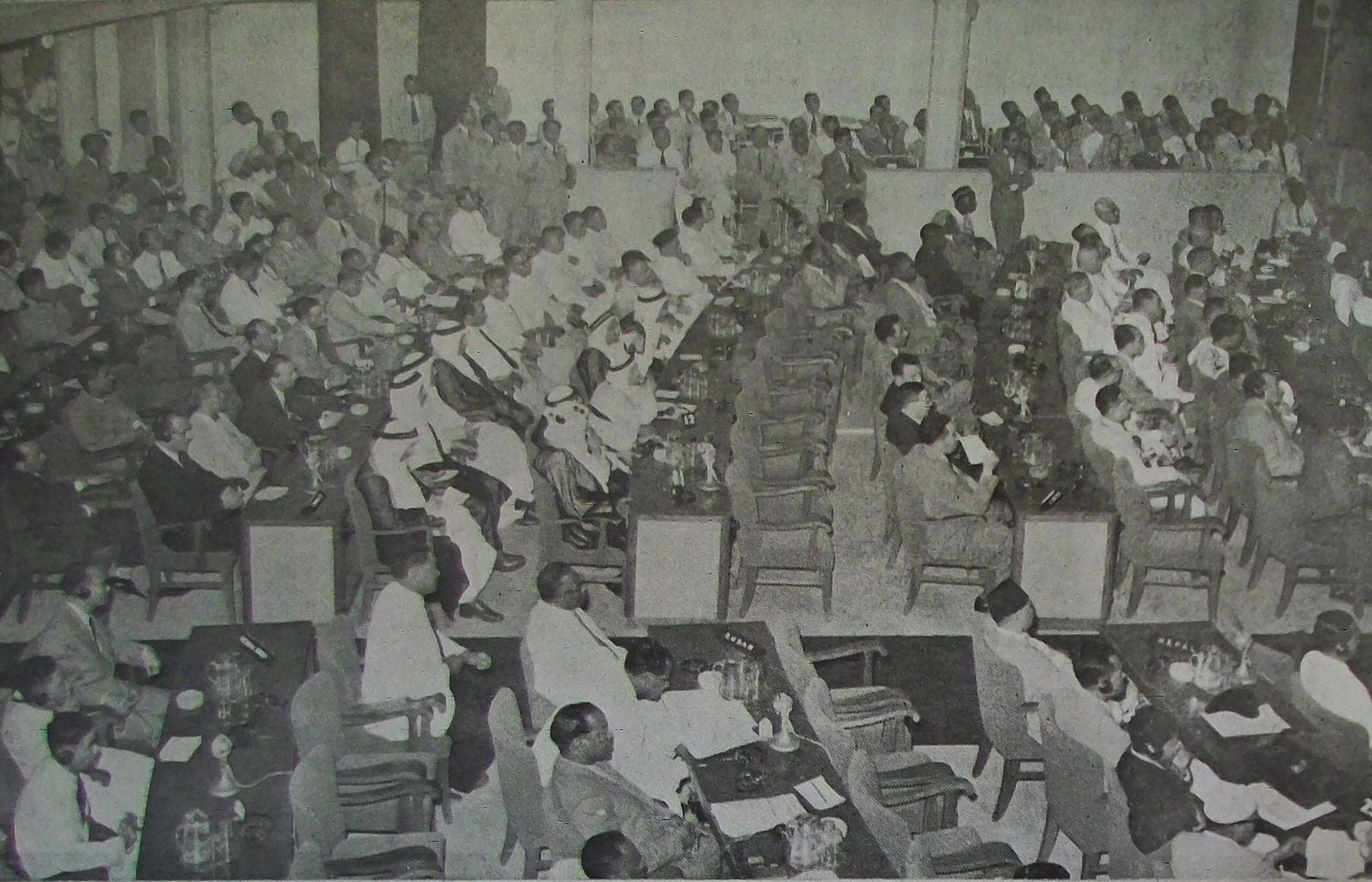
Plenary session during the Bandung Conference.
After Bandung
Today’s sentimentalists often claim that the Bandung Conference of 1955 was the hinge point against the prevailing international system ruled by Western powers. They are partially correct but their emphasis on moral declarations and paper victories is all too convenient. While Bandung did mark the genesis of Third World solidarity against the American and Russian blocs, such efforts remained abstract until 1956. The Suez Crisis—a last-ditch effort by Paris and London, with Israeli support, to cling to their colonial prestige—was decisively lost not on the battlefield, but through a gambit by Egypt’s leader, Gamal Abdel Nasser.
Gamal Abdel Nasser, the second President of Egypt, with Nikita Kruschev, former Prime Minister of the Soviet Union.
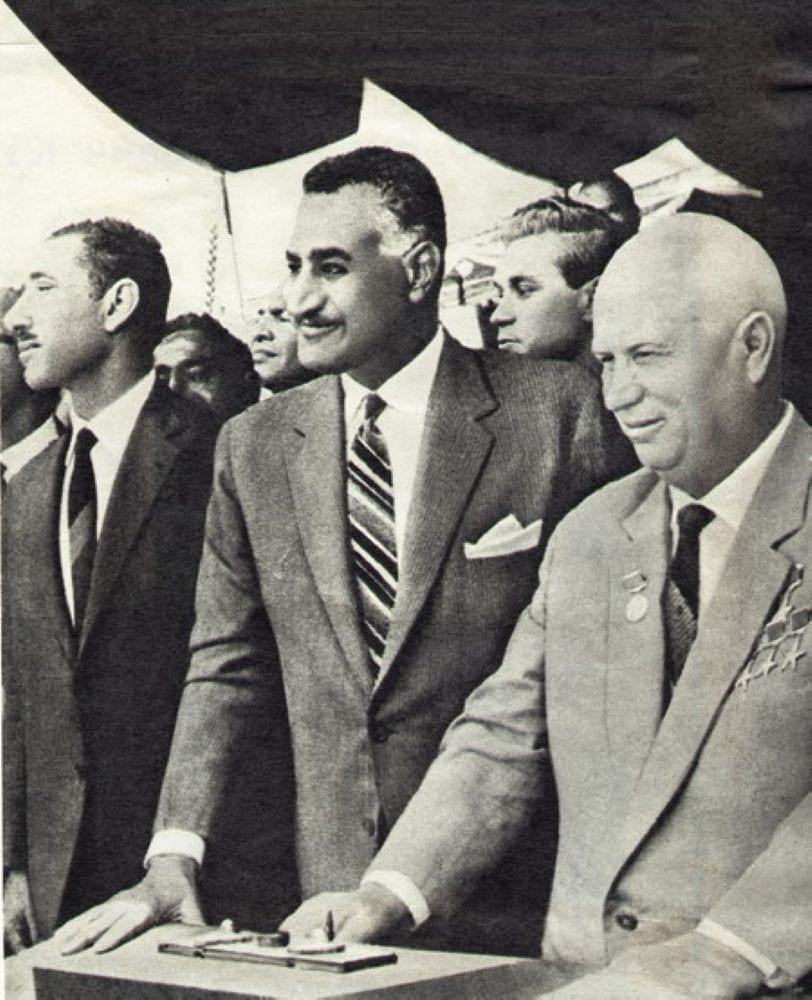
A popular officer who was one of the key figures that deposed the hated monarchy, blamed by the Egyptians for collaboration with the British four years prior, Nasser had a talent for taking risks and winning big payoffs in return. Suez was no different from his construction of the Aswan Dam, which provided his nation with cheap electricity. Though the conflict ended in a military stalemate, Nasser played the United States and the USSR against each other to intervene on his behalf. In the end, he expelled the occupying forces and secured Egypt’s control over a trade route that, for the previous century, had been a crown jewel of European power.
A British Centurion tank disembarks at Port Said during the Suez Crisis of 1956, symbolizing Britain’s last major bid to hold onto its fading empire.
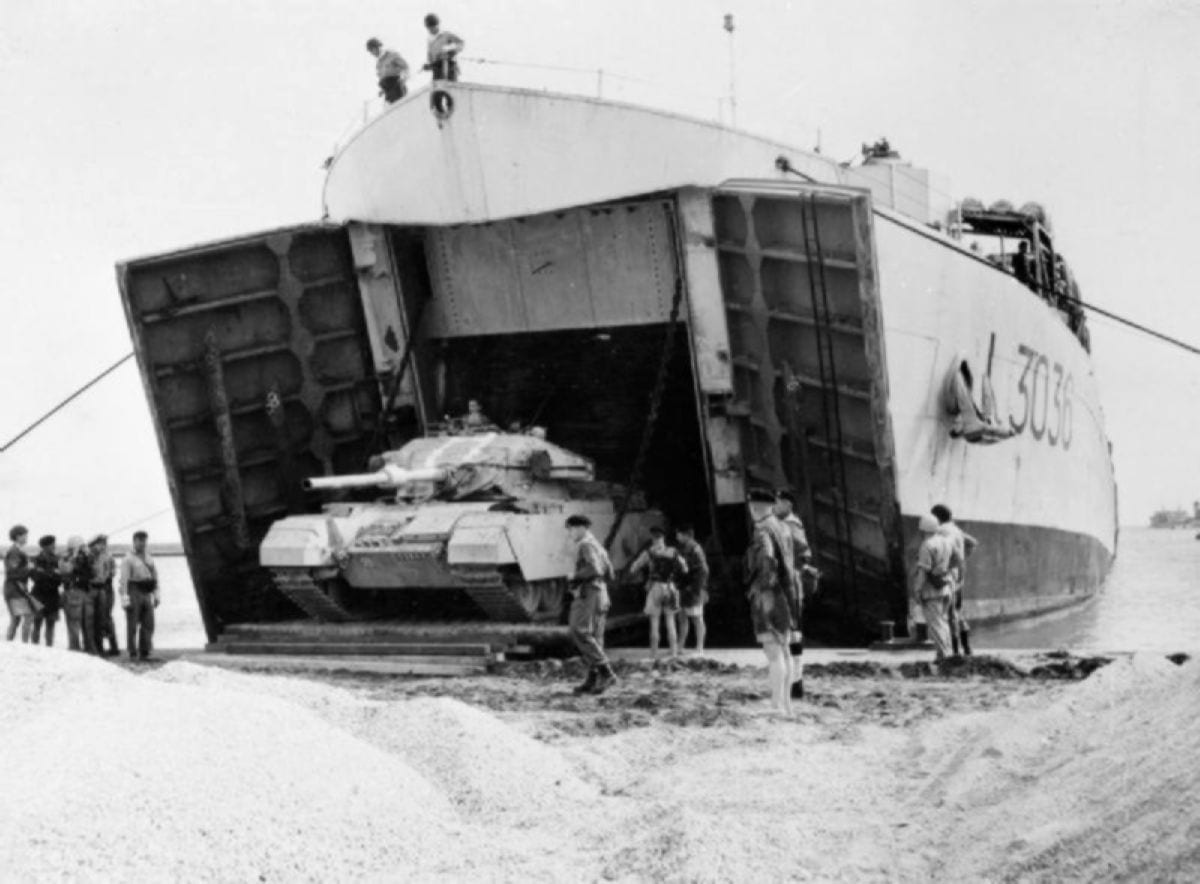
This move earned him the reputation as the liberator of not just the Arab world, but also the leading anti-colonial crusader of the Global South, even before that term gained currency. Existing national liberation movements looked up to Egypt for guidance, and asked themselves: If this country can punch above its own weight and triumph, what is our excuse? European decolonization is not the process that we are accustomed to, which is the peaceful transfer of authority to the natives, but a chain reaction sparked by the Suez fallout.
The Americans and the Russians have always been lukewarm to these aspirations. For decades, both superpowers have claimed to be the bastions of a new frontier, as opposed to the old empires—America with its struggle in 1776, and Russia in 1917. Through these intersecting twists and turns, an entire world order was unmade within a single generation.
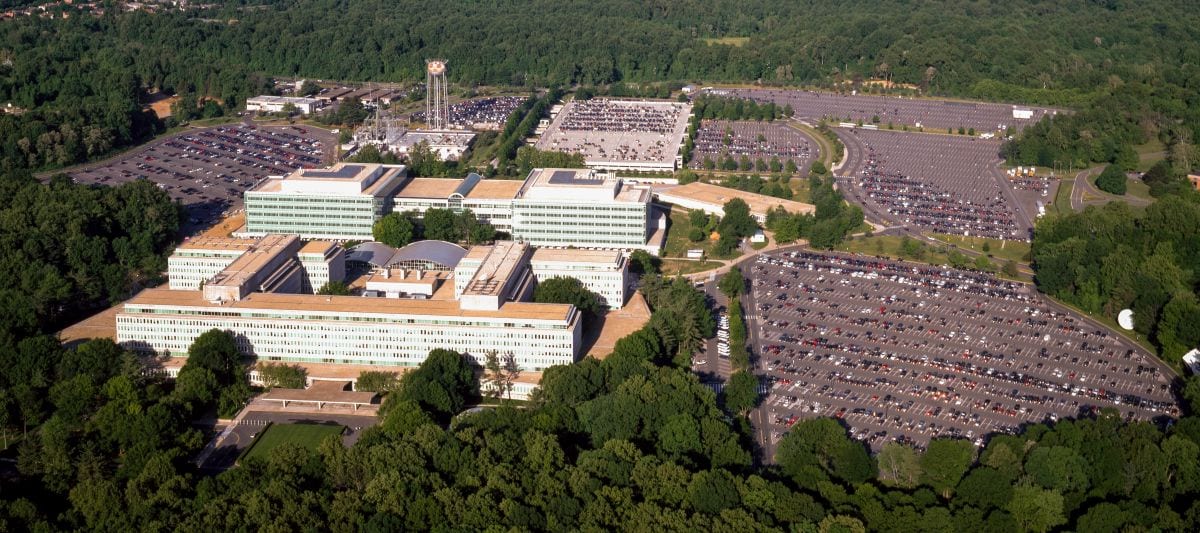
Aerial view of the Central Intelligence Agency headquarters, Langley, Virginia.
The Counterstrike
Predictably, not everyone is happy with these developments. At the top of the fomenting reaction is the Central Intelligence Agency (CIA). Despite being nominally loyal to the American state, the CIA has often exerted more control over foreign policy than civilian officials, especially under the tenure of its most controversial figure, the divisive Allen Dulles. From Operation Ajax, which deposed the Iranian government in 1953, to the overthrow of Guatemala’s Jacobo Árbenz in 1954, the CIA established itself as the foremost expert in “regime change”—a euphemism for instigating coups against leaders it did not favor.
Accompanying the CIA are several groups: Britain’s MI6, Israel’s Mossad, Le Cercle, the Safari Club, and a host of local partners. They all share the basic conviction that national liberation movements should be nipped in the bud and contained. This is because many of these groups were sympathetic to either the Soviet Union or China and made no effort to hide their contempt for the liberal global order. From this standpoint, the Cold War was less about capitalism versus communism and more about America and its allies working to embargo the Soviet Union for its refusal to be integrated into their sphere.
From there, all social and cultural struggles of the period domestically, be it civil rights or the Summer of Love, can be interpreted as downstream squabbles of a larger geostrategic conflict, only intensified by the Sino-Soviet split of the 1960s, when Moscow and Beijing clashed over the future of the Communist world and accused each other of betraying the international struggle. This split within the radical Left reached the Philippines with the separation of Jose Maria Sison’s camp from the old pro-Soviet Communist Party, a pattern later replicated across the globe. All in all, the Cold War was not only escalating into a nuclear arms race, but also becoming a conflict of competing visions of the world to come. During the Martial Law period, both Communist parties found themselves in opposite camps: Sison declared a people’s war against the regime, which grew more intense as the New People’s Army expanded in strength, while the old Communists accepted ministerial posts from the government and acted as conduits for Soviet efforts to draw Manila into its orbit.
ALSO READ
Opinion: Where Has the Glorification of Our Heroes Taken Us?
What Most People Get Wrong About Populism
The Big Stick
By the mid-1960s, the response to the tide of decolonization, anti-imperialism, and national liberation had become more pronounced, organized, and well-funded, with coercion as the reflex of those determined to stem the tide. From 1965 to 1966—though the details remain murky to this day—the Indonesian military carried out a series of mass killings of its rivals, the Indonesian Communist Party (PKI), over the course of 12 murderous months. Backed by the CIA and MI6, the Indonesian military under Suharto eradicated what had once been the largest Communist movement in the Third World, a movement that had never embraced armed struggle and had consistently adhered to a parliamentary path. These killings were justified in the name of an ideological crusade and came to be known as the “Jakarta Method,” in recognition of their perceived effectiveness.
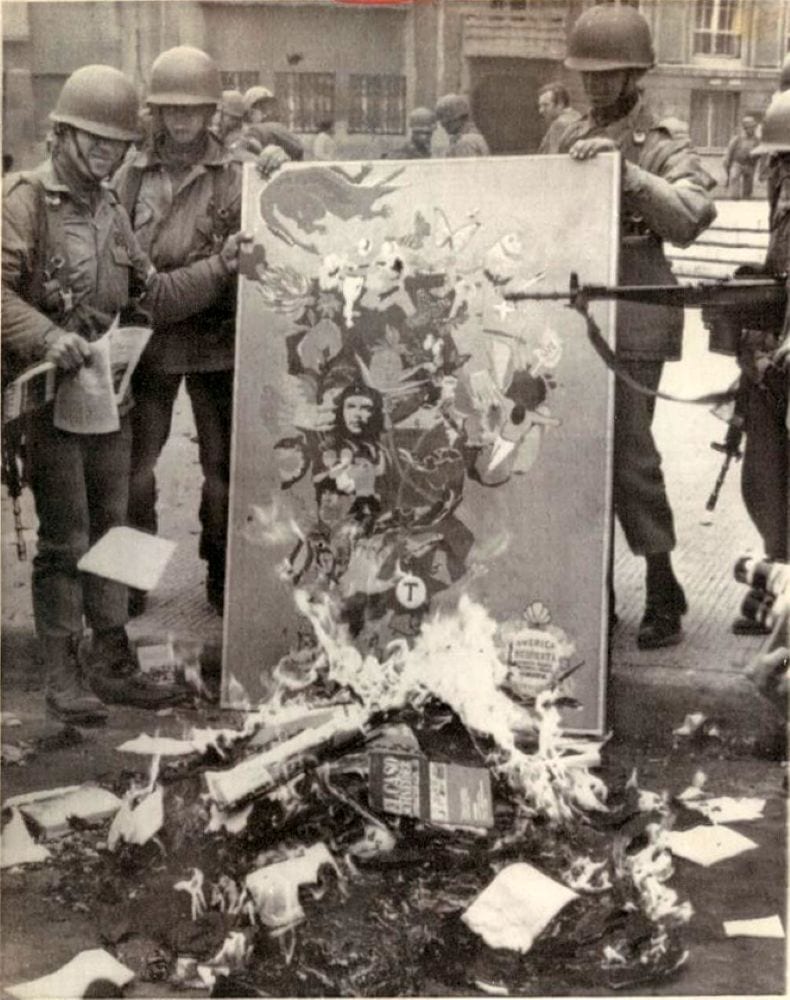
From there, Jakarta became shorthand for the harsh repression of any sentiment, movement, or organization that did not fall under NATO’s umbrella. From Latin America to Africa, several leaders aligned with Washington’s diktats adopted the Jakarta Method to launch their own campaigns to silence opposition. Pinochet’s coup against Chile’s Salvador Allende in 1973 bore all these imprints, and the perpetrators even bragged about them openly. The Chilean military’s actions fell within the prism of Operation Condor, the CIA’s program that assisted the juntas it sponsored in killing, imprisoning, or detaining political opponents—replacing JFK’s peace-oriented Alliance for Progress that had existed a decade earlier.
Chile, 1973. Soldiers burn Marxist literature in Santiago following the coup that toppled President Salvador Allende.
Parallel to Jakarta was Rome. In Italy, a series of bombings, assassinations, and skirmishes known as the Years of Lead erupted between the far left and the far right, with the Italian state cracking down on both. While ostensibly portrayed as isolated extremism between Communists and Fascists, it was later revealed in the 1990s that these activities fell under the umbrella of the “strategy of tension.” Not only were the incidents manipulated and engineered by intelligence services such as the CIA and the Propaganda Due (P2) Masonic Lodge, but their goal was also to exploit these tensions to impose a more authoritarian regime and condition the population to accept that order as a way to bury chaos altogether.
Lubricating both channels are the burgeoning drug trafficking and money laundering networks that first emerged from the Golden Triangle. Initially just a small-time smuggling racket run by the triads and remnants of the KMT who escaped the Chinese Civil War, the industry soon grew beyond anyone’s imagination. From heroin to cocaine, cultivation was encouraged as a way to generate funds from profits to finance black operations against America’s perceived rivals. As such, espionage and organized crime have been like peanut butter and jelly for most of modern history, with elements of the law and those who break it working arm in arm when it comes to their daily bread. As an aside, this is also the world that incubated and tolerated the notorious Jeffrey Epstein. Sounds familiar, doesn’t it?
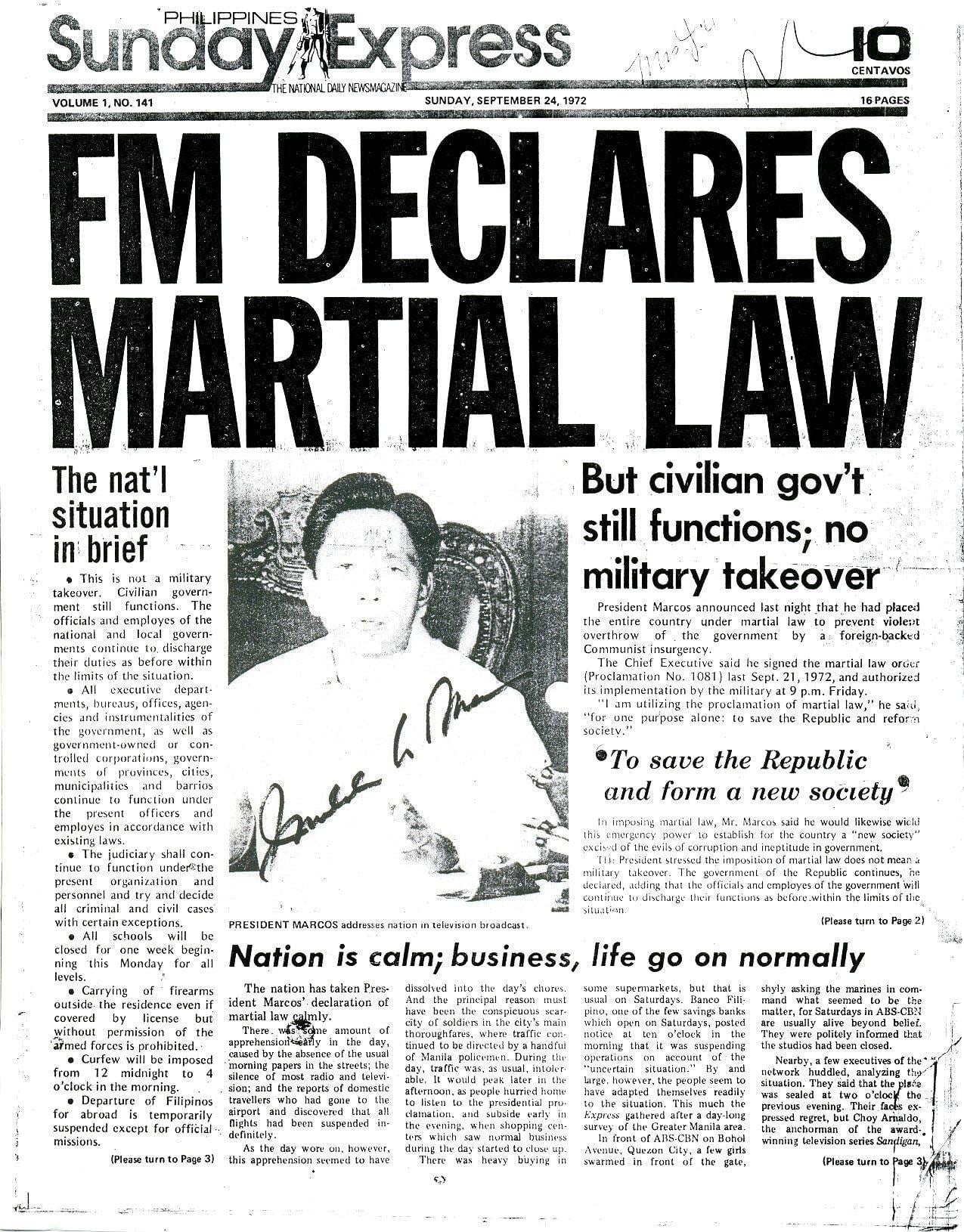
The September 24, 1972 Sunday edition of the Philippines Daily Express was the lone newspaper published following the martial law declaration.
Back to Manila
If we use the strategy of tension as a proof of concept, the events of 1970–1971 in the Philippines can be interpreted as a series of provocations designed to justify the declaration of Martial Law from the start. We have documents to prove it. For instance, the Marcos administration’s Oplan Sagittarius, devised by his inner circle known as the Rolex 12, framed the prevailing political and economic instability as an opportunity to seize total control, suppress the opposition, and secure their fortunes permanently.
This is likewise supported by CIA assessments that three-quarters of the attacks during those years were false flag operations by the government. In fact, the CIA is no stranger to such shenanigans. In the 1950s, they used psychological operations to defeat the Huk insurgency, employing the aswang as a motif to terrify townsfolk and drain support for Luis Taruc’s initiative. Ramon Magsaysay’s American friend, Edward Lansdale, considered the father of America’s psychological warfare, was a pivotal figure in planning Operation Mongoose, an aborted CIA scheme to manufacture public support for the invasion of Cuba by staging a series of terrorist incidents and blaming them on Castro’s government. Castro himself was the target of more than 600 assassination attempts, the most ever directed at a global leader.
Finally, weeks after Marcos’ Proclamation 1081, South Korea’s Park Chung Hee followed suit, declaring his own state of emergency in Seoul. Like Marcos’ New Society, he inaugurated the Yushin Restoration to cloak his goals with a sense of historical destiny and purpose. To no one’s surprise, both autogolpes received the stamp of approval from Henry Kissinger and Richard Nixon, whom many dissidents within the counterculture considered the very personifications of “The Man.” But for Tricky Dick and the Pentagon, this was just another Tuesday—at least until the Watergate scandal.
The rest, of course, is history. Its long gaze still has massive implications for why the Deep State is what it is, and it will take time for these revelations to fully stir the pot, as they began to do from 2016 onward. One only needs to look at Ghislaine Maxwell and her contacts to start dissecting Washington’s bloated, fentanyl-riddled entrails.
What do these ties infer? The answer is simple. If the legacy of Martial Law’s depravity and impact still retains its fangs, those who fight for its memory should adopt a broader geopolitical eye to the occurrences abroad, for these incidents still happen, albeit in a more sporadic manner, the most recent being the destabilization plots against Venezuela by the second Trump administration. Behind the mask of nation-building, combating fake news, and human rights, there is a shadow underneath the guise. This can take the form of an Air America drug trafficking ring, a progressive NGO that parrots liberal leftist rhetoric, or a string of crony businesses somewhere in the Pacific.
Oftentimes, truth is stranger than fiction, more than we would like to admit.
Further Reading:
Bevins, V. (2020). The Jakarta Method: Washington's Anticommunist Crusade and the Mass Murder Program that Shaped Our World. Public Affairs.
Blum, W. (1995). Killing Hope: U.S. Military and CIA Interventions since World War II. Common Courage Press.
O’Neill, P. (2019). CHAOS: Charles Manson, the CIA, and the Secret History of the Sixties. Little, Brown and Company.
Scott, P.D. (2014). The American Deep State: Wall Street, Big Oil And The Attack On U.S. Democracy. Rowman and Littlefield.
Talbot, D. (2015). The Devil's Chessboard: Allen Dulles, the CIA, and the Rise of America's Secret Government. Harper Perennial.
Webb, G. (1988). Dark Alliance: The CIA, the Contras, and the Crack Cocaine Explosion. Seven Stories Press.
Williams, P. (2021). Operation Gladio: The Unholy Alliance Between the Vatican, the CIA, and the Mafia. Tantor and Blackstone Publishing.
