

A Weekend in Spain With the Lexus ES 300h

On a recent trip to Spain, I was handed the key to a 2023 Lexus ES 300h, the latest iteration of the luxury car brand’s executive sedan. There are plenty of ways to explore the capital Madrid, especially since the city has an excellent public transport system, but nothing beats going around the city in comfort and style, and in a Lexus, no less.
The Lexus ES 300h
.jpg)
There’s always a bit of nervousness when driving around a new city—and country—for the first time. You’re extra conscious about following road rules and have to navigate through unfamiliar city streets and avenues, not to mention acclimating to driving a new car. But it’s perhaps to Lexus’ credit that my anxieties were eased somewhat as soon as I slid behind the wheel of the ES. Electronically adjustable seats upholstered in plush leather (synthetic, for all you animal lovers out there), a crystal-clear infotainment system (right beside an analog clock, which is a nice touch), and of course, a general air of luxury and refinement.
ALSO READ
Why the P4.82 Million Lexus RZ450E Is a Big Deal for Lexus and Toyota
We Drove the All-New Lexus RX in California. Here's What We Think
Just before easing out of the Lexus showroom in Madrid, an official was kind enough to adjust the language settings to English (my Spanish doesn’t go far beyond “Hola” and “Gracias”) and tutor me about the car’s voice-activated control system. Just like your mobile phone, asking your car to do things is as simple as saying “Hey Lexus!” and speaking out your command.
My first instruction was to get to my hotel right just across from the Prado Museum. In minutes I was cruising along Madrid’s freeways feeling like I’ve been driving the ES for years.
Driving the ES in Madrid, Spain
.jpg)
The ES 300h has a 2.5-liter, four-cylinder direct injection engine capable of churning 215 hp and 221 Nm of torque, and it has an electronically controlled continuously variable transmission (E-CVT). It’s the kind of car that you’ll likely see picking up the hotshot company chairman or CEO at the driveway, although it works just as well if you drive it yourself.
Perhaps the most significant feature of the ES 300h is its side mirrors—or lack thereof. Instead of conventional mirrors, the car has cameras on either side projecting images onto a digital screen in the interior. Admittedly, it took some getting used to—I kept glancing at the mirrors that weren’t there before focusing my attention on the screens when I needed to know the situation on either side of the car.
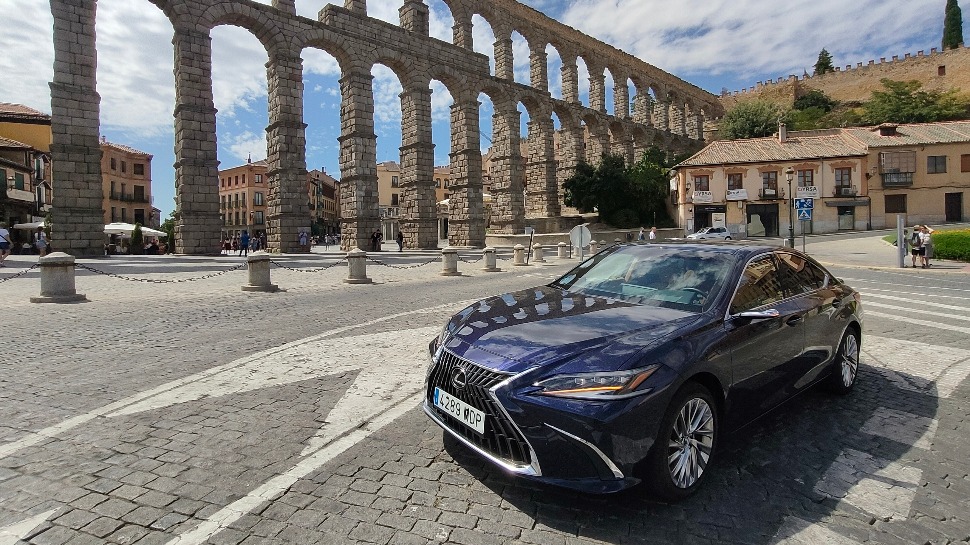
The ES in front of the ancient Roman aqueduct in Segovia, Spain
.jpg)
After a while though I saw the advantages of having the digital screens. You know those stickers side mirrors sometimes have? The ones that say, “Objects in mirrors are closer than they appear.” That holds true for the digital screens on the ES as well. While mobile, the screens project a slightly zoomed-in image of the scenario behind and automatically refocuses with an extended, wide-angle view (think of a phone’s wide lens camera when you click on the 0.5 setting when taking a photo or video) when signaling to turn left or right or going in reverse. This allows for extra maneuverability—no more blind spots—adding an extra layer of safety.
In addition, the rearview mirror is also a digital screen, projecting an image of the back of the car when you switch to reverse. This, coupled with audio sensors, is, of course, especially useful when you’re parking in tight spaces. A sunscreen in the read windscreen automatically recoils when you’re in reverse, helping you see the back of the car more clearly.
The ES 300h has an option with digital screens instead of conventional side mirrors
.jpg)
And not that I had to deal with any condensation—I had caught the summer heat wave in Spain the week I was there—but Lexus says that the cameras are equipped with technology to make it resistant to things like raindrop stains, misting, or freezing. The carmaker also adds that it has a built-in sensor that automatically reduces glare from headlights from cars approaching from behind.
I would find out later Lexus actually introduced the digital side mirror option for the ES way back in 2018, becoming the first carmaker to do so for a high-volume production car. I couldn’t help but think if the Philippines is ready for this kind of tech: would there be fewer accidents and collisions? We’ll have to wait until Lexus decides to bring it here.
Cameras outside project real-time images of the situation behind to a digital screen in the interior
.jpg)
The next day, I decided to go on a quick day trip to the ancient town of Segovia, which is only about an hour away from Madrid. There are buses and trains that make the trip, but it was a nice, easy drive with the ES. After inputting my destination via voice command (“Hey Lexus! Let’s go to the Roman aqueduct of Segovia”), we were on our way. The navigation system is ridiculously intuitive, giving precise directions and real-time arrival estimates. Exactly an hour later, I was there.
Because it’s a hybrid, the ES is also incredibly fuel efficient; I logged an average of about 20 kilometers per liter throughout my time with it.
This ES has a hybrid engine so it's incredibly fuel efficient
.jpg)
There’s an old saying that if you can drive in Manila, you can drive pretty much anywhere. That might be more of a joke, but there’s more than some level of truth in it. Having to deal with less-than-ideal road conditions, rowdy drivers, and often confusing road layouts and signages in the Philippines is good preparation for hitting the road in other parts of the world, particularly those in generally “better” conditions in First World countries.
It helps though if your car can take at least some of the stress away, and that’s what the ES did. When it came time to return the ES, I gave the Spanish Lexus official a big smile. He barely spoke English and I don’t speak Spanish, but somehow, what I wanted to convey was understood.
