
Notes From the Tsz Shan Monastery: Of Big Buddhas and Small Men

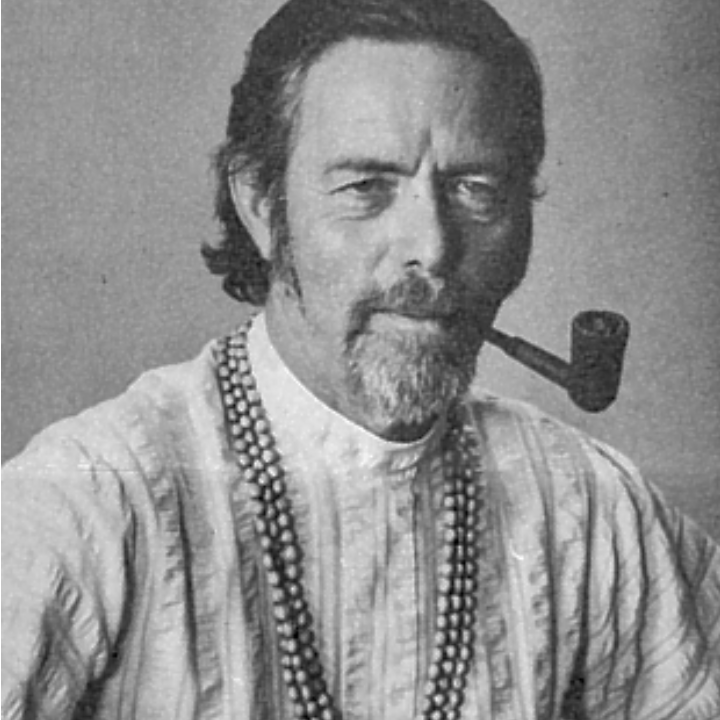
My first encounter with Buddhism, for better or for worse, was through my favorite spiritual entertainer, the great Allan Watts. While he isn’t exactly the greatest representation of Buddhist scholarship (he got a lot of things wrong, especially about zen and meditation), Watts did offer a unique, imaginative view of the world with his comparative mysticism, with enlightenment as the end goal.
At the Tsz Shan Monastery in Hong Kong, I think of Watts' wackadoodle writings again, and the quasi-Buddhist leanings I know him from. I approach this place with healthy skepticism, as an outsider looking in, but with Watts' annoying voice in my head. This is a sanctuary for "spiritual purification," I've been told. And for a man who may be as spiritually bankrupt as I am, I thought it would be a good exercise to participate in this reckoning.
"Nobody believes in God like an atheist: 'There is no God, and I am His prophet.'"
ADVERTISEMENT - CONTINUE READING BELOW- Alan W. Watts, Buddhism the Religion of No-Religion
ALSO READ:
‘Tapos, Pinag-Tripan Nila si Jesus:’ Is the Taglish Bible Disrespectful?
An Atheist Asks: Do We Really Need Religion To Be Happier?
Allegories Built in the Tsz Shan Monastery
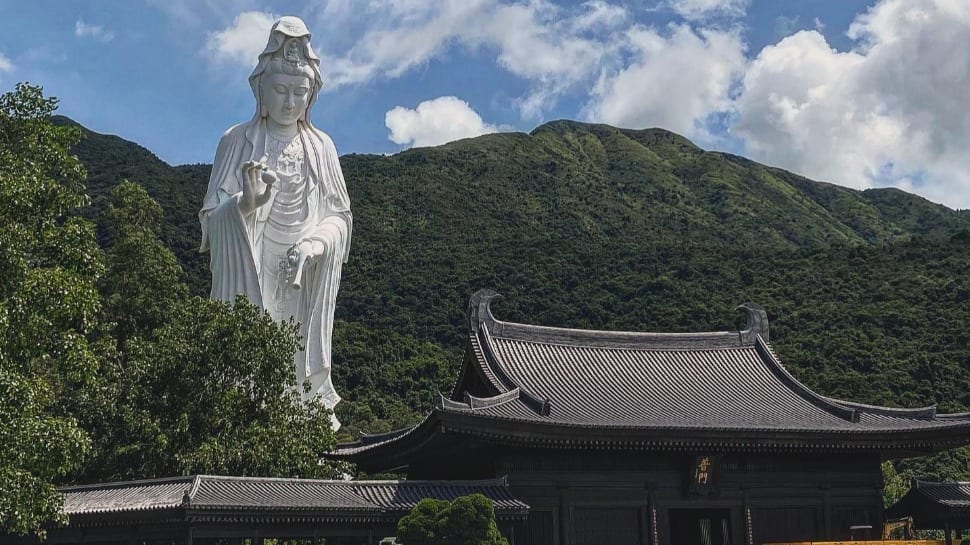
Guan Yin, or Cintacakra Avalokitevara, is a tenth-level bodhisattva associated with great compassion.
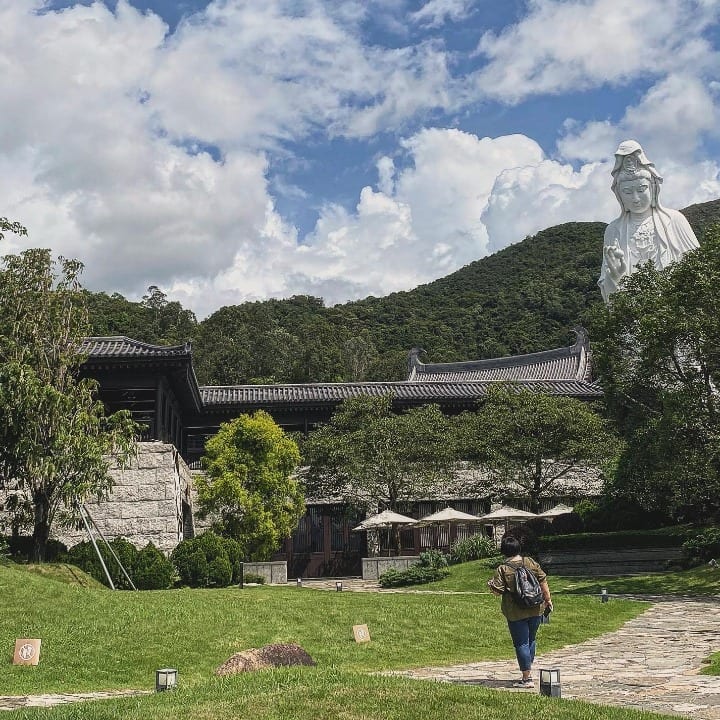
Upon arriving at the Tsz Shan Monastery, visitors will come to understand what it means to behave in the presence of calmness. Such is the case with contemplative spaces like this: you must engage with the physicality of the area as part of your own spiritual pursuits.
Borrowing from the lost architecture of the Tang, Northern Song, Liao, and Jin dynasties, these buildings' halls and grounds are riddled with Buddhist allegories. Dark African padauk wood, often mistaken for ebony, is meant to elevate intellectual evolution, prompting the removal of barriers between the self and the natural environment. Growth and harmony, meanwhile, are coded in the wavy white-grey granite.
We arrive at the Universal Gate with the circular Brilliance Pond. The pond itself is mesmerizing, forming two concentric circles, serving as another mirror of sorts and another avenue for self-reflection. Stretching five bays with a height of 14 meters, this area of the monastery is punctuated by a statue of the wish-fulfilling, six-armed Guan Yin, or Cintacakra Avalokitevara. The walls are carved out with this interesting calligraphy of the Ten Great Vows of bodhisattvas Samantabhadra.
The architecture of the Tang, Northern Song, Liao, and Jin dynasties have this distinct timber framing, multistory elevation, elaborate paths and courtyards, and an emphasis on "decoration meets function." Most of these structures are hardly preserved in good condition.
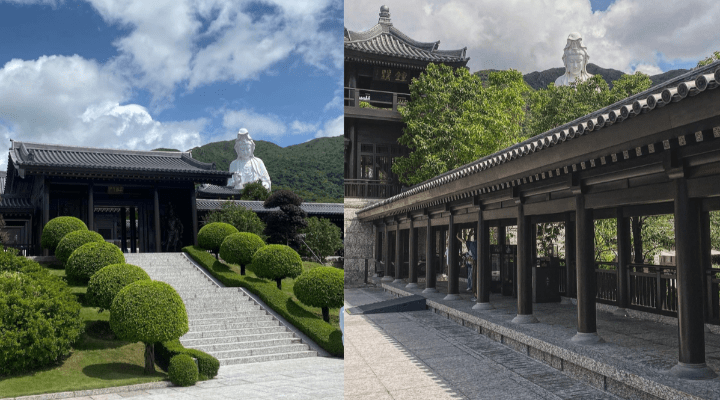
Emerging from the Universal Gate, the first thing that catches our attention is, of course, the gigantic Buddha leaning over this theater. Another Guan Yin representation. The precinct and by extension this lush enclave is framed by this immaculate 76-meter-tall Guan Yin statue. Her iconography is derived from the sculptural forms of Buddhas during the Song dynasty. On her topknot, if we squint just enough, an image of Amitabha appears, meant to symbolize cascading blessings and protection. Her right hand clutches the wisdom mani pearl, while her left, has a vase, another metaphor for cleansing the phenomenal world.
The Compassion Path is the best way to reach Guan Yin. Stretching from the Universal Gate Hall, this walkabout is adorned with eighteen aged Buddhist pines that sort of guide the visitor toward the Thousand Wishes Pond, a large bronze water vessel that serves as an instrument for water offerings.
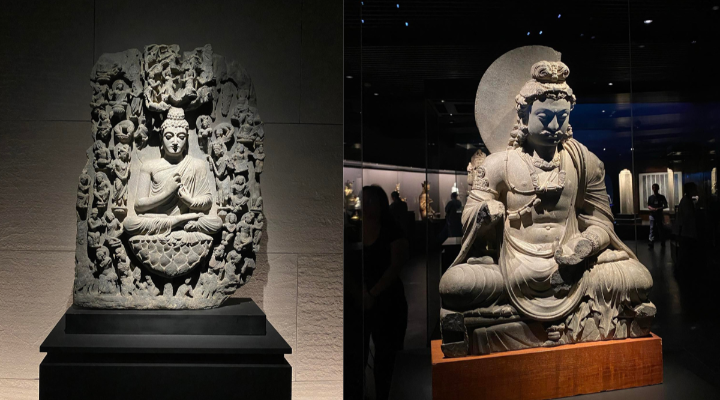
(From left) Tsz Shan Monastery Buddhist Art Museum's "Relief of Sakyamuni Buddha Preaching" from the Kushan Dynasty, 2nd to 3rd century; "Seated Maitreya Bodhisattva" from the Kushan Dynasty, 3rd century.
The monastery also opens its doors for higher learning of Dharma, and even spiritual counseling. Its research and learning arm, the Tsz Shan Institute offers would-be Buddhists and scholars the opportunity to bridge theory and practice. The Buddhist Spiritual Counselling Centre of Tsz Shan Monastery, on the other hand, is a first in Hong Kong. It's a center that offers counseling services for the spiritually bankrupt (like myself) and for the ones in need of positive spiritual energy in their lives. Regular volunteering programs are available, too.
Everything, and everyone, here is interconnected to create harmony.
Watts' Half-Baked Musings Vs. My Half-Baked Musings
For all Watt's faults, he was a provocative lecturer during a time when secularization grew. And as a young man, I remember being jolted by his books. At the heart of his own beliefs were fascinating ramblings on Eastern philosophy, new-age theory, and pop psychology. For that, Watts, despite his fallacies, at least I think, will always endure. It's either that or maybe because I'm just a fan of crazy hippies.
See, Buddhism isn't exactly a religion, that much I know. I guess I just find it fascinating how spiritually sound the Buddhist can be. Spirituality and religion are split from the same tree of faith we cling to in times of crisis. Religion is perhaps the organized version of faith, one that has its institution and structure that relates to God. On the contrary, spirituality seems more of a vague concept, a shapeless mechanism that allows us to see the world beyond reality and ourselves. Or at least, this is how I think of the two.
Buddhism isn't even about philosophy or creed. The Noble Truths are more of a means to achieve awakening, and with a conscious practice, enlightenment. Really, it's a set of philosophical, moral, and spiritual inquiries into life, people, ourselves, the cosmos, and beyond; all of which, should lead us to the cessation of our suffering. From there, liberation will come. But perhaps the thing I respect the most about it is how it advocates for binary ways of thinking.
Watt's The Way of Zen (1957) still is one of the best-selling books of Buddhism, in spite of its practical and philosophical lapses.
It's been a while since I've concerned myself with morals. Buddhism, as a local scholar at the monastery tells me, doesn't care about that stuff either. The usual dialogues about good or bad or the moral and immoral, is too rooted in the Judeo-Christian way of thinking. Buddhism teaches us to transcend these black-and-white notions and, ultimately, teaches just to try to lessen the suffering and pain that persists in the world.
I think the idea of chasing goodness is, in itself, an illusory and futile quest. It bleeds into creating karma that reeks of ill-intent. Buddhism asks us to conquer these thoughts and opt for compassion instead. Compassion comes from Prajnaparamita, and in simplistic terms, means to wish for others to be liberated from suffering, too. It serves as a conduit for love (or loving-kindness, as alluded to earlier).
To choose compassion over desire, that, even I still need to work on. But this experience leaves me with such a peculiar curiosity. In Buddhism the Religion of No-Religion, Watts said, "Nobody believes in God like an atheist: 'There is no God, and I am His prophet.'" That always read funny to me because, well, it's pretty true for the Godless. Hence, this whole half-baked piece.
I leave the Tsz Shan Monastery not necessarily as a changed man, but as a man who just had a nice spiritual breakthrough. What that means, I'll find out soon enough. Perhaps those answers will come to me later on during a random midnight haze or a boring Tuesday morning. They always arrive at the dullest times, after all.
Ultimately, I think spiritual experiences are meant to make you feel...rather small. It is only then that you see a glimpse of the sublime bigness that connects us all, the overarching "wholeness" that traces from the vastness of the universe to the smallest organism on Earth. I'd like to believe that there's a power that comes from knowing just how infinitely incomprehensible life and being is, and how much you still don't know, and how glorious all this unchecked texture is. We comb through the tall task of this bigness with our totems, chants, labels, institutions, ideas, dreams, desires, groups, and the self, only to find that underneath this cosmic cobweb lies a smallness that requires infinite compassion. Only from here do we get to start walking on the path to the gates of freedom.
For more information on reservations, you may visit the Tsz Shan Monastery information desk here.
