
The MTRCB Banned My Show. That’s Not Going to Stop Me From Promoting Sex Education

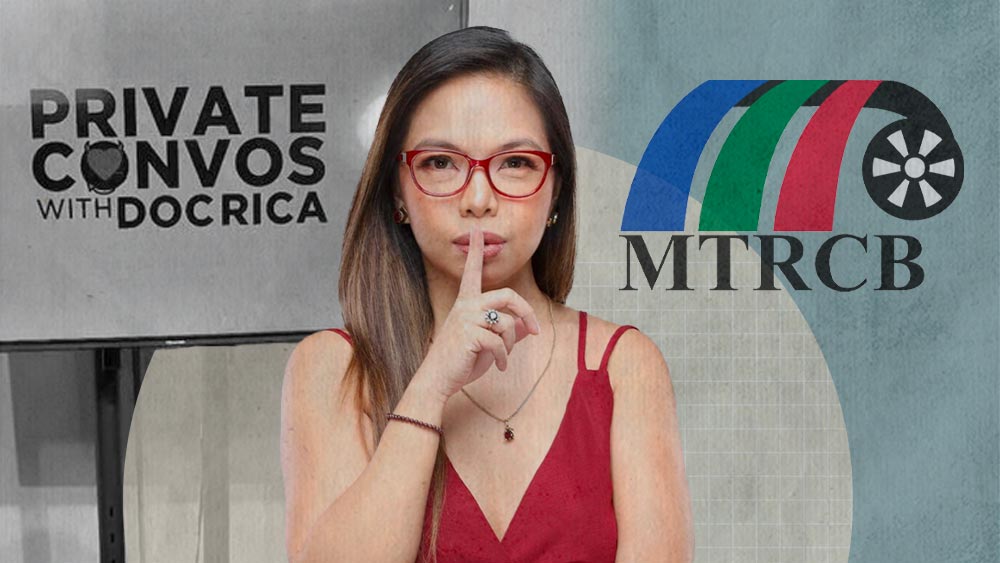
When I learned about MTRCB banning my show last January 30, I was shocked, to say the least. I felt disillusioned. It reminded me that despite strides towards a more sexually positive society, substantial misconceptions and fears persist.
This disillusionment was profound, almost pushing me to the brink of giving up. Lost and demotivated, I was ready to pack up and leave. I asked myself: What is the point of doing all of my work the past 10 years?! Nothing.
But it took one person to hold my hand and tell me, “I am angry for you” to rekindle the fire that was once inside me. Thank you, Steph.
Since then, the overwhelming support I got even from people I didn’t know reminded me that the fight will never be easy. Believe me, even my dead mother found a way to slap me out of my self-inflicted doubts. The clarity of people’s support helped me stand up again and push for the advocacy I started: for Filipinos to see sex not as lewd or vulgar, but as an essential, dignified part of our humanity deserving of celebration and respect.
ALSO READ
The MTRCB Has Banned the Talk Show of a Licensed Sex Therapist from Airing
The MTRCB Has No Idea Who It Is Anymore. And Neither Do We.
So here I am, writing my piece, because they may have taken away my show, but they can never take away my voice, and being silent will be a disservice to those who paved the way before me, like Dr. Margarita Holmes, and those who are fighting with me.
This ban reveals a troubling oversight in our societal approach to sexual education. By conflating educational content with prurient interest, we not only blur the line between exploitation and education but also fail to address the pressing issues that plague our youth.
Teenage pregnancies, the alarming rise in HIV infections, and pervasive gender-based violence are not mere statistics; they are stark realities that our country faces. Silencing discussions around sexuality does not protect our children from these "inappropriate" realities; rather, it leaves them vulnerable to the very dangers we seek to shield them from.
The irony is stark: while educational content faces censorship, mainstream media often disseminates material that trivializes relationships and objectifies individuals, with little to no consequence. What moral development are we teaching children with primetime shows revolving on affairs, violence, and what some netizens decry as “soft porn?” This double standard questions the very foundation of what we consider morally acceptable, favoring sensationalism over substantive, life-saving knowledge.
Research consistently supports comprehensive sex education (CSE), including open discussions in sexuality, as a crucial tool in addressing these issues. The World Health Organization (2015) found that open and affirming discussions on sex is linked with positive health behaviors, like increased condom use and delayed sexual initiation, directly counteracting factors leading to teenage pregnancies and the spread of HIV (World Health Organization, 2015).
Moreover, encouraging open conversations about sexuality plays a significant role in combating gender-based violence by promoting respect, consent, and equality. Studies have shown that sex education that includes discussions on values, decision-making, and ethical considerations can lead to healthier relationships and a deeper understanding of consent (Kubicek et al., 2010). By fostering an environment of respect and understanding, we empower our youth to stand against the tide of violence and discrimination, championing a society that values the dignity and worth of every individual. But I guess, that’s not what we want our youth to develop, do we?
Facing the ban on my show, I am undeterred, but driven by a renewed sense of purpose. This moment is a clarion call to continue advocating for a society that embraces sex for its potential to educate, enlighten, and protect.
The challenges of teenage pregnancies, HIV, and gender-based violence are daunting, yet our path is clear. We must champion open discussions on sex as a beacon of hope, arming our youth with knowledge, respect, and understanding and providing adults with the wisdom to have better relationships, whether it’s with their partners, their children, and others.
They may have silenced one platform, but the conversation is far from over. My resolve, and that of those standing with me, is only strengthened by these obstacles, for we recognize the profound value of the knowledge we seek to spread. Sex is powerful. It needs to be celebrated. It demands respect.
I am calling for us to move forward in our mission to cultivate a future where discussions about sex are liberated from stigma and recognized as fundamental to our existence and the cornerstone of a more healthful, respectful society. And with this call, I invite everyone to join in this critical conversation, ensuring that the silence imposed on one platform becomes the catalyst for louder, more impactful dialogues across our society.
Dr. Rica Cruz is the Founder of Unprude. She holds the distinction of being the first and only Filipino to be given a Diplomate in Clinical Sexology by the American Board of Sexology, and to be part of the Editorial Board of the top scientific journal, The Journal of Sex Research.
