
The Queen Has Arrived

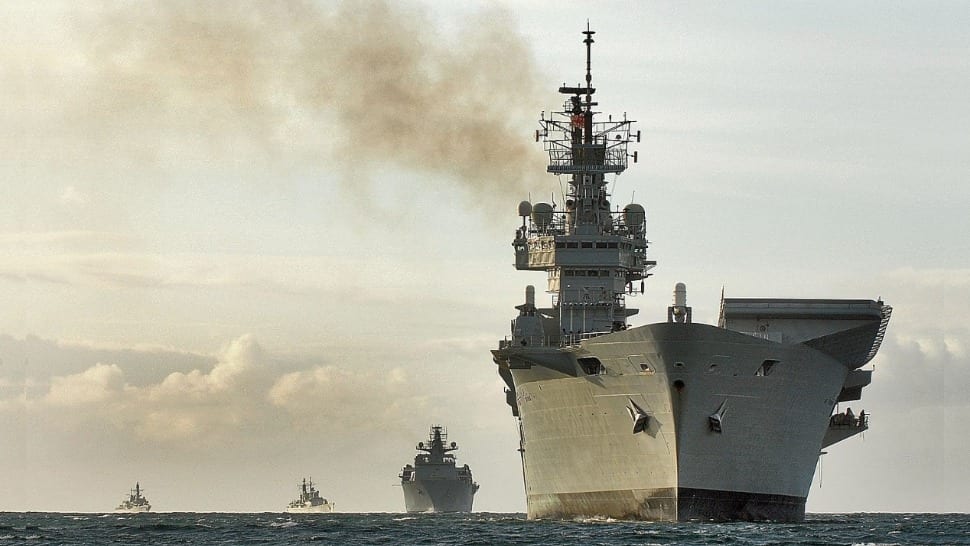
Her Majesty’s Ship (HMS) Queen Elizabeth and her escorts of submarines, destroyers, and attack cruisers have ignored China’s warnings and have finally entered the much disputed South China Sea. The warships comprise the U.K.’s Carrier Strike Group 21, the kingdom's largest and most formidable strike group.
The U.K.'s Carrier Strike Group 21 with the HMS Queen Elizabeth in the Middle

The HMS Queen Elizabeth and its escorts are in the region to enforce the United Nations Convention on the Law of the Seas (UNCLOS) by conducting freedom of navigation operations (FONOPS) in the hotly contested waters. The strike group has entered the South China Sea through the Bashi Channel between Taiwan and the Philippines on October 4.
Prior to the arrival of the strike group, China had issued warnings to the U.K., telling it not to carry out “improper acts.” In a statement published by state mouthpiece Global Times, China accused the British of bringing back its colonial days.
“The People’s Liberation Army Navy is at a high state of combat readiness. China has been closely monitoring the progress of the Carrier Strike Group, which is currently sailing through the South China Sea en route to Japan. It has also accused Britain of “still living in its colonial days,” the Global Times wrote.
HMS Queen Elizabeth, Britain's Most Powerful Warship


The U.K.’s participation in the South China Sea FONOPS has a twofold purpose: first is to project British power and global relevance through military operations. Second is to aid the U.S. and its allies in containing China’s expansion in the region.
The HMS Queen Elizabeth carries at least 18 F-35B stealth fighters (Lockheed Martin F-35 Lightning II), a fifth-generation fighter considered the most advanced in the world. The price tag for each F-35B stealth fighter is a staggering P3.86 billion ($80 million).
An F-35B Stealth Fighter
.jpg)
The impressive contingent also includes missile-guided destroyers HMS Defender and HMS Diamond, anti-submarine frigates HMS Kent and HMS Richmond, and logistical naval ships HMS Tidespring and HMS Fort Victoria. The carrier strike group will be escorted by an Astute-class nuclear submarine, the most advanced nuclear-powered submarine in service with the Royal Navy.
HMS Defender

HMS Diamond

How World Powers are Cancelling China’s Claim on the West Philippine Sea
By conducting FONOPS in the South China Sea, world powers such as the U.K., U.S., Germany, France, Australia, Canada, and Japan are canceling China’s claim of sovereignty over the South China Sea and the West Philippine Sea.
China cannot legitimize its claim if other countries flagrantly disregard that “sovereignty.” The U.K., U.S., and Western allies are actually delegitimizing China’s territorial claims in Philippine waters by making sure there is nothing innocent about their warships’ passage through the waters.
Under international laws, military ships must pass through the waters of another nation as quickly as possible through the most expedient route. This is called “innocent passage.”
Since the U.K. does not recognize China’s claims in the West Philippine Sea and the South China Sea, it makes sure that its warships don’t sail as expeditiously as possible nor take the most direct route to anywhere. It will zigzag across the waters to make it apparent that there is nothing innocent about their passage in the region.
The West Philippine Sea is that part of the South China Sea on the west side of the Philippines in which maritime rights of the country extend. Its different maritime zones generate special maritime rights exclusive to the Philippines.
Unlike China, the Philippines does not consider the entirety of the West Philippine Sea as part of its territorial waters. It does not exercise sovereignty over the entire area but it asserts sovereign rights over the West Philippine Sea, such as the right to explore and exploit the resources in its exclusive economic zone and prevent other countries from doing so.
