Philippine mythology is rich in fantastic creatures and ghosts. While the belief in the factual existence of the White Lady is in retreat these days, there are, in fact, ghosts in the shallow tropical waters around many of the Philippine islands. But instead of something paranormal, they are in fact, biological and real. They’re called the ghost pipefish.
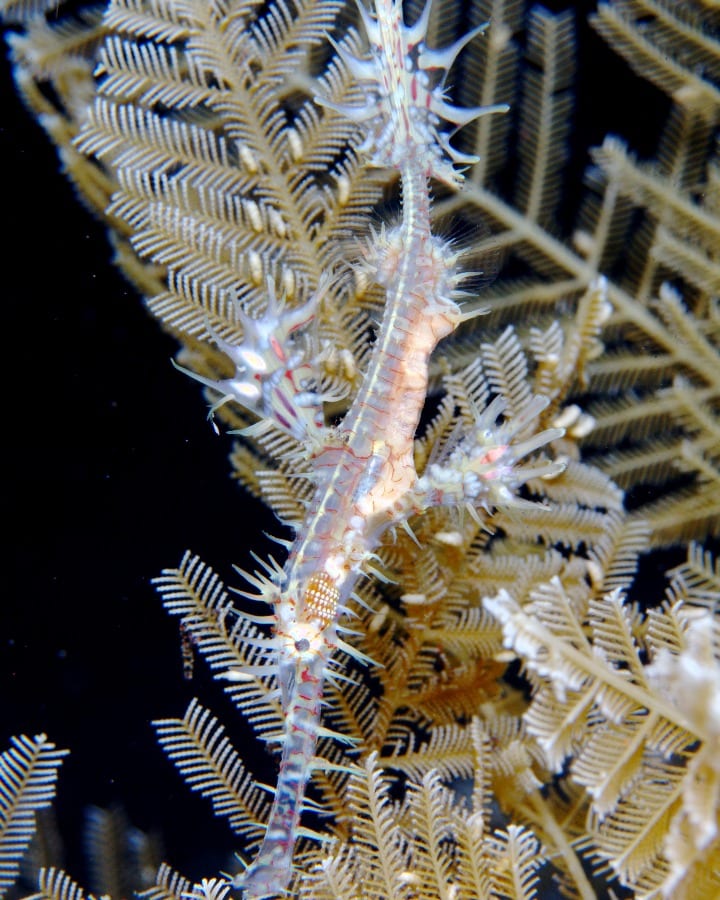
This ghost pipefish is hiding in front of a crinoid, an organism related to jellyfish
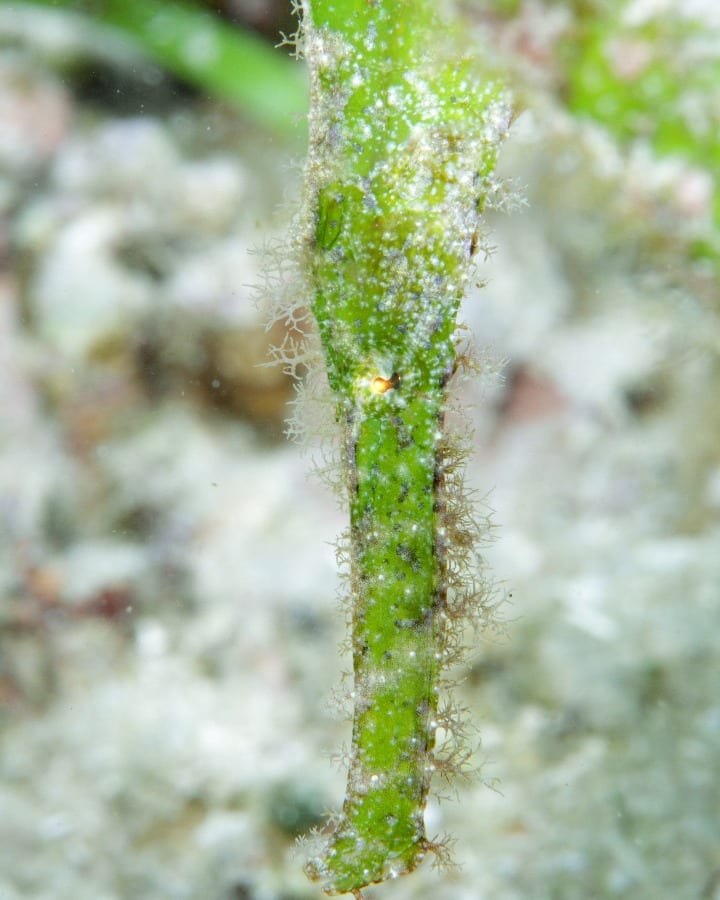
These sea creatures don’t hide by the virtue of their supernatural ghostly powers, but by the very real biological power of camouflage. They don’t look the least like stereotypical fish, like a lapu-lapu or a carp; instead, they have evolved to resemble marine plants, algae, or inedible invertebrates. Take a look at the images in this article, and ask yourself if you would have identified these creatures as fishes, had you seen them without an accompanying explanation?
ADVERTISEMENT - CONTINUE READING BELOW
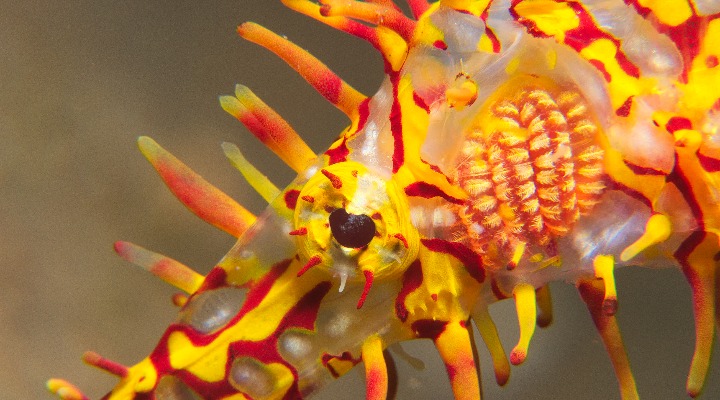
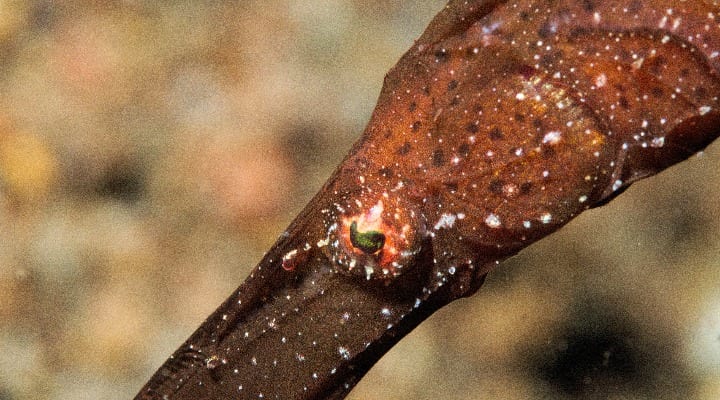
Close up of the face of an ornate ghost pipefish
Klaus Stiefel
Typically less than 12 centimeters in length, these fish drift inconspicuously over the reef, sand or seagrass and evade detection by hungry predatory fishes. There are a few different species, which a sharp-eyed scuba diver can observe in Philippine waters.
CONTINUE READING BELOW
watch now
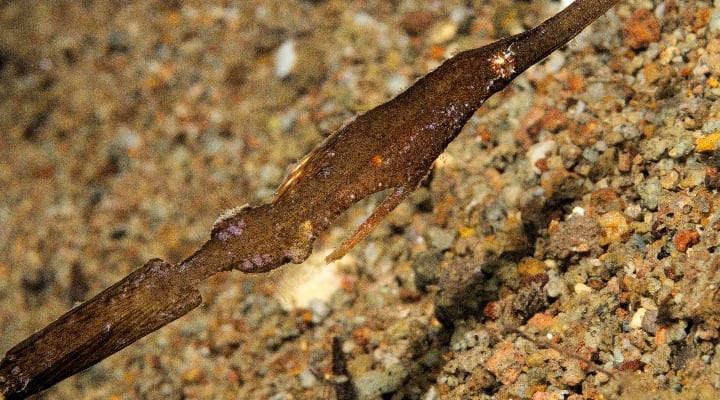
A pair of robust ghost pipefish drifting over the sand in Dauin, Negros Oriental
Klaus Stiefel
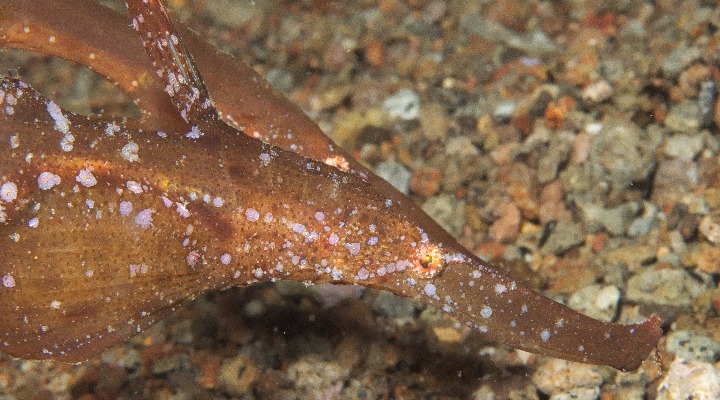
The robust ghost pipefish mimics blades of detached seagrass. Often traveling in pairs, they don’t just look like seagrass, they behave like it too: instead of swimming straight ahead like “regular” fish do, they drift along in the current, just like a dead piece of seagrass would. Only when they spot a tiny shrimp, their main prey, do they dart forward in a surprisingly rapid motion for these otherwise very placid fish.
ADVERTISEMENT - CONTINUE READING BELOW
A juvenile ghost pipefish hiding in front of a feather star
PHOTO: Klaus Stiefel
The Halimeda ghost pipefish pretend to be a string of the Halimeda algae, a marine algae easily recognized by its shape made up of circular digits arranged in a row. The Halimeda algae grows in sandy areas in shallow water, and that’s where you can also find the Halimeda ghost pipefish.
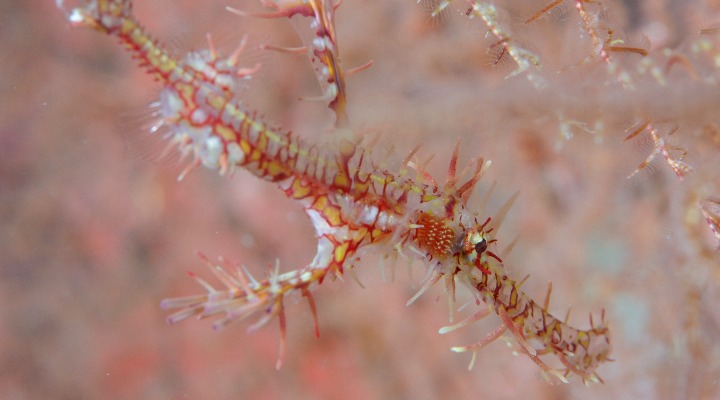
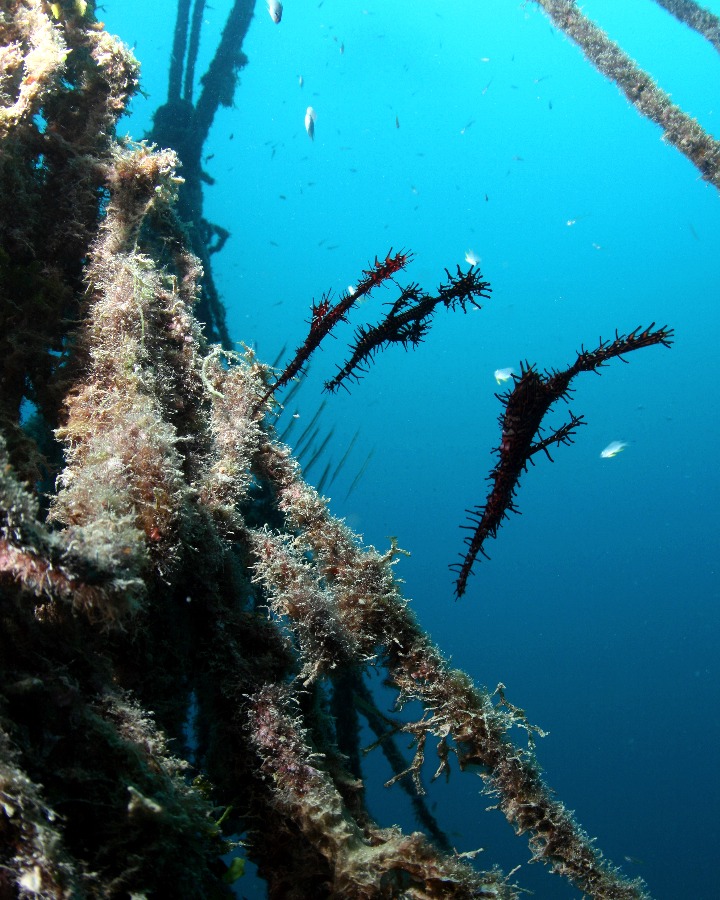
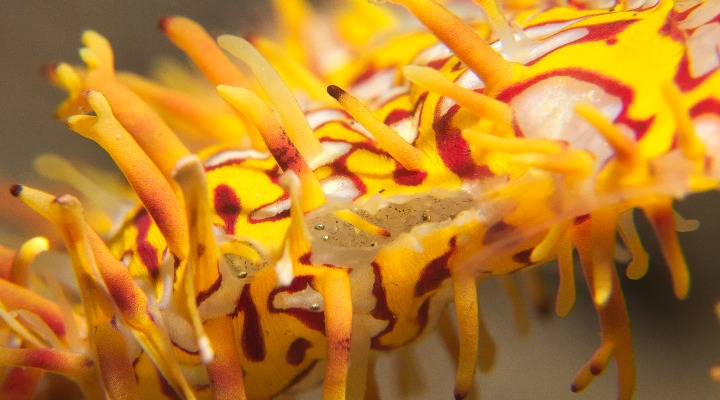
The ornate, or harlequin ghost pipefish mimics feather stars, also called crinoids. Crinoids are distant relatives of the sea stars, but instead of grazing the seafloor they have turned their arms upwards, and feed on plankton, the ubiquitous small organisms in the water column. The arms have evolved into a net of plankton-catching main- and side-arms, and the ornate ghost pipefish pretends to be one of these arms. Crinoids are not poisonous or venomous, but don’t contain much meat, and lots of small hard skeletal plates instead. No predatory fish would munch on these, and by extension, the predators don’t munch on the ornate ghost pipefish either.
The Halimeda ghost pipefish pretend to be a string of the Halimeda algae, a marine algae easily recognized by its shape made up of circular digits arranged in a row
Klaus Stiefel
ADVERTISEMENT - CONTINUE READING BELOW
Somewhat like seahorses
The ghost pipefishes are somewhat related to seahorses, since they are not in the same family of fishes, but in the same order, which is the wider unit of classification of animals that biologists use (animals in the same order are less closely related than those in a family).
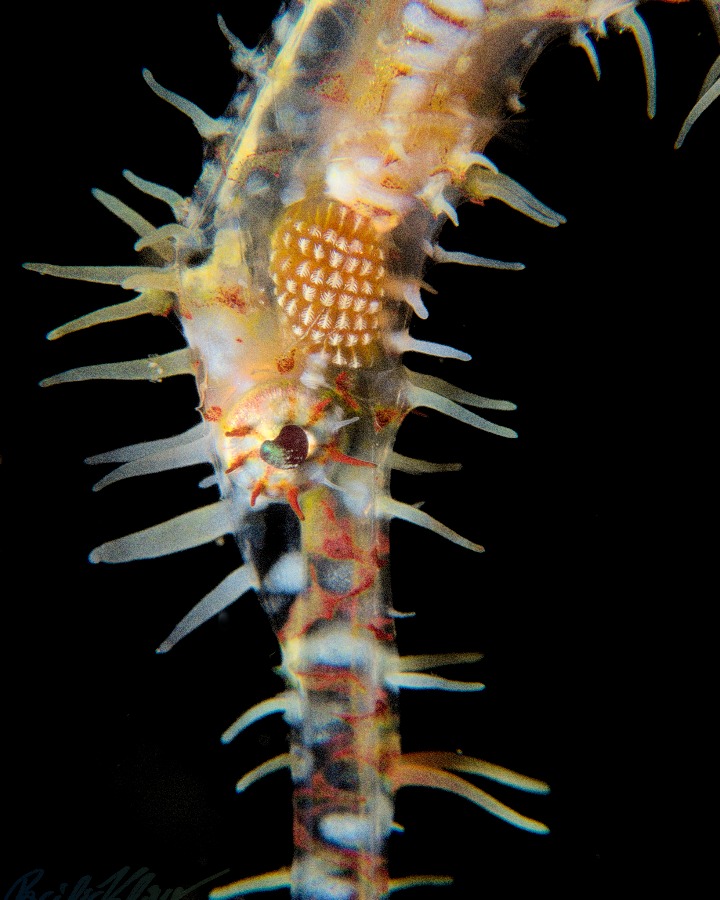
The ghost pipefish are different from the “common” pipefish, which are more closely related to seahorses (these are the same fish family with seahorses). Just like the ghost pipefish, they often rely on camouflage to avoid detection by predators. But, like in seahorses, in “regular” pipefishes the male attaches the fertilized eggs to his body. The reproduction in ghost pipefishes works in a different way, and is a really unique biological adaptation. In our ghostly friends, the female carries the fertilized eggs between her pelvic fins (see the image in this article, and the footage in the linked video). The eggs don’t just rest in the pouch formed by her fins, but they are actively supplied with nutrients and oxygen by a structure called the cotylephore. This structure, formed by the skin of the female, is equivalent to the mammalian placenta, which equally nourishes the embryo during development.
A group of three ornate ghost pipefish next to discarded ropes underwater
PHOTO: Klaus Stiefel
While there are, of course, differences in the detailed workings of a cotylephore and a placenta, this is nevertheless an amazing convergence in function between only very distantly related animals.
In the video below you can see fertilized eggs carried by a female robust ghost pipefish:
Once the eggs hatch, the larvae spend weeks in the water column, and only settle when the ghost pipefish juveniles are a few centimeters long. The young fish are often almost transparent at this stage. There seem to be irregular seasons for the occurrence of ghost pipefish, with months when they are essentially absent from the reefs, seagrass meadows and sandy patches of a diving location, followed by weeks where they are somewhat common.
Is this a detached blade of seagrass, or a fish?
Klaus Stiefel
Close up of a robust ghost pipefish
Klaus Stiefel
The highly effective camouflage of the ghost pipefishes is, obviously, meant to deceive would-be predators, mostly bigger fishes. It also works on the eyes of human scuba divers though. These animals are extremely hard to spot, and many unsuspecting divers swim by them every day, not realizing they had just missed a chance to observe one of the most unusual fish alive. Typically, only knowledgeable underwater naturalists—now including you!—who know about the existence of ghost pipefish will potentially discover these hard-to-spot creatures. Hence, the surprise and fascination are always great when one discovers a ghost pipefish.
The intricate skin flaps make this ornate ghost pipefish look like a feather star
Klaus Stiefel
The downside of the very cryptic nature of this fish is that it’s difficult to motivate the general public to protect what they don’t know well—or what is even difficult to see. This is generally a problem with the sandy, superficially empty-looking habitats of the ghost pipefish. They are much less charismatic than the colorful and pretty coral reefs nearby. Everybody loves “Nemo,” but who loves a fish which looks like a blade of seagrass? Hopefully more naturalists will, in the future.
Dive Trip Tips
An awesome location to observe ghost pipefish is Dauin in Negros Oriental. Dauin can be reached from the provincial capital of Dumaguete in about 30 minutes by car. The diving hot-spot is home to lots of excellent scuba diving resorts. On the high-end side I recommend Sea Explorers and Silver Reef, while on the more budget-friendly side I can recommend La Torture Diving Resort. Excellent dive guides who spot critters like the ghost pipefish are a must in Dauin.
The fertilized eggs of an ornate ghost pipefish, in-between the pelvic fins of the female
PHOTO: Klaus Stiefel
Many visitors come to Dauin and merely take advantage of it as a jump-off point to rightfully famous Apo Island (which is a barangay of Dauin). It’s a mistake, though, to miss out on the diving along the coast of mainland Negros. This is where, after often only a five-minute boat ride, among many other fascinating creatures the ghost pipefish can be seen.
We use cookies to ensure you get the best experience on Esquiremag.ph. By continued use, you agree to our privacy policy and accept our use of such cookies. Find out more here.